
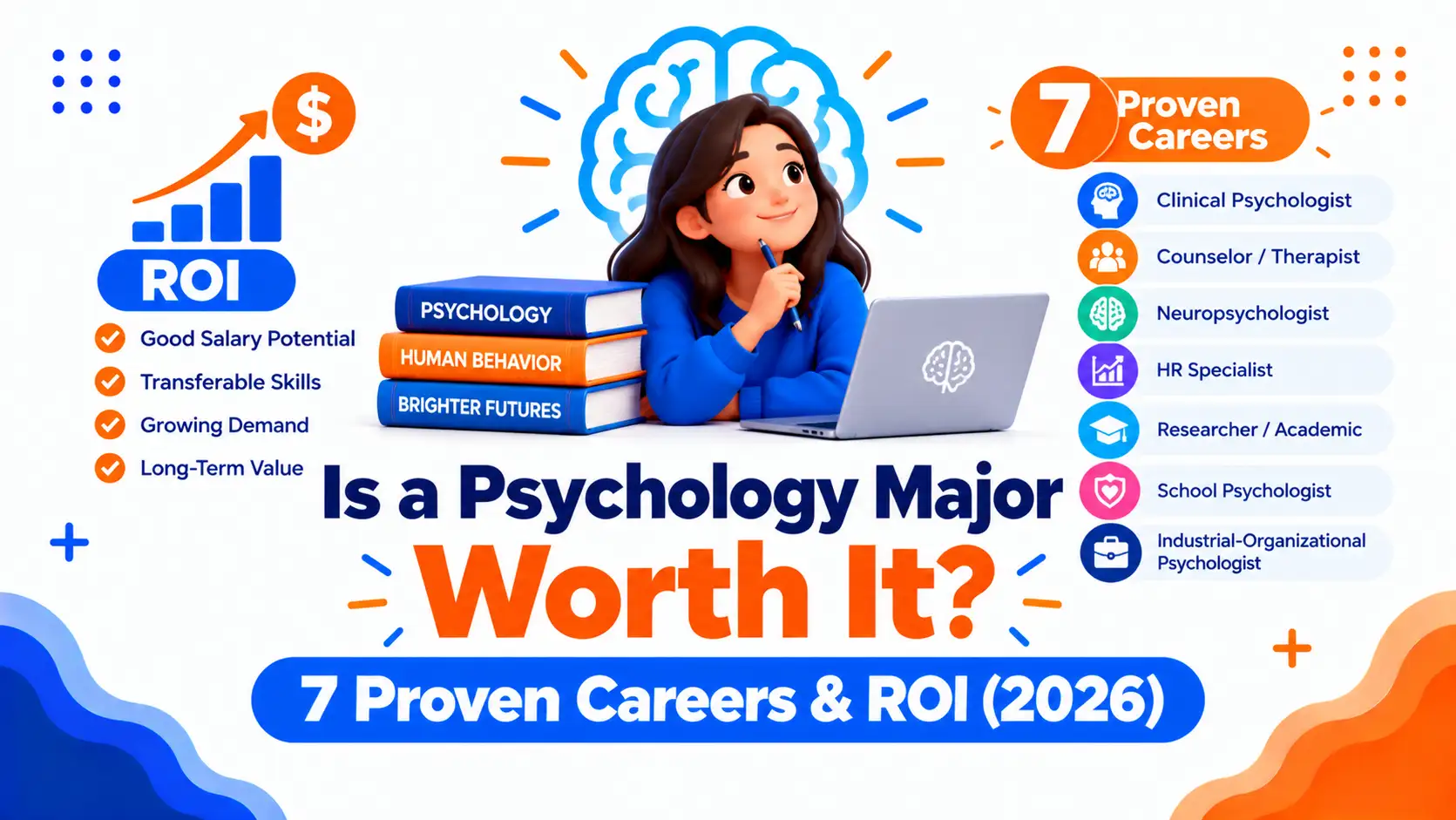
Choosing a major feels like a bet with your money and your time. Psychology sits in the middle of that debate: popular, flexible, and often misunderstood. This guide gives you the verdict first, then the evidence. You’ll see which skills employers pay for, seven careers with realistic salaries, the costs, and how to decide if this degree fits your goals.
Is a Psychology Major Worth It?
Yes, a psychology major is worth it for students who plan to attend graduate school or use its transferable skills in data analysis, communication, and human behavior. It pays off less for students who expect a high-paying clinical job with only a bachelor’s degree.
That’s the short version. The longer version depends on three things: what you do with the degree, how much you borrow, and whether you’re willing to add skills like statistics or data tools.
Psychology is a flexible degree, not a job-training program. Nursing leads to nursing. Accounting leads to accounting. Psychology leads to many places, and that can feel like a strength or a weakness depending on how you plan.
Here’s a quick scorecard.
| Factor | Rating | Why |
| Career flexibility | High | Skills apply to HR, marketing, UX, healthcare, and education |
| Entry-level pay | Moderate | Many bachelor’s-level jobs start in the $40,000–$65,000 range |
| Earning ceiling | High with grad school | Licensed and doctoral roles pay far more |
| Cost risk | Depends on school | Low-cost programs improve ROI sharply |
| Job market demand | Growing | Mental health and data-driven roles keep expanding |
If you want a broader view of the field, start with our plain-English guide to what psychology is.
What Do You Actually Study in a Psychology Major?
A psychology major combines core science courses, statistics, and research methods with electives in areas like clinical, social, and cognitive psychology. Most programs take 4 years and 120 credits, with roughly 30 to 45 credits in psychology.
Most bachelor’s programs follow a similar path. Here’s what a typical roadmap looks like.
Year 1: Foundations
- Introduction to Psychology
- General education courses (writing, math, biology)
- Sometimes a first statistics course
Year 2: Core science
- Statistics for the Behavioral Sciences
- Research Methods and experimental design
- Biological or behavioral neuroscience
Year 3: Specialty courses
- Social psychology
- Cognitive psychology
- Developmental psychology
- Abnormal psychology
Year 4: Applied work
- Practicum or internship (if offered)
- Capstone research project
- Advanced electives
Which Psychology Courses Are the Hardest?
Statistics and research methods are usually the hardest psychology courses, mostly because they feel more like math and science than “understanding people.” Biological psychology also surprises students with its heavy emphasis on memorization.
Is psychology a hard major overall? It’s moderate. The reading load is steady, and the writing is constant. But the difficulty is different from engineering. You won’t face brutal problem sets every week. You will face APA-style papers, lab reports, and exams that test how well you apply concepts, not just repeat them.
Here’s a tip that saves many students: take statistics early, and learn SPSS or R while you’re at it. Those two skills show up in job postings again and again.
Curious about the depth of each subfield? Our breakdown of the types of psychology shows where each specialty leads.
What Skills Do You Learn as a Psychology Major?
Psychology majors build both hard skills (statistics, research design, data analysis) and soft skills (communication, critical thinking, empathy). Employers value this mix because it applies in almost every industry that deals with people.
Skills aren’t just resume filler. They’re the real product of your tuition. Here’s how they break down.
Hard skills
- Statistical analysis (SPSS, R, Excel, sometimes Python)
- Survey and experiment design
- Data interpretation and visualization
- Scientific and APA-style writing
- Literature review and source evaluation
Soft skills
- Active listening
- Conflict resolution
- Persuasion and clear explanation
- Ethical judgment
- Critical thinking about cause and effect
The National Association of Colleges and Employers (NACE) publishes research on the competencies employers want in new graduates, including critical thinking, communication, and teamwork. Psychology coursework trains all three.
Here’s a scenario. A student designs a survey in her research methods class, collects 120 responses, and analyzes them in SPSS. That’s the same workflow a junior market researcher or UX analyst follows. The difference is the topic, not the process. Our psychology survey examples show what that looks like in practice.
What Jobs Can You Get With a Bachelor’s Degree in Psychology?
A bachelor’s degree in psychology can lead to entry-level jobs in human resources, market research, UX research, social services, sales, and education support. You cannot work as a licensed psychologist without a graduate degree, but many related careers don’t require one.
This is the question behind “what can you do with a psychology major without a master’s?” The honest answer: a lot, but the job titles rarely say “psychology.”
For a dedicated list, see our guide to BA psychology jobs in 2026. If you want a hands-on entry point, psychology research assistant jobs are a common first step, especially if grad school is in your plans.
What Are the 7 Best Career Paths for Psychology Majors?
The strongest career paths for psychology majors are HR specialist, UX researcher, market research analyst, social services case manager, school or career counselor, I-O psychologist, and clinical psychologist. The first four need a bachelor’s degree. The last three need graduate study.
Below are the salary and education benchmarks. Treat the salary figures as estimates that vary by city, employer, and experience.
| Career Path | Minimum Required Degree | Typical Entry Salary | Key Skill Required |
| HR Specialist | Bachelor’s (B.A. / B.S.) | ~$65,000 | Interpersonal & Conflict Resolution |
| UX Researcher | Bachelor’s (B.A. / B.S.) | ~$85,000 | Qualitative Research & Data Analysis |
| Market Research Analyst | Bachelor’s (B.A. / B.S.) | ~$55,000–$65,000 | Survey Design & Statistics |
| Social Services Case Manager | Bachelor’s (B.A. / B.S.) | ~$40,000–$50,000 | Empathy & Documentation |
| School / Career Counselor | Master’s | ~$55,000–$65,000 | Counseling & Assessment |
| I-O Psychologist | Master’s / Ph.D. | ~$105,000 | Organizational Behavior & Analytics |
| Clinical Psychologist | Doctorate (Ph.D. / Psy.D.) | ~$90,000 | Psychological Assessment & Diagnostics |
1. Is HR a Good Career for Psychology Majors?
Yes, human resources is one of the most natural fits for psychology majors, because HR work depends on understanding motivation, conflict, and behavior. HR specialists handle hiring, employee relations, training, and benefits.
The U.S. Bureau of Labor Statistics tracks this field in its Human Resources Specialists profile, including pay and job outlook. Psychology majors often stand out in interviews because they can explain why a hiring process fails, not just how to run one.
2. Can You Become a UX Researcher With a Psychology Degree?
Yes, UX research is one of the highest-paying bachelor’s-level routes for psychology majors. UX researchers study how people use apps and websites, then recommend design changes. The work draws on cognitive psychology, survey design, and interviews.
To break in, build a small portfolio. Run a usability test on a local business’s website, write a two-page findings report, and show it. Hiring managers care more about proof of method than a job title. The O*NET OnLine database lets you search related occupations and see the skills and tasks each one requires.
3. What Does a Market Research Analyst Do?
A market research analyst studies consumer behavior and turns survey and sales data into business recommendations. Psychology majors do well here because they already know sampling, bias, and hypothesis testing.
The BLS lists this occupation as fast-growing in its Occupational Outlook Handbook, so it’s worth checking the current numbers before you commit.
4. Is Social Services a Realistic Path?
Yes, but it pays less. Case managers and community support workers help clients access housing, healthcare, and benefits. The work is meaningful and often emotionally heavy. It’s also a common stepping stone to a Master of Social Work (MSW) or counseling degree.
5. What Do School and Career Counselors Do?
They help students choose classes, careers, and paths after graduation. You’ll need a master’s degree and state credentials. The pay is steady, and the work is a strong fit if you enjoy guiding people through the decision-making process.
6. What Does an I-O Psychologist Do?
Industrial-organizational (I-O) psychologists apply psychology to the workplace, improving hiring, Leadership, culture, and productivity. This is among the best-paying paths in psychology, and a master’s degree is often enough to get started.
See our breakdown of research psychologist salaries in 2026, along with the full list of the highest-paying psychology jobs for comparison.
7. Is Clinical Psychology Worth the Extra Years?
For many people, yes, but it’s a long road. Clinical psychologists diagnose and treat mental health conditions. You’ll typically need a doctorate (Ph.D. or Psy.D.), supervised clinical hours, and a state license.
The BLS Psychologists profile reports pay, education requirements, and job growth for the profession. It’s the best place to check the latest figures. Our how to become a psychologist guide walks through the steps in order.
Do You Need a Ph.D. to Work in Psychology?
No, you don’t need a Ph.D. to work in psychology-related fields, but you do need a doctorate to use the title “psychologist” in most U.S. states. A bachelor’s or master’s degree opens up many related job opportunities.
Here’s how the degree levels compare.
| Degree | Time After High School | What It Unlocks |
| Bachelor’s (B.A. / B.S.) | 4 years | HR, research support, UX, market research, social services |
| Master’s (M.S. / M.A.) | 6 years | I-O psychology, counseling, school psychology, research roles |
| Doctorate (Ph.D. / Psy.D.) | 8–10 years | Licensed clinical practice, university research, senior roles |
Licensing rules differ by state and country. In the U.S., each state board sets its own requirements, and the American Psychological Association (APA) explains accreditation and training standards. In the UK, the British Psychological Society (BPS) sets the standards. Always check your local board before you plan your path.
If you’re outside the U.S., our psychologists’ salary worldwide guide compares pay across countries.
Is a Bachelor’s Degree in Psychology Worth the Cost?
A psychology degree has a good return on investment when tuition stays moderate, and you add marketable skills, and a weak one when you borrow heavily and stop at a general bachelor’s degree. ROI is about the gap between cost and lifetime earnings.
Let’s make that concrete. The National Center for Education Statistics publishes average tuition and fees by school type. Public in-state schools cost far less than private universities, and the gap adds up to tens of thousands of dollars over four years.
Here’s a simple way to test your own ROI:
- Estimate total cost. Add tuition, housing, books, and expected loan interest.
- Estimate your likely starting salary. Use the table above and your local job postings.
- Divide. If your total student debt exceeds your expected first-year salary, be careful.
- Add the grad school factor. If you need a master’s or a doctorate, add those costs as well and look for funded programs.
A practical rule: keep your total borrowing below your expected starting salary. That’s a common guideline in financial aid counseling, not a law, but it protects you from a payment you can’t manage.
Ways to raise your ROI:
- Start at a community college, then transfer
- Pick an in-state public school
- Apply for research assistant positions that pay or give credit
- Take a statistics or data analysis minor
- Complete at least one internship before graduation
Want salary numbers by role? Our psychology career pathways and salary article lays them out side by side.
What Are the Pros and Cons of Majoring in Psychology?
The main advantages of a psychology major are career flexibility, strong transferable skills, and a clear path to graduate study. The main drawbacks are lower entry pay and the need for more schooling to practice clinically.
Pros
- Applies to many industries
- Builds research and communication skills
- Interesting, relevant to daily life
- Strong base for law, medicine, business, and social work
- Growing demand tied to mental health awareness
Cons
- Entry-level pay can be modest
- Job titles rarely match the major
- Clinical roles require graduate degrees
- Competition for research and grad school spots
- Easy to graduate without a clear plan
That last point matters most. Students who plan early do well. Students who wait until senior year to think about careers often feel stuck.
Who Should Choose a Psychology Major, and Who Shouldn’t?
Choose psychology if you’re curious about human behavior, comfortable with statistics, and willing to plan for graduate school or build extra skills. Skip it if you want a guaranteed job title and salary right after a bachelor’s degree.
You’ll likely thrive if you:
- Enjoy reading and writing about people
- Don’t mind learning statistics
- Want options, not a single track
- Are open to graduate school
You may want another major if you:
- Need high pay immediately and can’t add training
- Dislike research and writing
- Want a job title that matches your degree exactly
Not sure yet? Test the waters through a high school or introductory course. Our AP Psychology guide helps you preview the material before you commit.
How Do You Make a Psychology Degree More Valuable?
You make a psychology degree more valuable by pairing it with practical skills, real experience, and a clear career target before graduation. The degree alone is a foundation. What you build on it decides your outcome.
Follow this step-by-step plan:
- Year 1: Explore. Talk to professors and career services about what graduates actually do.
- Year 2: Learn statistics well. Start learning SPSS, R, or Excel.
- Year 3: Join a research lab or find an internship. Ask for a specific project you can describe on a resume.
- Year 4: Complete a capstone or honors project. Build a small portfolio. Apply to jobs or grad programs early.
Add-on skills that raise your pay:
- Data analysis (Python, SQL, Tableau)
- Project management
- Business writing
- A second minor such as business, computer science, or communications
Interested in the science side? Our guides to neuroscience jobs in 2026 and the experimental psychologist path show where research-focused students often land. You can also follow the best psychology blogs to keep learning outside class.
At yourbrainlens, we focus on turning psychology topics into practical decisions, so the goal of this guide is the same: help you choose with facts, not hype.
Frequently Asked Questions
Is a psychology major worth it?
Yes, for students who plan to attend graduate school or develop skills in data analysis, research, and communication. The degree is flexible and opens many careers, but entry-level pay can be modest. Its value rises with low tuition, internships, and added technical skills.
What jobs can I get with a bachelor’s degree in psychology?
Common options include HR specialist, market research analyst, UX researcher, case manager, and research assistant. Most of these roles don’t have “psychologist” in the title. You’ll need a graduate degree and a license to practice as a clinical psychologist.
Is psychology a useful major for non-clinical careers?
Yes. Psychology teaches research methods, statistics, and an understanding of behavior, which employers use in marketing, HR, UX design, education, and healthcare administration. Many graduates never work in a clinical setting.
What are the most difficult courses in a psychology major?
Statistics, research methods, and biological psychology are usually the toughest. They involve math, lab work, and memorization. Students who take them early and get tutoring help tend to do well.
Do I need a Ph.D. to work in psychology?
Not for every job. A bachelor’s or master’s degree qualifies you for many related roles. However, most U.S. states require a doctorate and a license to work as a clinical psychologist, so check your state board’s rules.
What skills do you learn as a psychology major?
You learn statistical analysis, research design, critical thinking, writing, and communication. You also build empathy, active listening, and ethical judgment. These are useful in nearly every people-focused career.
Conclusion: Should You Major in Psychology?
A psychology major is worth it when you match it with a plan. The degree gives you a strong base in research, data, and human behavior. Your choices around cost, internships, and graduate study decide how far that base carries you.
Your next steps:
- Decide whether you’re aiming for a bachelor’s-level career or graduate school.
- Compare tuition costs and choose a program you can afford.
- Sign up early for statistics and research methods.
- Build one real project or internship before you graduate.
- Check current pay and outlook data on the BLS Occupational Outlook Handbook for the careers you’re considering.
Ready to map your path? Explore our BA psychology jobs guide and the highest-paying psychology careers next, then pick your first step at yourbrainlens today.




2 thoughts on “Is a Psychology Major Worth It? 7 Proven Careers & ROI (2026)”