
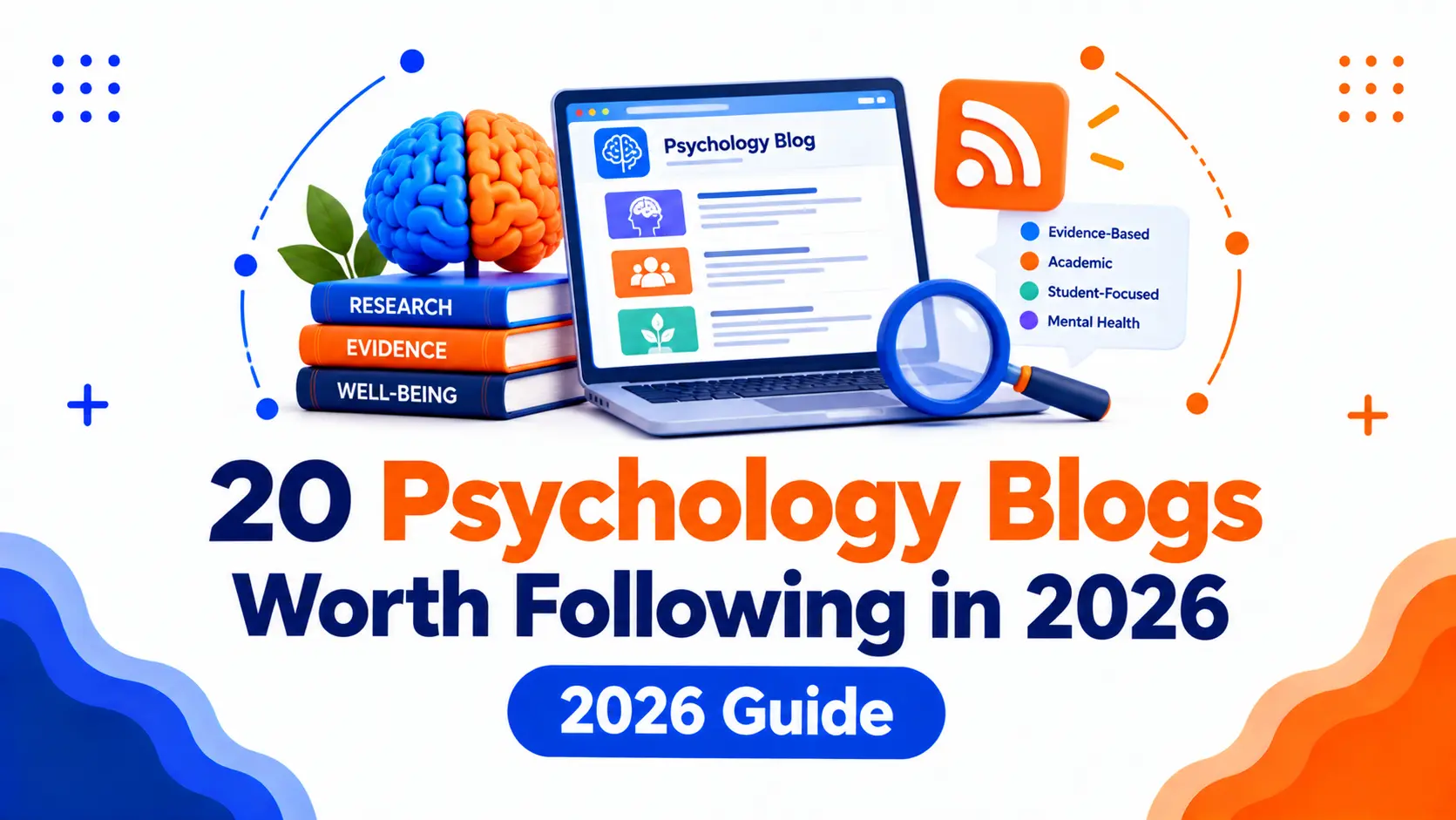
Finding psychology stuff online that you can really trust is tougher than it should be. Search results are littered with rehashed listicles and half the links lead to sites that closed years ago. This guide solves that problem. Here are 20 psychology blogs and journals that are actively creating great work in 2026 – evaluated for credentialed authorship, evidence-based claims, and true benefit to readers, whether you’re a student, a clinician, or just wondering about why people do what they do.
What Are the Best Psychology Blogs to Follow in 2026?
The most trustworthy psychology blogs combine credentialed authors with citations to peer-reviewed research. That short list includes Psychology Today, Psych Central, PositivePsychology.com, Simply Psychology, and the news arms of major scientific bodies like the American Psychological Association and the Association for Psychological Science. Each covers a different corner of the field — clinical practice, self-improvement, cognitive theory, or breaking research — so the “best” one depends on what you’re after.
Here’s the full rundown, grouped by focus area so you can find your fit fast.
General Psychology & Mental Health
- Psychology Today — The largest general-audience psychology publication online, with thousands of contributing clinicians writing on relationships, trauma, parenting, and workplace behavior. Strong for browsing broad topics and finding a therapist directory in the same place.
- Psych Central — Reader-friendly explainers on specific conditions (anxiety, ADHD, depression) written or reviewed by licensed clinicians. Good starting point if you or someone you know just got a diagnosis.
- Verywell Mind — Medically reviewed articles with a strong health-editorial process, useful for symptom checklists and treatment overviews.
- HelpGuide — A nonprofit resource focused on practical coping tools rather than theory, good for crisis-adjacent situations like grief or burnout.
Positive Psychology & Self-Improvement
- PositivePsychology.com — Worksheets, exercises, and frameworks grounded in the positive psychology research tradition started by Martin Seligman. Heavier on practical tools than most competitors.
- Greater Good Magazine (UC Berkeley) — Published by UC Berkeley’s Greater Good Science Center, this one translates studies on gratitude, empathy, and resilience into everyday language.
- The Gottman Institute Blog — Research-backed relationship advice from a lab with decades of longitudinal marriage data.
- Tiny Buddha — Less clinical, more reflective — useful for readers who want psychology framed through personal essays rather than research summaries.
Cognitive Science & Neuroscience
- Simply Psychology — An education-first site that breaks down theories like Piaget’s stages or classical conditioning in plain language, popular with students. If you’re comparing frameworks, our own cognitive psychology guide pairs well with their theory overviews.
- Neuroscience News — Aggregates and summarizes peer-reviewed neuroscience studies as they’re published, useful for staying current on brain research.
- BrainFacts.org — Backed by the Society for Neuroscience, this is one of the more rigorously reviewed public-education neuroscience resources available.
- Mind Hacks — A long-running blog examining how cognitive science intersects with everyday decision-making.
Clinical & Research-Based Publications
- APA PsycPORT / APA News — The American Psychological Association’s official news channel, covering policy, new studies, and practice guidelines directly from the field’s largest professional body.
- APS Observer — The Association for Psychological Science’s magazine, aimed at researchers but accessible enough for serious general readers.
- NIMH Science News — The National Institute of Mental Health publishes government-funded research summaries directly, with no editorial spin.
- Frontiers in Psychology (Blog & Journal) — An open-access journal whose editorial blog highlights notable published studies for non-specialist readers.
Social, Organizational & Applied Psychology
- Harvard Business Review — Psychology & Behavioral Economics section — Not a psychology blog by name, but HBR’s coverage of workplace behavior, bias, and decision-making draws directly from behavioral science research.
- Character & Context (Society for Personality and Social Psychology) — Academic-adjacent but written for a general audience, focused on social psychology findings.
- The Jed Foundation Blog — Focused on mental health in adolescents and young adults, useful for parents and educators.
- Brain Pickings successor, The Marginalian — Not strictly clinical, but its essays on human nature, creativity, and cognition regularly cite psychological research in accessible form.
How Do I Know If a Psychology Blog Is Scientifically Reliable?
A reliable psychology blog cites peer-reviewed sources and features credentialed authors — think Ph.D., Psy.D., or LCSW after the byline. Beyond that, check publication dates (psychology research turns over fast), look for correction policies, and be wary of any site whose headlines promise instant fixes to complex conditions.
A quick reliability checklist:
| Signal | Reliable Blog | Red Flag |
| Author credentials | Listed, verifiable (Ph.D., LCSW, etc.) | Anonymous or “staff writer” only |
| Sourcing | Links to studies, journals, or agencies like NIMH/APA | No citations, or links to other blogs |
| Tone | Explains uncertainty and nuance | Absolute claims (“this always works”) |
| Update cadence | Recently reviewed or dated | No dates, or stale content from a decade ago |
| Monetization | Ads/affiliate content clearly separated from editorial | Content reads like a product pitch |
If a blog fails two or more of these, treat its claims with caution — or at minimum, cross-check them against a primary source like the National Institute of Mental Health before acting on them.
What Subfields of Psychology Do Top Blogs Cover?
Modern psychology blogs typically split coverage across four core subfields: cognitive/neuroscience, clinical/abnormal psychology, social/organizational psychology, and positive psychology. Knowing which subfield a blog specializes in helps you pick sources that actually match your research.
- Cognitive & Neuroscience — memory, perception, attention, and how the brain physically supports thought. If you want the underlying science, our brain study psychology piece breaks down the research methods used in this space.
- Clinical & Abnormal Psychology — diagnostic frameworks, therapy modalities, and treatment research. Readers researching specific conditions may also find our mental health pathology guide helpful for terminology.
- Social & Organizational Psychology — group behavior, workplace dynamics, and Leadership psychology, an area where our social characteristics guide offers additional context.
- Positive Psychology — habit formation, resilience, and well-being, distinct from clinical treatment and focused on optimizing already-healthy functioning.
Which Psychology Blogs Discuss AI and Human Behavior?
A small but growing number of journals (including Psychology Today, HBR’s behavioral science coverage, and Neuroscience News) frequently cover the intersection of artificial intelligence with cognition, decision-making, and mental health. Cross-reference dates attentively, since this is a fast-moving area; a 2023 take on AI and attention spans may already be outdated by 2026’s research.
Things to watch in this space include AI-powered therapy chatbots, how algorithms affect decision fatigue, and research into screen-mediated social comparison. These are all areas where peer-reviewed sources tend to get ahead of blog commentary, so consider blog coverage a starting point, not the final word.
Which Psychology Blogs Are Best for University Students?
If you are a student studying for a paper or coursework, the best places to look are Simply Psychology, APA PsycPORT, and Frontiers in Psychology, because they will take you to primary research rather than repeating what somebody else has said. Simply Psychology in particular is organized around the common syllabus subjects – attachment theory, cognitive development, classical vs operant conditioning – so it can be easily cross referenced against a textbook.
For students building out broader subject knowledge, pairing blog reading with structured references like our psychological theories guide or types of psychology overview can help organize scattered blog content into a coherent study framework.
Are There Regional or Local Psychology Blog Resources?
Yes — most U.S. states have a regional branch of the American Psychological Association that publishes localized mental health resources, practitioner directories, and policy updates. These regional affiliates are worth checking if you’re looking for licensed providers or state-specific mental health initiatives rather than general content. State psychological association sites are typically listed through APA’s own state and provincial associations directory.
Frequently Asked Questions
What is the single most trusted psychology publication online?
Among general-audience sites, Psychology Today has the widest reach and the largest base of credentialed contributors. However, for research accuracy, official outlets like APA News or NIMH carry more weight, as they publish directly from the source.
Do I need a psychology degree to understand these blogs?
No. Every blog on this list is written for a general audience, though sites like Frontiers in Psychology lean more academic. Simply Psychology and PositivePsychology.com are the most beginner-friendly starting points.
How often should I expect new content from these sources?
Most major sites publish weekly at minimum; government and academic outlets like NIMH and APS tend to post less frequently but with higher research rigor per article.
Can psychology blogs replace therapy or professional diagnosis?
No. Every reputable blog on this list will say the same thing — educational content is not a substitute for a licensed clinician’s evaluation. Use these sources to understand concepts, not to self-diagnose.
Are free psychology blogs as reliable as paid academic journals?
Reliability depends on sourcing, not price. A free blog that cites peer-reviewed journals (like NIMH’s public research summaries) can be just as trustworthy as a paywalled journal article, just written for a broader audience.
How do these blogs handle corrections when research changes?
The more rigorous outlets — APA, APS, NIMH — issue updates or follow-up pieces when new research shifts consensus. Independent blogs vary widely; check for dated revision notes before trusting older posts.
Final Thoughts
Psychology content online ranges from rigorously sourced to borderline fiction, and the difference usually comes down to who’s writing it and what they’re citing. Start with the outlets above based on what you actually need — clinical questions to Psych Central or Verywell Mind, research literacy to APA or NIMH, self-improvement tools to PositivePsychology.com or Greater Good Magazine. For deeper subject grounding beyond any single blog, browse yourbrainlens’s own library of psychology guides to build a foundation these publications can build on.
Bookmark two or three from this list that match your actual interests, not all twenty — a smaller, well-vetted reading list beats a cluttered one you’ll never open.




One thought on “20 Psychology Blogs Worth Following in 2026 (Top List)”