
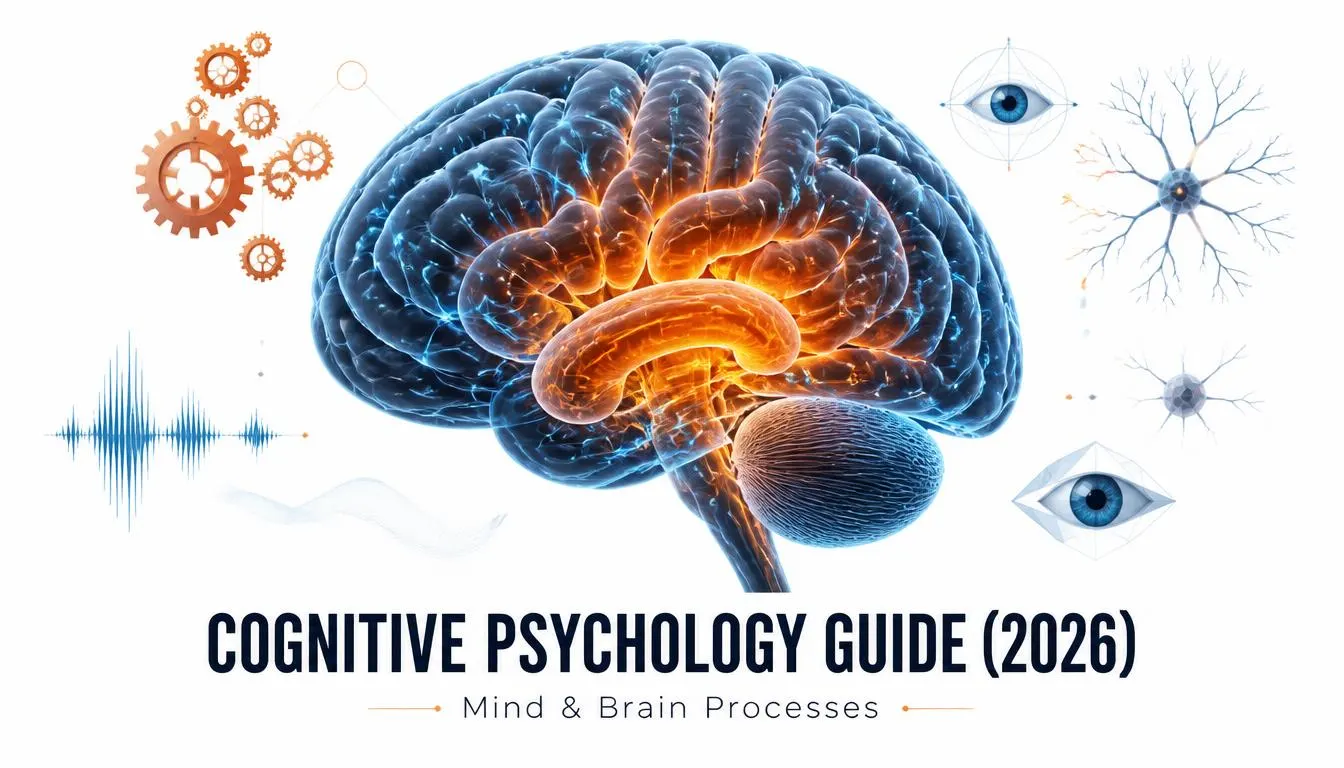
Why Understanding Cognition Changes How You See Your Own Mind
You forget a name mid-introduction. You solve a problem in the shower, not at your desk. You “just know” something is wrong before you can explain why. None of that is random. It’s cognitive architecture at work — memory systems, attention filters, and decision shortcuts operating underneath conscious awareness. This guide maps out how cognitive psychology explains all of it, from working memory to the biases that quietly steer your choices.
What Is Cognitive Psychology?
Cognitive psychology focuses on studying how the mind takes in, stores, transforms, and uses information — covering memory, attention, perception, language, and problem solving as interconnected systems rather than isolated skills. It treats the brain, functionally, as an information-processing system: input arrives through the senses, gets filtered and interpreted, and eventually shapes a decision or an action. Ulric Neisser, often credited with naming the field in his 1967 book Cognitive Psychology, framed mental activity this way deliberately — as a pipeline of processing stages, each with its own rules and limitations.
This framing is what separates cognitive psychology from earlier behaviorist approaches, which studied stimulus and response but treated the mind itself as an unobservable “black box.” Cognitive psychology opened that box up.
What Is the Difference Between Cognitive Psychology and Behavioral Psychology?
Cognitive psychology studies internal mental processes like memory and reasoning, while behavioral psychology studies observable behavior shaped by reinforcement and conditioning, largely setting internal mental states aside. A behaviorist explains a child’s tantrum through learned reward patterns — what behavior got attention in the past. A cognitive psychologist asks what the child understood, expected, or misjudged about the situation that triggered the reaction. Neither framework is wrong; they answer different questions. Modern cognitive-behavioral approaches, most notably Aaron Beck’s work on cognitive therapy, deliberately merge both — treating distorted thought patterns as something that can be identified and restructured, which then changes behavior downstream.
What Are the 4 Main Cognitive Processes?
The four core cognitive processes are attention, perception, memory, and problem solving/reasoning — each acting as a distinct stage in how raw sensory input becomes usable knowledge and action. Understanding them individually makes it much easier to see where things go wrong in daily life — a “memory problem,” for instance, is often actually an attention problem in disguise.
How Does Attention Filter Information?
Attention is the cognitive gatekeeper that selects which incoming information gets processed further, since the brain cannot consciously handle everything the senses take in at once. Donald Broadbent’s Filter Model, one of the earliest formal attention theories, proposed that unattended information gets blocked early, based on basic physical features like pitch or location, before deeper meaning is even processed. Later research complicated this picture — the “cocktail party effect,” where you suddenly notice your name spoken across a noisy room, shows that some meaningful content does slip past the filter. Attention, in other words, is selective but not absolute.
How Does Perception Turn Sensation Into Meaning?
Perception is the process of organizing and interpreting raw sensory data into a coherent, meaningful experience of the world. Two people can look at the same ambiguous image and perceive entirely different things, because perception isn’t a passive recording — it’s an active construction shaped by expectation, context, and prior experience. This is where schema theory becomes central: schemas are mental templates built from experience that guide how new sensory information gets interpreted. A doctor and a patient looking at the same X-ray “see” very different things, not because their eyes work differently, but because their schemas do.
What Is the Multi-Store Memory Model?
The Multi-Store Memory Model, proposed by Richard Atkinson and Richard Shiffrin, describes memory as three separate stages — sensory memory, short-term memory, and long-term memory — each with different capacity and duration. Sensory memory holds raw input for a fraction of a second. Short-term memory holds a small amount of information briefly, unless it’s rehearsed. Long-term memory stores information indefinitely, in a much larger and more durable capacity. George Miller’s landmark 1956 paper proposed that short-term memory holds roughly seven items, plus or minus two — a number so influential it’s still referenced in interface design and instructional material today, even as later research has refined the estimate downward for certain types of information.
How Does Working Memory Differ From Short-Term Memory?
Working memory is an active system that not only holds information temporarily but manipulates it for reasoning, comprehension, and learning. In contrast, short-term memory is a simpler, more passive storage concept. Alan Baddeley’s Working Memory Model expanded on the older short-term memory concept by proposing multiple specialized components:
- Central Executive — the control system that directs attention and coordinates the other components.
- Phonological Loop — handles verbal and auditory information, useful for holding a phone number in mind just long enough to dial it.
- Visuospatial Sketchpad — handles visual and spatial information, like mentally rotating an object or navigating a route.
- Episodic Buffer (added later) — integrates information across the other components into a single coherent episode.
This model explains why you can lose your train of thought when interrupted mid-sentence — the central executive’s limited capacity gets divided between the interruption and the original task, and something gives.
What Role Does Working Memory Play in Language and Problem Solving?
Working memory supports language acquisition and problem solving by temporarily holding partial information — a half-finished sentence, an intermediate calculation — long enough for the mind to complete the larger task. Children with stronger working memory capacity tend to acquire vocabulary and grammar more efficiently, because parsing a new sentence structure requires holding earlier words in mind while processing what comes next. The same mechanism applies to multi-step problem solving: mental math, for instance, requires holding an intermediate result in working memory while computing the next step, which is exactly why complex calculations are so much easier on paper than in your head.
How Do Cognitive Biases Affect Decision Making?
Cognitive biases are systematic patterns of deviation from rational judgment, produced by the mental shortcuts the brain uses to make fast decisions under uncertainty. Daniel Kahneman and Amos Tversky’s decades of collaborative research — later summarized in Kahneman’s book Thinking, Fast and Slow — demonstrated that these shortcuts aren’t occasional lapses. They’re a built-in, predictable feature of how the mind operates, and they show up the same way across nearly all human populations studied.
What Is Dual-Process Theory (System 1 and System 2)?
Dual-Process Theory describes two distinct modes of thinking: System 1, which is fast, automatic, and intuitive, and System 2, which is slow, effortful, and deliberate. System 1 operates via heuristics and intuition, making snap judgments with minimal conscious effort — recognizing a friend’s face, reacting to a sudden loud noise. System 2 engages for tasks that require careful reasoning — solving a multi-step math problem, evaluating a complex financial decision. Most cognitive biases emerge because System 1 handles a decision that really needed System 2’s scrutiny, and the error goes unnoticed because System 1 feels just as confident as System 2 would.
How Does Dual-Process Theory Affect Everyday Decisions?
Consider two common biases through this lens:
- Anchoring bias — an initial number (a first price shown, an opening offer) skews all subsequent judgments, because System 1 latches onto the first reference point instead of recalculating from scratch.
- Availability heuristic — people judge how likely an event is based on how easily examples come to mind, not on actual statistical frequency. This is why people often overestimate the risk of shark attacks and underestimate the risk of heart disease — one is vivid and memorable; the other isn’t.
Recognizing which system is driving a decision — and deliberately slowing down to engage System 2 for high-stakes choices — is one of the most practical, evidence-backed habits to come out of decades of cognitive bias research.
How Does Neurocognition Connect Mind and Brain?
Neurocognition examines how specific brain structures and neural processes give rise to cognitive functions like memory, attention, and language, bridging cognitive psychology with neuroscience. This is also the clearest dividing line between cognitive psychology and neuroscience as separate but overlapping fields: cognitive psychology models behavior and mental processes functionally, often without direct reference to brain tissue, while neuroscience maps those same processes onto specific neural circuits, using tools like fMRI and EEG. Modern cognitive neuroscience increasingly merges both—testing whether a cognitive model (like Baddeley’s working memory components) maps onto distinct, separable brain regions, which in several cases it does.
What Is Metacognition, and Why Does It Matter?
Metacognition is the awareness and understanding of one’s own thought processes — essentially, thinking about thinking. It’s what allows a student to recognize “I don’t actually understand this chapter” rather than mistaking familiarity with the material for genuine comprehension. This distinction explains why rereading notes feels productive but often produces weaker exam results than active recall testing. Metacognitive skill also underlies self-regulation more broadly: noticing when System 1 is making a call that deserves System 2’s attention is itself a metacognitive act.
How Does Cognitive Development Change These Processes Over Time?
Cognitive processes aren’t fixed from birth — they develop in structured stages, most notably described by Jean Piaget, whose theory proposed that children move through sensorimotor, preoperational, concrete operational, and formal operational stages, each unlocking new reasoning capabilities. A child in the preoperational stage, for example, typically hasn’t yet grasped conservation — the idea that pouring liquid into a differently shaped container doesn’t change its quantity. By the concrete operational stage, that reasoning is usually solid. Piaget’s stage model has been refined and challenged since its introduction. Still, it remains foundational for understanding why cognitive processes like abstract reasoning aren’t available to a five-year-old the same way they are to a fifteen-year-old.
How Is Cognitive Psychology Studied Academically Today?
Cognitive psychology holds a firm, structured place across academic pathways:
- In the US, it forms a dedicated tested domain — often labeled Unit 5 — within the AP Psychology curriculum. It shows up heavily in the psychological, social, and biological foundations section of the MCAT.
- Coursera and similar platforms offer standalone cognitive science courses that pair lecture content with structured problem sets, often used as a supplement to formal coursework.
- University programs typically deliver core material through LMS-hosted lecture notes and flashcard-based review tools, particularly for memorization-heavy content like Baddeley’s model components or Piaget’s stages.
- In the UK, cognitive neuroscience research centers are concentrated at several major universities, often collaborating directly with clinical neuropsychology departments.
- Across Europe, cognitive psychology sequencing within psychology degrees is standardized through the European Credit Transfer System (ECTS), which affects how deeply and in what order these topics are taught relative to other psychology subfields.
- The International Cognitive Science Association publishes guidelines that shape research standards and terminology consistency across the field globally.
For anyone building study material, organizing content around the four core processes — attention, perception, memory, and problem solving — tends to track more closely with how exam boards structure their units than a flat chronological list of theorists.
Where BrainLens Fits Into Your Cognitive Psychology Study Path
Cognitive psychology gets taught as a list of names and models — Baddeley, Piaget, Kahneman — without always connecting why those models matter for understanding your own mind. That gap is exactly where BrainLens is built to help. Rather than presenting dry definitions in isolation, our guides connect each framework back to a recognizable daily experience, so the model actually sticks instead of evaporating after the exam.
If group behavior and social influence interest you as a companion topic, our social psychology guide explores how individual cognition shifts once other people enter the picture. For a wider foundation across the field, our complete overview of psychology’s major branches is a strong starting point, and our guide to core psychological theories expands further on frameworks like schema theory and dual-process reasoning referenced throughout this piece.
To understand how the experimental methods behind studies like Miller’s and Kahneman’s actually work, our breakdown of psychological research methods is a useful companion read. And since cognitive processes shift meaningfully across the lifespan, our developmental psychology guide pairs naturally with Piaget’s stage theory covered above.
For an academic anchor on these topics, the American Psychological Association’s overview of cognitive psychology is a solid external reference for further reading.
FAQs: Cognitive Psychology Explained Simply
What does cognitive psychology focus on studying?
It focuses on studying mental information processing — how the mind takes in, stores, transforms, and applies information through attention, perception, memory, and reasoning.
What are the 4 main cognitive processes?
Attention, perception, memory, and problem solving/reasoning form the four core cognitive processes studied in the field.
How does the human mind process and store information?
Information moves through sensory memory, then short-term or working memory, and finally into long-term memory, with each stage governed by different capacity and duration limits.
What is the difference between cognitive psychology and behavioral psychology?
Cognitive psychology studies internal mental processes like memory and reasoning, while behavioral psychology focuses on observable behavior shaped by conditioning and reinforcement.
What is the difference between cognitive psychology and neuroscience?
Cognitive psychology models mental processes functionally, often independent of brain structures, while neuroscience maps those same processes onto specific neural circuits and regions.
Why do cognitive biases happen if the brain is supposedly rational?
Biases arise because fast, intuitive System 1 thinking often handles decisions that would benefit from slower, deliberate System 2 reasoning, and the resulting shortcut feels just as confident as careful analysis would.
Start Applying What You’ve Learned
Cognitive psychology isn’t abstract theory locked inside a textbook. It’s the reason you forget names under pressure, solve problems away from your desk, and trust snap judgments more than they sometimes deserve. Once you can name the process — attention, memory, bias, or otherwise — you can start working with your own mind instead of against it. Start your journey to understand how your mind really works with us at yourbrainlens.






12 thoughts on “Cognitive Psychology Guide 2026: How the Mind Processes Life”