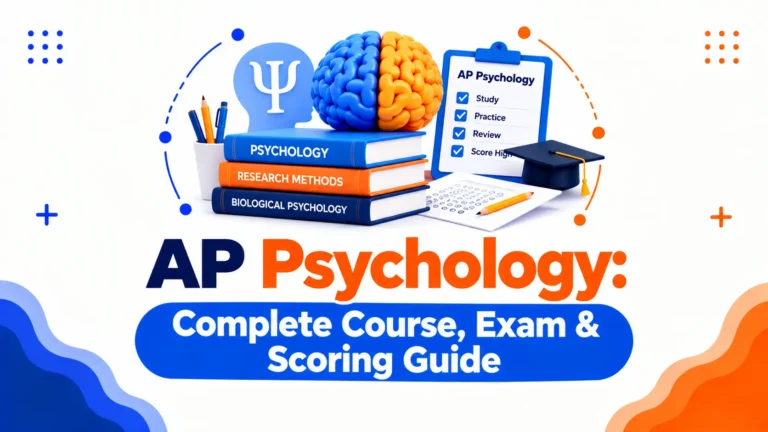
Six weeks is enough to prepare for the AP Psychology exam if you study with a system. Most students fail by rereading notes instead of testing themselves. This guide gives you a week-by-week plan, a breakdown of all five units, and step-by-step methods for the AAQ and EBQ free-response questions. Follow it, and a 5 is realistic.
How Is the AP Psychology Exam Structured?
The digital AP Psychology exam has two sections: 100 multiple-choice questions in 70 minutes and 2 free-response questions in 50 minutes. The multiple-choice section counts for two-thirds of your score. The free-response section, an Article Analysis Question and an Evidence-Based Question, counts for the rest.
The College Board’s official AP Psychology course page publishes the Course and Exam Description (CED). It is the single most reliable source for what can appear on test day. Read it once at the start. Confirm the current exam format there too, because the College Board occasionally adjusts timing and scoring.
| Section | Questions | Time | Score Weight |
| Multiple-Choice (MCQ) | 100 | 70 minutes | about 67% |
| Free-Response (FRQ) | 2 (AAQ + EBQ) | 50 minutes | about 33% |
The exam is taken in the Bluebook app, the College Board’s digital testing platform. You should download it early and practice in it. Highlighting, flagging questions, and the on-screen timer all behave differently from paper. Surprises on exam day cost points.
What Are the 5 Units on the AP Psychology Exam?
The AP Psychology exam covers five units: Biological Bases of Behavior, Cognition, Development and Learning, Social Psychology and Personality, and Mental and Physical Health. Each unit carries roughly 15–25% of the multiple-choice section so that no single unit can carry you. Weak spots show up quickly.
Here is the full breakdown, along with the core ideas to master in each:
| Unit | Core Topics | What Students Usually Miss |
| 1. Biological Bases of Behavior | Neurons, neurotransmitters, brain structures, nervous system, sleep, sensation and perception | Mixing up brain regions and their functions |
| 2. Cognition | Memory, language, problem-solving, intelligence, cognitive biases | Confusing encoding, storage, and retrieval |
| 3. Development and Learning | Classical and operant conditioning, Piaget, Erikson, Bandura | Telling reinforcement from punishment |
| 4. Social Psychology and Personality | Conformity, obedience, attribution errors, personality theories | Matching researchers to their studies |
| 5. Mental and Physical Health | Psychological disorders, treatments, stress and health psychology | Distinguishing similar disorders |
Research methods and statistics run through every unit. You will see operational variables, correlation versus causation, and basic statistical interpretation in both the MCQs and the FRQs. Our guide to psychological research methods covers the foundations.
How Do You Build a 6-Week AP Psychology Study Plan?
A strong 6-week plan gives one unit to each of the first five weeks and reserves week six for full-length practice exams. Study 45–90 minutes a day, six days a week. Spend about 70% of that time on active recall (flashcards, practice questions, writing from memory) and 30% on reading.
Here is the overview:
| Week | Focus | Main Goal |
| 1 | Unit 1: Biological Bases + research methods | Learn brain structures and neuron basics |
| 2 | Unit 2: Cognition | Master memory models and cognitive biases |
| 3 | Unit 3: Development and Learning | Nail conditioning and developmental stages |
| 4 | Unit 4: Social Psychology and Personality | Connect studies to concepts |
| 5 | Unit 5: Mental and Physical Health | Sort disorders and treatments |
| 6 | Full practice exams + FRQ drills | Build speed and fix gaps |
If you have a different timeline, our AP Psychology study guide and the broader AP Psychology guide help you adapt.
What Should You Do Each Day of the Week?
Use the same six-day rhythm every week: learn on days one and two, practice on days three and four, review on day five, and test yourself on day six. A repeating routine removes the daily decision of what to study. That decision is where most cramming plans collapse.
- Day 1: Read the unit overview and skim your textbook or notes.
- Day 2: Build flashcards for the hardest 20–30 terms.
- Day 3: Do 20–25 multiple-choice questions on the topic.
- Day 4: Write one short FRQ-style response from memory.
- Day 5: Review every question you got wrong and write down why you got it wrong.
- Day 6: Take a timed quiz covering the whole unit.
- Day 7: Rest. Your memory consolidates while you do.
Sleep matters here. Research summarized by the American Psychological Association links good sleep to better learning and memory. Staying up until 2 a.m. to cram works against the exact skill you are training.
What Does Week 1 Look Like (Biological Bases of Behavior)?
Week 1 should cover neurons, the nervous system, major brain structures, and the research methods you will use all year. Start here because biology gives you a vocabulary the later units borrow. Aim to explain how a signal travels through a neuron without looking at your notes.
Focus on these building blocks:
- Neuron anatomy: dendrites, soma, axon, myelin sheath, terminal buttons.
- Action potentials: how a neuron fires and how neurotransmitters cross the synapse.
- Nervous system divisions: central versus peripheral, somatic versus autonomic.
- Brain structures: hippocampus, amygdala, cerebellum, frontal lobe, and the rest.
- Sensation and perception: thresholds, signal detection, and perceptual sets.
Draw the brain from memory every day. Label it. Check it. Redraw the parts you missed. This beats reading a diagram ten times because the effort of recall builds memory. For extra reading, try our overview of how the brain is studied in psychology.
What Does Week 2 Look Like (Cognition)?
Week 2 focuses on memory, thinking, language, and intelligence, with special attention to the three-stage memory model and common cognitive biases. Cognition questions often present a short scenario and ask you to name the concept. Practice labeling real-life examples rather than only memorizing definitions.
Key ideas to lock in:
- Memory stages: encoding, storage, retrieval.
- Memory types: sensory, short-term (working), long-term, explicit and implicit.
- Forgetting: decay, interference, retrieval failure.
- Biases and heuristics: confirmation bias, availability heuristic, anchoring, functional fixedness.
- Language: phonemes, morphemes, syntax, and Chomsky versus Skinner debates.
Here is a quick example. Your friend is sure that plane crashes are common because she saw a news story about one last week. That is the availability heuristic: judging likelihood by how easily examples come to mind. Making up your own examples like this is one of the fastest ways to learn the terms. Our cognitive psychology guide offers more.
What Does Week 3 Look Like (Development and Learning)?
Week 3 covers classical conditioning, operant conditioning, observational learning, and the major developmental theorists, including Piaget and Erikson. This is where many students lose easy points by mixing up similar terms. The fix is to build side-by-side comparison charts and quiz yourself on them.
Learning basics:
| Concept | Key Question to Ask |
| Classical conditioning | Is a neutral stimulus being paired with an automatic response? |
| Operant conditioning | Is a behavior being strengthened or weakened by its consequence? |
| Observational learning (Bandura) | Is someone learning by watching a model? |
Remember the reinforcement-versus-punishment trick. Positive means adding something. Negative means removing something. Reinforcement raises the chance of a behavior. Punishment lowers it. Four combinations, and you can derive any of them.
For development, memorize Piaget’s four stages (sensorimotor, preoperational, concrete operational, formal operational) and Erikson’s eight psychosocial stages. Our guides to psychosocial development stages and key psychology theorists make good review sheets. Our developmental psychology guide covers the wider picture. The attachment styles explainer is a useful extra on early relationships.
What Does Week 4 Look Like (Social Psychology and Personality)?
Week 4 covers conformity, obedience, attribution errors, group behavior, and the major personality theories. The exam loves classic studies here, such as Asch’s line experiments and Milgram’s obedience research. Learn each study as a three-part package: what was done, what was found, and what it shows.
Core ideas:
- Conformity and obedience: Asch and Milgram.
- Attribution: the fundamental attribution error and self-serving bias.
- Group effects: social facilitation, social loafing, groupthink, the bystander effect.
- Attitudes: cognitive dissonance and persuasion.
- Personality: Big Five, psychodynamic, humanistic, trait, and social-cognitive approaches.
Two terms trip students up constantly. Our post on normative versus informational social influence separates them cleanly. For the bigger picture, see our social psychology guide.
A practical tip: when you read about a study, ask what the independent variable and dependent variable were. This habit pays off twice, once for the multiple-choice questions and again for the FRQs.
What Does Week 5 Look Like (Mental and Physical Health)?
Week 5 covers psychological disorders, their treatments, and the effects of stress on physical health. Sort disorders into categories (anxiety, mood, psychotic, personality, neurodevelopmental, and so on) and learn one defining feature for each. Then pair each category with the therapies and medications used to treat it.
Study in this order:
- Diagnosis basics: what makes a behavior “abnormal,” and how clinicians classify disorders.
- Major disorder categories: key symptoms for each.
- Treatment approaches: psychodynamic, cognitive-behavioral, humanistic, and biomedical.
- Stress and health: the general adaptation syndrome, coping styles, and health psychology.
Keep your tone factual when studying this unit. These are real conditions affecting real people, and the exam expects precise, respectful use of terms. The National Institute of Mental Health publishes clear, reliable overviews of many disorders, which is useful for checking your understanding. Our mental health and pathology guide and talk therapy guide round out the topic.
If you ever find that studying these topics stirs up something personal, talk to a trusted adult, counselor, or doctor. Your wellbeing matters more than any exam.
What Should You Do in Week 6 (Full Practice and Review)?
Week 6 is for full-length timed practice exams, targeted review of weak units, and FRQ drills. Take one full practice exam early in the week and another near the end of the week. Between them, spend your time on the questions you missed, not on topics you already know.
A simple week-six schedule:
- Day 1: Full timed practice exam in Bluebook-style conditions.
- Day 2: Score it, then log every miss by unit and by error type.
- Day 3: Re-study your two weakest units.
- Day 4: Two FRQ sets, one AAQ and one EBQ, under timed conditions.
- Day 5: Second full practice exam.
- Day 6: Light review of flashcards and your error log.
- Day 7: Rest and sleep.
Tracking error types is the high-information-gain step most plans skip. Sort each miss into one of the following: a knowledge gap, a vocabulary mix-up, a misread question, or a timing problem. Each type needs a different fix, and you cannot choose the right one without the label.
How Do You Answer the AP Psychology Article Analysis Question (AAQ)?
To answer the AAQ, read the short research summary, identify the variables and the research method, then apply the exact terms the prompt requests. Each point on the rubric is earned by naming and applying a concept, so precise vocabulary beats long explanations.
Use this four-step approach:
- Read the prompt first. Know what each part asks before you read the article.
- Mark the study basics. Underline the hypothesis, the sample, the independent variable, and the dependent variable.
- Answer each part in order. Label your responses (A, B, C) to match the prompt.
- Apply, don’t just define. Tie each term to a detail from the article.
Here is an example of the gap between a weak and a strong response.
- Weak: “The dependent variable is something the researchers measure.”
- Strong: “The dependent variable is the number of words participants recalled after the 24-hour delay.”
The second version earns the point because it applies the concept to the study. The College Board’s AP Psychology exam resources include past free-response questions and scoring guidelines you can use to practice.
How Do You Answer the Evidence-Based Question (EBQ)?
For the EBQ, make a claim, support it with specific evidence from the provided sources, and connect that evidence to a psychological concept. You are building a short argument. Every sentence should either state your claim, cite evidence, or explain how the evidence supports the claim.
A reliable structure:
- Claim: One sentence answering the question directly.
- Evidence: Quote or reference specific details from the sources.
- Reasoning: Explain why that evidence supports your claim, using course terminology.
- Limits: Where the prompt asks, note a limitation or counterpoint.
Do not summarize the sources. The graders want an argument, not a book report. Practice one EBQ every week from week two onward, and by week six the format will feel automatic.
Which Study Methods Work Best for AP Psychology?
Retrieval practice and spaced repetition are the two most effective study methods for AP Psychology. Retrieval practice means pulling information out of memory, through flashcards or blank-page recall, instead of rereading it. Spaced repetition means reviewing material at growing intervals rather than all at once.
Compare common methods:
| Method | Effectiveness | Why |
| Rereading notes | Low | Feels productive, builds little memory |
| Highlighting | Low | Passive, with no recall involved |
| Flashcards with self-testing | High | Forces active retrieval |
| Practice questions | High | Mirrors real exam demands |
| Spaced review | High | Fights forgetting over time |
| Teaching the topic aloud | High | Exposes gaps instantly |
This is also good AP Psychology material in itself: the testing effect and the spacing effect appear in the Cognition unit. You can study the content as you use it. At yourbrainlens, we tell readers to treat their own study sessions as a live experiment in cognitive psychology.
Is AP Psychology Hard to Self-Study?
AP Psychology is one of the more manageable AP courses to self-study, because the content is mostly vocabulary, concepts, and applied examples rather than heavy math. Self-studying still takes discipline. The biggest risks are skipping research methods and never practicing the FRQs.
If you are self-studying, add these supports:
- Use the official CED as your checklist.
- Take diagnostic quizzes at the start of each unit.
- Find a study partner or online group to compare FRQ answers.
- Book timed practice exams on your calendar like real appointments.
Online tutoring and structured prep can help if you get stuck, whether you are in the USA or taking the exam internationally. Exam registration and school policies vary by country, so confirm details with your school’s AP coordinator.
What Mistakes Should You Avoid When Studying for AP Psychology?
The most common mistakes are memorizing definitions without examples, ignoring research methods, skipping FRQ practice, and cramming the night before. Each one is avoidable with the plan above.
- Memorizing without applying. The exam gives you scenarios, not definitions.
- Skipping statistics and methods. They appear in every unit.
- Practicing only MCQs. The FRQ section is a third of your score.
- Confusing similar terms. Build comparison charts for look-alike concepts.
- Last-minute cramming. It works against how memory consolidates.
- Never reviewing wrong answers. Your errors are your best study guide.
Frequently Asked Questions
How many units are on the AP Psychology exam?
There are five units: Biological Bases of Behavior, Cognition, Development and Learning, Social Psychology and Personality, and Mental and Physical Health. Each unit makes up roughly 15–25% of the multiple-choice section. Research methods and statistics appear within all five.
What is the format of the digital AP Psychology exam?
The exam has a 70-minute multiple-choice section with 100 questions and a 50-minute free-response section with two questions. The free-response section includes an Article Analysis Question and an Evidence-Based Question. You take it in the College Board’s Bluebook app.
How do you study for AP Psychology free-response questions?
Practice with past prompts and the official scoring guidelines, and write timed responses by hand or on a device. Focus on applying precise terms to the details in the question. Review your answers against the rubric and note what each missed point had in common.
Can you get a 5 on AP Psychology in six weeks?
Yes, if you study consistently and use active recall. A 5 usually means strong performance on both sections, so prioritize practice exams and FRQ drills in the final week. Students who start from zero should plan on closer to 60–90 minutes of daily study.
What is the best way to study for AP Psychology if you are short on time?
Spend most of your time on practice questions and flashcard self-testing, and use the unit weights to prioritize. Review every wrong answer and log the reason. Do not reread whole chapters, because passive review is the slowest way to improve.
Your Next Steps
You now have a complete 6-week structure, a unit-by-unit roadmap, and a method for both free-response questions. The plan only works if you start. Here is your first move:
- Download Bluebook and complete a practice session this week.
- Read the official CED and mark your weakest unit.
- Block six study sessions on your calendar for week one.
- Start your error log today.
Keep building your knowledge with the free resources at yourbrainlens. Start with our AP Psychology study guide, then explore our complete psychology guides to deepen your understanding of each unit. Open your calendar, pick your week-one start date, and begin.