You’ve probably heard both words used as if they mean the same thing. They don’t. Resilience helps you bounce back after life hits hard. Emotional strength keeps you steady while it’s happening. This guide explains how each one works, how they support each other, and seven research-backed ways to build both, with simple daily exercises you can start today.
What Is the Difference Between Resilience and Emotional Strength?
Resilience is your ability to adapt and recover from stress, while emotional strength is your ability to stay steady and in control during stress. Resilience is flexible and forward-moving. Emotional strength is stable and grounding. Healthy people need both working together.
Think of a tall building in an earthquake zone. The foundation keeps it standing. The flexible frame lets it sway rather than snap. Emotional strength is the foundation. Resilience is the flex.
| Feature | Emotional Strength | Resilience |
| Core job | Holding steady under pressure | Adapting and recovering after pressure |
| Timing | During the stress | During and after the stress |
| Main skill | Self-regulation | Cognitive flexibility |
| Metaphor | Foundation | Flexible frame |
| Weakness when missing | Panic, outbursts, shutdown | Rigid thinking, getting stuck |
| Strengthened by | Emotional regulation techniques, stress tolerance | Reframing, support, learning from setbacks |
Psychologists describe psychological resilience as the process of adapting well in the face of adversity, trauma, or significant stress. The American Psychological Association’s overview of resilience stresses that it’s not a rare trait. It’s a set of behaviors, thoughts, and actions that anyone can learn.
Can You Have Emotional Strength Without Resilience?
Yes, but it comes with a cost. Some people stay calm under pressure and never show a flicker of panic. That looks like strength. But if they can’t adjust their plans, ask for help, or change their thinking after a setback, they stay stuck.
The reverse also happens. Some people recover fast from every blow yet fall apart emotionally in the moment. They bounce back, but they bounce hard.
Mental toughness sits where the two overlap. It’s the practical result of steady emotions plus a flexible mind.
How Do Resilience and Emotional Strength Work Together in a Crisis?
Emotional strength keeps your thinking brain online during a crisis, and resilience then helps you adapt, learn, and recover. Together they move you from survival to growth. Without strength, stress takes over. Without resilience, you stay frozen after the storm passes.
Picture a person who loses their job unexpectedly. In the first hour, emotional strength does the work. They feel the shock and fear, but they breathe, avoid sending an angry email, and wait before making big decisions.
Over the next weeks, resilience takes the lead. They update their résumé, call old colleagues, and treat the layoff as information instead of a verdict on their worth. They might even switch careers.
That pairing is what researchers call post-traumatic growth, a term developed by psychologists Richard Tedeschi and Lawrence Calhoun. It describes positive change that can follow a struggle with a major life crisis. Growth isn’t guaranteed, and it doesn’t erase the pain. But it becomes more likely when you can hold steady and adapt.
Here’s how the partnership plays out in stages:
- Impact: Emotional strength limits the damage of the first reaction.
- Processing: Both work together. You feel the emotion without being run by it.
- Adapting: Resilience takes over. You test new plans and tolerate uncertainty.
- Growing: You gain new skills, deeper relationships, or a clearer sense of purpose.
What Happens in Your Brain When You’re Under Stress?
Under stress, your amygdala triggers a threat response that floods your body with stress hormones, and your prefrontal cortex works to calm it down. Strong emotional regulation depends on that handoff. The more you practice calming the reaction, the faster your brain learns to do it.
Writer and psychologist Daniel Goleman coined the term amygdala hijack for moments when the brain’s alarm center overrides rational thinking. You’ve felt it. Your heart pounds, your voice rises, and you say something you regret.
During that response, your body releases cortisol, a hormone that prepares you to fight or flee. Short bursts are normal and useful. Chronic, unmanaged stress is a different story. The National Institute of Mental Health offers guidance on caring for your mental health, including sleep, physical activity, and connection, all of which affect how your body handles stress.
The good news is neuroplasticity. Your brain keeps reshaping its connections based on what you repeat. Each time you pause, breathe, and choose a response, you strengthen the pathways for self-regulation. Researchers at the Harvard Center on the Developing Child have long emphasized that supportive relationships and healthy coping skills help buffer the effects of stress.
It’s slow work. It’s also real.
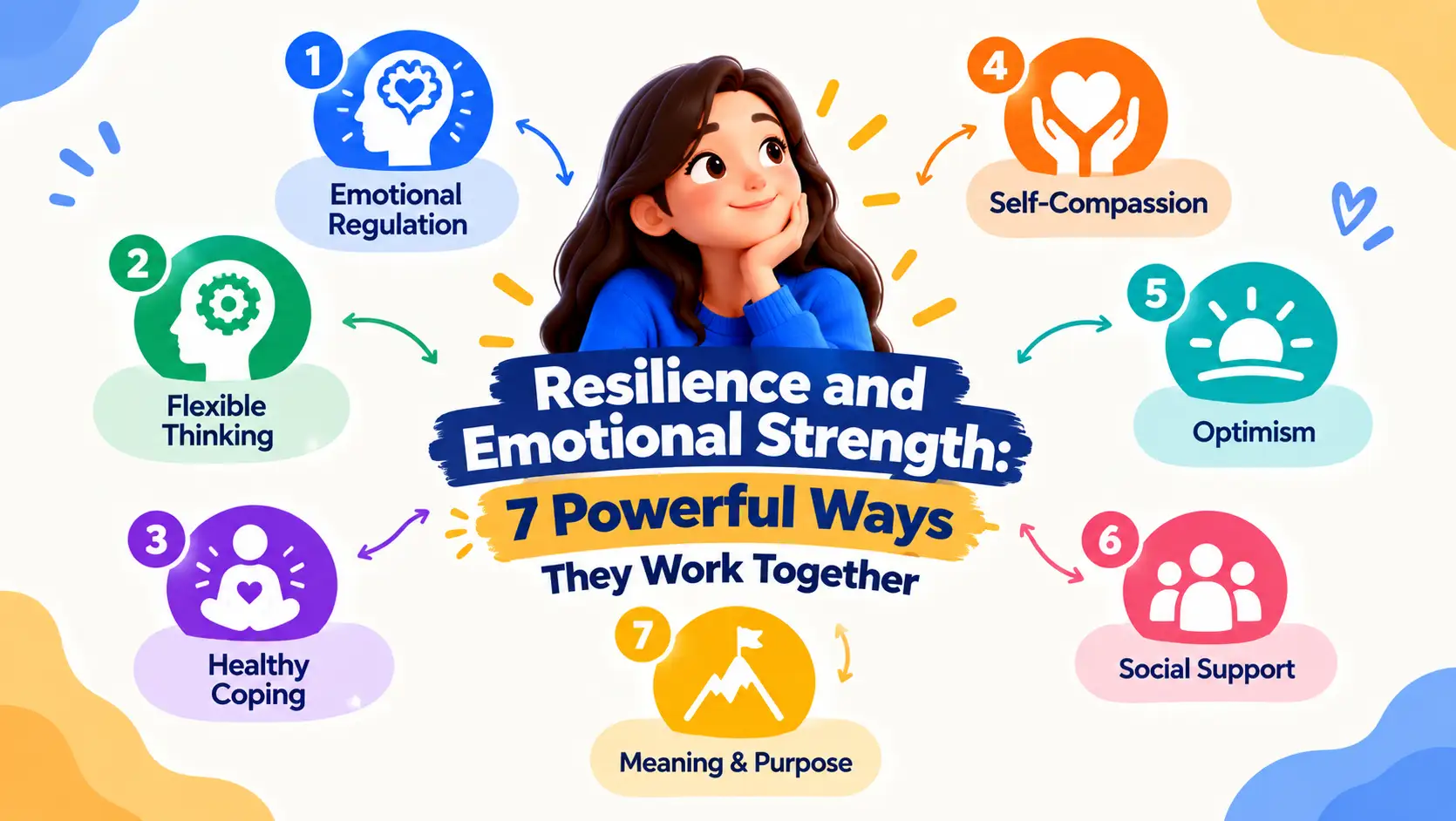
What Are the 7 Core Pillars of Building Emotional Endurance?
The seven pillars of emotional endurance are self-awareness, emotional regulation, cognitive reframing, a sense of control, meaning and purpose, strong relationships, and physical care. Each pillar strengthens either stability, adaptability, or both. Build them together, and your stress recovery speed improves noticeably.
How Does Self-Awareness Build Emotional Strength?
You can’t manage what you can’t name. Self-awareness is the first piece of emotional intelligence (EQ), and it starts with simply labeling what you feel.
Try this. When a strong emotion hits, finish this sentence: “Right now I feel ___ because ___.” Research on affect labeling suggests that naming a feeling can reduce its intensity. “I’m angry” is a start. “I’m embarrassed and it’s coming out as anger” is better.
Keep a two-minute evening note. Write down the strongest emotion of the day and what triggered it. After two weeks, patterns show up.
How Do Emotional Regulation Techniques Help?
Regulation doesn’t mean suppression. Pushing feelings down usually makes them louder later. It means changing how long and how intensely a feeling controls you.
Three techniques worth practicing:
- Slow exhale breathing. Breathe in for four counts, out for six. The longer exhale signals your body to settle.
- The 90-second pause. Wait before replying to anything that makes your blood boil. Most of the physical surge fades within a couple of minutes if you don’t feed it with angry thoughts.
- Grounding. Name five things you can see and three you can hear. It pulls attention back to the present.
For more calming options, see our guide to 7 easy ways to reduce stress.
How Does Cognitive Reframing Make You More Resilient?
Cognitive reframing means looking at a situation from a different angle, so it loses some of its power. It’s the heart of cognitive flexibility.
Psychologist Albert Ellis built a classic tool for this, the ABC Model from Rational Emotive Behavior Therapy (REBT):
- A, Activating event: Your boss criticizes your report.
- B, Belief: “I’m terrible at my job and everyone knows it.”
- C, Consequence: You feel ashamed and avoid your boss for a week.
The event doesn’t create the feeling. The belief does. So challenge B. Ask: “Is this 100% true? What would I tell a friend? What else could this mean?” A more balanced belief might be, “This report had gaps, and now I know what to fix.”
Martin Seligman’s work on learned optimism points the same way. Pessimistic people tend to explain bad events as permanent, personal, and pervasive. Optimists see them as temporary, specific, and changeable. You can learn to shift your explanatory style. Our article on how positive thinking affects the brain explores this further.
Why Does a Sense of Control Matter?
Psychologists call it locus of control. People with an internal locus believe their actions shape outcomes. People with an external locus feel life happens to them.
Nobody controls everything. The skill is sorting. Draw two columns: “I can influence this” and “I can’t.” Spend your energy on the first column. Let the second column go as best you can.
A person facing a health scare can’t control the diagnosis. They can control which questions they ask, how they follow their care plan, and who they lean on. That shift from helpless to active is a core part of adversity quotient, your capacity to handle hardship.
How Do Meaning and Purpose Protect You?
Viktor Frankl, a psychiatrist and Holocaust survivor, wrote in Man’s Search for Meaning that people can endure almost any “how” if they have a “why.” His view was that meaning can be found even in suffering, through purpose, love, or the stance we take toward unavoidable pain.
You don’t need a grand mission. Purpose can be raising your kids well, finishing a degree, caring for a parent, or building something small but real.
Ask yourself weekly: “What did I do this week that mattered to me?” It keeps your values in view when things get hard. It also supports psychological stamina over the long haul.
Why Are Relationships Central to Resilience?
The APA’s resilience guidance puts connection near the top of the list. Supportive relationships offer perspective, practical help, and reassurance that you’re not alone.
Early bonds shape how we seek support as adults. If you want to understand your own patterns, read our explainer on attachment styles.
Quality beats quantity. Two people you can call at midnight are worth more than two hundred acquaintances. Reach out before the crisis, not during it. Send a message today to check in.
Sometimes friends aren’t enough, and that’s fine. A trained professional can teach you tools you can’t easily find on your own. Our talk therapy guide explains what to expect.
How Does Physical Care Support Emotional Endurance?
Your brain lives inside your body. Poor sleep, skipped meals, and no movement make every emotion harder to manage.
The basics matter most:
- Sleep: Aim for a steady schedule. Tired brains overreact.
- Movement: A 20-minute walk can lift mood and burn off stress chemistry.
- Food and water: Low blood sugar worsens irritability.
- Limits on alcohol and doomscrolling: Both can quietly erode recovery.
It isn’t glamorous. It works.
What Are the 7 Cs of Resilience?
The 7 Cs of resilience are competence, confidence, connection, character, contribution, coping, and control. Pediatrician Kenneth Ginsburg developed this model to describe the building blocks of resilient young people, and it applies to adults too. It’s a useful checklist for spotting your weak links.
| The C | What It Means | Quick Self-Check |
| Competence | Feeling capable of handling situations | Do I trust my ability to solve problems? |
| Confidence | Believing in yourself | Do I recognize my strengths? |
| Connection | Having close ties to others | Who would I call in a crisis? |
| Character | Having a clear sense of right and wrong | Do my actions match my values? |
| Contribution | Helping others and the world | Where do I make a difference? |
| Coping | Having healthy stress strategies | What do I do when I’m overwhelmed? |
| Control | Knowing your choices shape outcomes | What can I influence right now? |
Score yourself from 1 to 5 on each. Your lowest two scores become your focus for the next month.
What Daily Exercises Build Emotional Strength and Resilience?
The best daily exercises are short, repeatable habits: a morning intention, a breathing pause, a reframing check, an evening reflection, and one act of connection. Five to ten minutes a day, practiced consistently, beats an occasional big effort. Small reps train your nervous system.
Here’s a simple routine you can follow:
- Morning (2 minutes): Set one intention. “Today I’ll stay calm in the meeting at 2 p.m.”
- Midday (1 minute): Do the 4-in, 6-out breathing. Do it before lunch, before a hard call, or in traffic.
- When something goes wrong (3 minutes): Run the ABC check. Write the event, the belief, and a more balanced belief.
- Afternoon (2 minutes): Text or call someone you care about.
- Evening (3 minutes): Write one hard thing, one thing you handled well, and one lesson.
Make the evening note specific. “I handled it well” says little. “I paused before answering my sister and didn’t snap” gives your brain a real example to build on.
Notice the thoughts running in the background too. Our guide to the mind and thoughts can help you understand how those patterns form.
What Are the Biggest Myths About Mental Toughness?
Mental toughness doesn’t mean suppressing emotions or never asking for help. It means feeling difficult emotions, staying functional, and adapting. The strongest people often have the best support systems. Believing otherwise leads many people to struggle in silence.
Myth 1: Tough people don’t feel pain. They feel it. They just don’t let it make every decision.
Myth 2: Resilience is something you’re born with. Genes and early life play a role, but the APA and other researchers describe resilience as learnable.
Myth 3: Bouncing back means returning to who you were. After a deep loss, people rarely return to the same self. Often they bounce forward, changed.
Myth 4: Asking for help is weakness. It’s a coping skill. Knowing when to get support is part of emotional intelligence.
Myth 5: Positive thinking fixes everything. Forced positivity can backfire. Real reframing is honest. It acknowledges what’s hard and still finds the next workable step.
Myth 6: Pushing through exhaustion proves strength. Chronic overwork often leads to burnout. Recovery is part of endurance, not its opposite.
Some personality styles make these myths more tempting. If you’re a driven, never-slow-down type, you might see yourself in our comparison of Type A vs Type C personality.
When Should You Seek Professional Support?
Seek professional help when distress lasts for weeks, disrupts sleep, work, or relationships, or includes thoughts of harming yourself. Resilience-building is not a replacement for treatment. A licensed mental health professional can assess what’s going on and offer evidence-based care.
Signs it’s time to reach out:
- Feeling hopeless or numb most days for two weeks or more
- Panic that keeps returning
- Using alcohol or other substances to cope
- Trouble functioning at work or home
- Any thoughts of self-harm
If you’re in crisis, contact your local emergency number or a crisis line in your country right away. To learn more about how professionals understand mental health conditions, see our mental health pathology guide.
Frequently Asked Questions (FAQ)
How do emotional strength and resilience differ?
Emotional strength is your ability to stay steady and regulate your reactions during stress. Resilience is your ability to adapt and recover afterward. Strength is the foundation, and resilience is the flexibility. Healthy coping usually needs both.
Can you have emotional strength without resilience?
Yes, though it’s limited. Someone can stay calm under pressure but struggle to adapt or learn from setbacks. Over time, that rigidity can lead to burnout or stagnation. Adding cognitive flexibility and support turns steadiness into true resilience.
What are the 7 Cs of resilience?
The 7 Cs are competence, confidence, connection, character, contribution, coping, and control. Developed by pediatrician Kenneth Ginsburg, the model works as a checklist for the skills and supports that help people recover from adversity.
How do you train yourself to be emotionally strong?
Practice small habits daily. Name your emotions, practice slow breathing, challenge unhelpful beliefs using the ABC Model, get enough sleep, and stay connected with people. Repetition rewires your responses through neuroplasticity, so progress builds over weeks and months.
Why is emotional resilience important for mental well-being?
Resilience helps you recover from stress more quickly, rather than getting stuck in it. People with stronger coping skills tend to handle setbacks with less lasting distress. It doesn’t prevent hardship, but it changes how you move through it.
Conclusion: Where Should You Start?
Resilience and emotional strength are two halves of one skill set. Strength holds you steady. Resilience helps you adapt and grow. You can build both, and you don’t need to overhaul your life to start.
Pick one pillar this week. Maybe it’s the 4-in, 6-out breath. Maybe it’s the evening note. Run it for seven days and see what shifts.
At yourbrainlens, we publish plain-English psychology guides to help you understand your mind and act on what you learn. Explore our psychological theories guide or our brain and psychology study guide next, and share this article with someone who could use a steadier week.