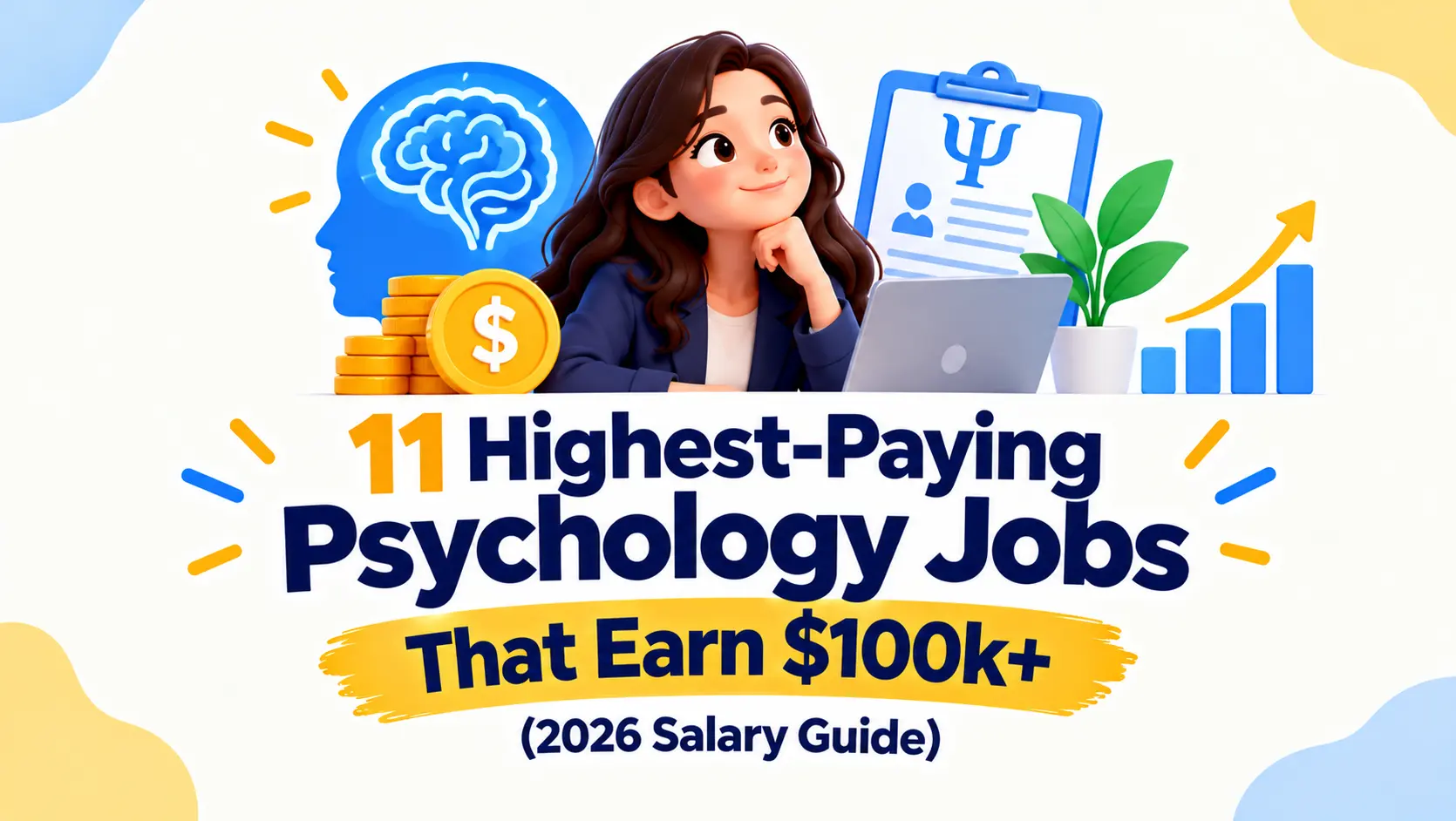
Most people assume psychology careers pay modestly. That’s only half true. A school counselor and a psychiatrist both work in “mental health,” yet their paychecks can sit $150,000 apart. This guide ranks the highest paying psychology jobs by realistic salary range, shows the degree and license each one needs, and answers the big question: do you need a PhD? You’ll also see where a master’s degree can still reach six figures.
What Are the Highest-Paying Psychology Jobs?
The highest-paying psychology jobs are psychiatrist, industrial-organizational (I-O) psychologist, clinical neuropsychologist, and forensic psychologist. Psychiatrists usually top the list because they hold medical degrees. Among non-medical roles, I-O psychology and neuropsychology lead, with many professionals earning $100,000 to $180,000 or more.
Here’s a quick comparison before we go deeper. Figures are typical ranges and shift by state, employer, and experience.
| Rank | Career | Typical Education | Typical Salary Range |
| 1 | Psychiatrist | M.D./D.O. + residency | $250,000–$300,000+ |
| 2 | I-O Psychologist | Master’s or PhD | $110,000–$180,000+ |
| 3 | Clinical Neuropsychologist | PhD/PsyD + fellowship | $110,000–$180,000 |
| 4 | Forensic Psychologist | PhD/PsyD | $90,000–$200,000+ |
| 5 | Human Factors Psychologist | Master’s or PhD | $100,000–$160,000 |
| 6 | Executive Coach / Consulting Psychologist | Master’s or PhD | $100,000–$300,000+ |
| 7 | Private-Practice Clinical Psychologist | PhD/PsyD + license | $100,000–$200,000 |
| 8 | Health Psychologist (hospital/VA) | PhD/PsyD | $100,000–$140,000 |
| 9 | Psychometrician / Quantitative Psychologist | Master’s or PhD | $100,000–$150,000 |
| 10 | UX Researcher | Master’s or PhD | $110,000–$170,000 |
| 11 | School Psychologist (EdS, high-pay districts) | EdS or doctorate | $85,000–$120,000 |
The Bureau of Labor Statistics (BLS) psychologist outlook reports a median wage for all psychologists far below these top figures. That gap tells you something useful: specialty and setting matter more than the word “psychologist.”
How Much Do Psychologists Really Earn Compared With Other Fields?
Psychologists earn a median wage in the mid-$90,000s according to BLS data, but top specialties in business and healthcare pay 50% to 100% more. The average hides a wide spread. Counseling and school roles sit lower, while corporate, medical, and consulting roles climb fast.
Think of psychology pay like a mountain. The base is wide: many roles pay $50,000 to $80,000. The peak is narrow: specialists with advanced credentials, niche skills, or business clients.
If you want a more detailed salary breakdown by role, our psychology career pathways and salary guide covers the full range. For global comparisons, see psychologists’ salaries worldwide.
What Are the 11 Best-Paying Psychology Careers?
The 11 best-paying psychology careers span medicine, business, law, technology, and education. Each rewards a different mix of schooling, licensing, and industry skill. Below, you’ll see what each job does, what it pays, and what it demands.
1. What Does a Psychiatrist Earn?
Psychiatrists are medical doctors (M.D. or D.O.) who diagnose mental illness and prescribe medication. They finish medical school, then a four-year residency. BLS data on physicians and surgeons show that physicians are among the highest-paid workers in the country, and psychiatrists typically earn between $250,000 and $300,000 or more.
The trade-off is time. Expect 12 years of training after high school. Student debt is heavy. Still, the return is the strongest in the field.
2. How Much Do Industrial-Organizational Psychologists Make?
I-O psychologists apply behavioral science to workplaces. They design hiring systems, reduce turnover, build Leadership programs, and study employee motivation. Employers include corporate HR departments, management consulting firms, and federal agencies.
Pay is excellent: roughly $110,000 to $180,000, with consultants and senior leaders earning more through bonuses. I-O is also the rare field where a master’s degree can earn six figures. The Society for Industrial and Organizational Psychology (SIOP) lists programs and career resources. Our guide to the best organizational psychology colleges helps you compare schools.
3. What Does a Clinical Neuropsychologist Earn?
Neuropsychologists study how brain injuries, dementia, and developmental conditions affect thinking and behavior. They give detailed cognitive tests and write reports that guide treatment.
Salaries run about $110,000 to $180,000. Hospitals, rehab centers, and private practices all hire them. The path is long: doctorate, internship, and a two-year postdoctoral fellowship, followed by optional board certification. Related roles appear in our neuroscience jobs guide.
4. Why Do Forensic Psychologists Earn So Much?
Forensic psychologists evaluate people involved in legal cases. They assess competency to stand trial, custody disputes, and risk of reoffending. Some also testify as expert witnesses.
Salaried roles in courts or prisons pay $90,000 to $120,000. Independent experts can charge $200 to $500 per hour, so that total income can pass $200,000. The pay comes with pressure. Your reports can affect someone’s freedom or family.
5. What Is a Human Factors Psychologist?
Engineering or human factors psychologists make products, cockpits, medical devices, and software safer and easier to use. They study how people make errors, then design systems that prevent them.
Employers include aerospace firms, defense contractors, tech companies, and the federal government. Typical pay is $100,000 to $160,000. A master’s degree opens many doors here, which makes it a smart ROI pick.
6. How Much Can an Executive Coach Make?
Executive coaches and consulting psychologists work with leaders on communication, decision-making, and performance. Pay is uncapped. A new coach may earn $100,000. An established one with corporate clients can bill $300 to $1,000 per hour.
A background in psychology helps you stand out in a crowded coaching market because clients trust assessment skills and research-based methods. Credentials matter, but results and referrals matter more.
7. Can Private-Practice Clinical Psychologists Earn Six Figures?
Yes. Clinical psychologists in private practice often earn $100,000 to $200,000 once they build a full caseload. They set fees, choose specialties, and can add testing, supervision, or telehealth.
The path requires a PhD or PsyD, supervised hours, and passing the EPPP licensing exam administered by ASPPB. Startup years can feel lean. Income grows as your reputation does. For fee benchmarks, read our psychologist hourly rate guide.
8. What Do Health Psychologists Earn in Hospitals and VA Systems?
Health psychologists help patients manage chronic illness, pain, and lifestyle change. Many work in hospitals, cancer centers, and VA hospitals.
Government and hospital pay tends to be steady, about $100,000 to $140,000, with strong benefits and loan forgiveness options. If you like medicine but not medical school, this is a solid middle route. Learn more in our medical psychology guide.
9. What Does a Psychometrician Do?
Psychometricians design and validate tests, such as licensing exams, personality assessments, and school tests. They rely more on statistics than on counseling. If you enjoy data, this job pays well, around $100,000 to $150,000.
Testing companies, universities, and HR vendors hire them. Our article on psychology test validity explains the core ideas you’d work with daily.
10. Are UX Researcher Jobs Good for Psychology Majors?
Yes. Tech companies hire psychology graduates to study how people think, click, and decide. UX researchers run interviews, surveys, and experiments, then guide product design.
Pay often ranges from $110,000 to $170,000, and some roles are remote. Many hires hold a master’s or PhD in a research-heavy field. Strong statistics and clear writing set candidates apart.
11. How Much Do School Psychologists Make?
School psychologists test students, support teachers, and plan interventions. The standard credential is an Educational Specialist (EdS) degree, about three years of graduate study.
Typical pay is $70,000 to $100,000, but high-cost states, contract work, and administrative roles can push it past $110,000. It’s not the top of this list, yet it offers strong job security and a short training path.
Which Psychology Degree Pays the Most?
A doctoral degree (PhD or PsyD) or medical degree pays the most in psychology, but a master’s can reach six figures in I-O, human factors, and research roles. Degree level sets your ceiling, while specialty and industry set your actual income.
Here’s how each credential compares:
- Bachelor’s: Entry-level roles, often $40,000 to $65,000. See BA psychology jobs and the Bachelor of Psychology guide.
- Master’s: Opens I-O, UX research, and some consulting roles.
- EdS: Fastest route to school psychology.
- PhD or PsyD: Required for licensed clinical, forensic, and neuropsychology practice.
- M.D./D.O.: Required for psychiatry and prescribing.
Will the whole path pay off? Read our breakdown on whether a psychology major is worth it.
Can You Make $100K With a Master’s in Psychology?
Yes, you can make $100,000 with a master’s in psychology, mainly in industrial-organizational psychology, human factors, UX research, and psychometrics. Business-facing and data-heavy roles pay more than counseling roles at the same degree level.
Three things usually separate six-figure master’s graduates from the rest:
- Industry choice. Corporate, tech, and consulting employers pay more than nonprofits.
- Quantitative skills. Statistics, survey design, and analytics tools add real value.
- Experience. Most reach $100,000 after three to seven years, not in year one.
Short on time? A master’s in I-O psychology is often the fastest route to a high salary without a doctorate.
How Long Does It Take to Become a Board-Certified Neuropsychologist?
Becoming a board-certified neuropsychologist takes about 10 to 14 years after high school. That includes a four-year bachelor’s degree, five to seven years of doctoral study with an internship, a two-year postdoctoral fellowship, and then board certification through ABPP.
Here’s the typical timeline:
| Stage | Time |
| Bachelor’s degree | 4 years |
| Doctoral program (including internship) | 5–7 years |
| Postdoctoral fellowship | 2 years |
| Licensure and ABPP certification | 1–3 years |
Choose an APA-accredited program to avoid licensing roadblocks. Board certification through the American Board of Professional Psychology (ABPP) is optional in many settings. It does boost credibility and pay in hospital and expert-witness work.
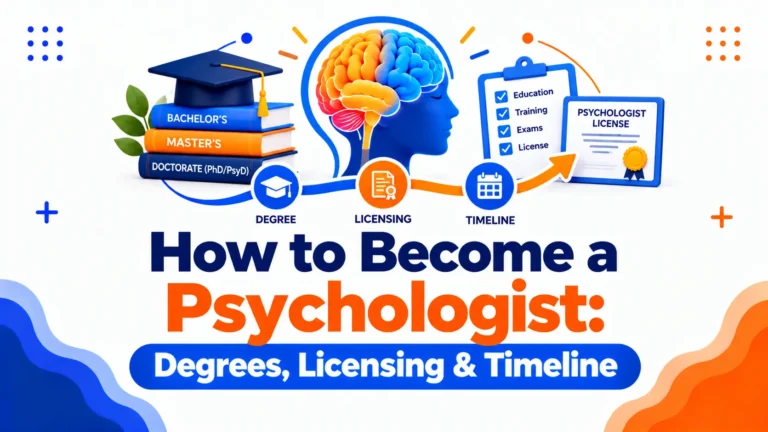
For general steps before specializing, start with how to become a psychologist.
PhD vs. PsyD: Which Pays More?
PhD and PsyD graduates earn similar salaries when they work in the same specialty and setting. The degree matters less than your license, specialty, and experience. A PhD leans toward research; a PsyD leans toward clinical practice.
| Factor | PhD | PsyD |
| Focus | Research and practice | Practice-focused |
| Typical length | 5–7 years | 4–6 years |
| Funding | Often tuition waiver plus stipend | Often self-funded |
| Debt risk | Lower | Higher |
| Best fit | Academia, I-O, research roles | Clinical, private practice |
The real difference is student debt ROI. Funded PhD programs can leave you nearly debt-free, while a costly PsyD may take years of income to recover. Compare total program cost, not just sticker salary.
Is I-O Psychology Higher Paying Than Clinical Psychology?
Yes, industrial-organizational psychology typically pays more than clinical psychology at entry and mid-career levels. I-O psychologists work for businesses with larger budgets, and many earn bonuses. Clinical psychologists can match them, but usually only after building a full private practice.
I-O also has a shorter path. Many professionals start with a master’s. Clinical psychology requires a doctorate and licensure. Yet clinical work offers flexibility, direct patient impact, and lasting income. Pick the field that fits your temperament, not just the paycheck. The BLS psychologist profile shows I-O consistently near the top of wage tables.
Where Are the Highest-Paying Psychology Jobs Located?
The highest-paying psychology jobs cluster in California, New York, Washington D.C., New Jersey, and other large metro areas with corporate and federal employers. The cost of living is high in these places, so compare take-home pay, not just salary.
Remote work is changing the map. Consulting, UX research, I-O work, and telehealth can be done from anywhere. Interstate compacts like PSYPACT allow licensed psychologists to provide telepsychology across participating states, expanding your client base without relocating.
If you’re searching for corporate psychology jobs near you, look at large employers such as consulting firms, banks, tech companies, and federal agencies. Remote roles exist too, particularly in assessment, research, and coaching.
How Can You Maximize Your ROI from Your Psychology Degree?
To maximize psychology degree ROI, choose a high-demand specialty, avoid unfunded debt, and build skills employers pay for, such as statistics, assessment, and consulting. Small choices early on change lifetime earnings.
Practical steps that work:
- Pick a funded program. A tuition waiver plus stipend can save $100,000 or more.
- Learn data skills early. R, Python, and survey design are valuable in nearly every high-paying specialty.
- Seek applied experience. Internships at companies, hospitals, or consulting firms beat extra classroom credits.
- Stack credentials. Board certification, project management, or analytics certificates raise your market value.
- Test the field first. Our guide to the types of psychology helps you match your interests to careers before you commit to years of study.
A real-world example shows the point. Two graduates finish master’s programs in the same year. One takes a counseling job at $52,000. The other joins a consulting firm in talent assessment at $85,000, then reaches $120,000 within five years. Same degree level, very different outcomes, because of specialty and industry.
What Do Experts at yourbrainlens Recommend for Choosing a Path?
YourBrainLens recommends choosing a career by combining three factors: salary range, training length, and daily work you can sustain. A high salary means little if the training drains you or the job doesn’t fit your personality.
Ask yourself:
- Do I prefer people, data, or systems?
- Can I commit to 8 to 12 years of training?
- Do I want clinical work, or business and research settings?
Then explore specific roles. Our research psychologist salary guide is a good next step if data and discovery appeal to you.
Frequently Asked Questions
What type of psychologist makes the most money?
Psychiatrists earn the most overall because they are medical doctors. Among non-medical specialties, industrial-organizational psychologists, clinical neuropsychologists, and consulting or forensic experts usually earn the most. Independent experts with strong client bases can earn more than $200,000.
Do I need a PhD to earn six figures in psychology?
No. A master’s degree can lead to six figures in I-O psychology, human factors, UX research, and psychometrics. A PhD or PsyD raises your ceiling and is required for licensed clinical practice, but it is not the only route to a high income.
What is the difference in pay between a PhD and a PsyD?
Pay is similar when both work in the same specialty and setting. The bigger gap is cost. PhD programs often include funding, while PsyD programs often carry higher tuition, which affects your net return.
Is industrial-organizational psychology higher paying than clinical psychology?
Usually yes, especially early in a career. I-O psychologists work in corporate settings with bonuses and consulting fees. Clinical psychologists can earn comparable amounts, but typically after building a private practice or gaining board certification.
What are the highest-paying psychology jobs without a medical degree?
The top options are I-O psychologist, clinical neuropsychologist, forensic psychologist, human factors psychologist, and executive coach. Most pay $100,000 or more at mid-career. Some require a doctorate, while others accept a master’s degree.
Can you make $100k with a master’s in psychology?
Yes, in the right field. Roles in I-O psychology, human factors, UX research, and psychometrics commonly reach $100,000 after a few years of experience. Counseling roles at the master’s level generally pay less.
Final Thoughts: Which High-Paying Psychology Career Should You Choose?
The highest-paying psychology jobs reward specialization, advanced training, and skills that businesses or hospitals badly need. Psychiatry leads on pay. I-O psychology and neuropsychology lead among non-medical paths. A master’s degree can still reach six figures if you choose the right industry.
Your next step: pick two careers from the table above, research their licensing requirements, and compare program costs this week. Then explore more of our guides at yourbrainlens to map your education and career plan with confidence.