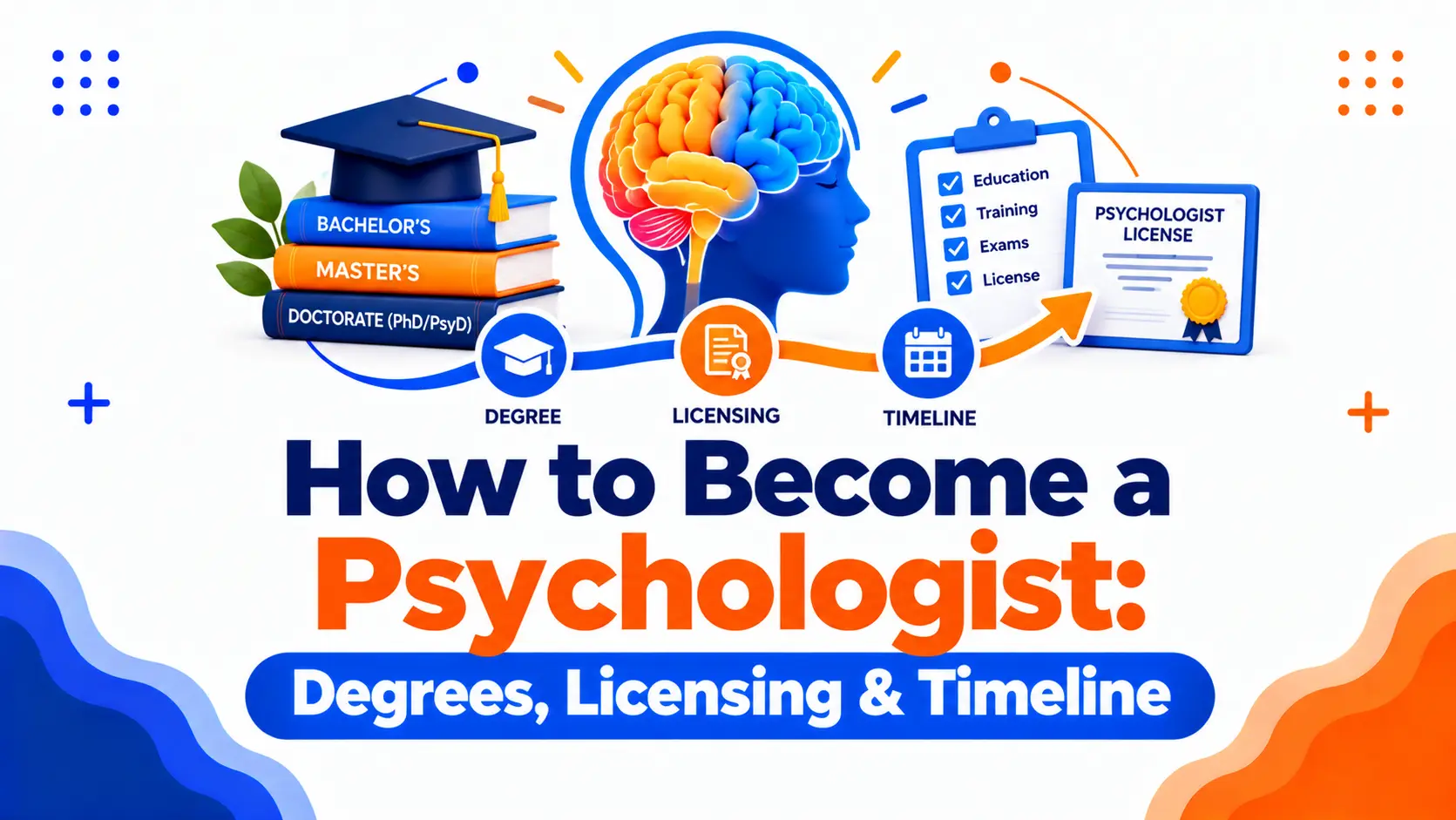
Becoming a professional psychologist is a lengthy process. You’ll need to earn a bachelor’s degree, then a PhD degree, then accumulate thousands of hours of supervised clinical experience, and then pass a battery of national and state licensure examinations. Most persons are fully licensed 8-12 years after high school. This book talks you through every step of the process in plain English: what degree you should get, how accreditation and internships function, what the EPPP actually assesses, and what the timetable and paperwork really look like in 2026.
What Does a Psychologist Actually Do?
Psychologists examine how individuals think, feel, and behave and use this knowledge to assess, diagnose, and treat mental and emotional disorders or conduct research. Some spend their careers at a clinic, seeing patients one on one. Others manage academic labs, consult for corporations, or work inside educational systems. In all 50 states, the label “psychologist” is a protected term, so you can’t call yourself one without a doctorate and state license.
Day-to-day work varies enormously by specialty:
- Clinical psychologists diagnose and treat mental health conditions through therapy and psychological testing.
- Counseling psychologists help clients manage life transitions, relationships, and everyday stress.
- School psychologists support students’ learning, behavior, and emotional development inside K-12 systems.
- Industrial-organizational psychologists apply behavioral research to workplace performance and hiring.
- Research or experimental psychologists design studies and publish findings rather than seeing clients directly — a path covered in more depth in yourbrainlens’s experimental psychologist guide.
If you’re still deciding whether this field fits you at all, it helps first to get oriented to the broader types of psychology before committing to a specific doctoral track.
What Are the Step-by-Step Requirements to Become a Psychologist?
Becoming a licensed psychologist requires four sequential stages: a bachelor’s degree, a doctoral degree, supervised clinical hours, and passing licensing exams. Skipping or reordering these stages isn’t possible — each one is a prerequisite for the next, and licensing boards verify the sequence before granting a license.
| Stage | Typical Length | What Happens |
| Bachelor’s degree | 4 years | Major in psychology, neuroscience, or a related field; build a research resume |
| Master’s degree (optional) | 2 years | Some doctoral programs require this; others admit straight from a bachelor’s |
| Doctoral degree (PhD or PsyD) | 4–7 years | Coursework, research or clinical training, dissertation, predoctoral internship |
| Postdoctoral supervised hours | 1–2 years | 1,500–2,000 hours under a licensed psychologist |
| Licensing exams | 3–6 months | EPPP Part 1, EPPP Part 2 (in most states), and a state jurisprudence exam |
Step 1: Earn a Bachelor’s Degree
The best basis is a major in psychology, biology, or neuroscience. Your major doesn’t matter as much as your research experience . Research experience is very important to doctoral admissions committees . If you worked in a professor’s lab or did an honors thesis in undergrad , that counts for a lot more than your major . Statistics and research methods classes are non-negotiable–almost every doctoral school demands you know them.
Step 2: Decide Whether You Need a Master’s Degree First
Some doctoral programs accept students directly from a bachelor’s degree; others expect a master’s in psychology or counseling first. A standalone master’s degree also opens a faster, separate career track: with two years of graduate study, you can become a Licensed Professional Counselor (LPC), Licensed Marriage and Family Therapist (LMFT), or Licensed Clinical Social Worker (LCSW) — respected clinical roles that don’t require the title “psychologist” or its doctoral-level licensure. If you’re weighing that shorter path against the full doctoral route, yourbrainlens’s psychology career pathways and salary breakdown lay out the trade-offs.
Step 3: Complete an APA-Accredited Doctoral Program
This is the step that determines nearly everything downstream — degree type, internship eligibility, and how smoothly your license transfers between states. It deserves its own section below.
Step 4: Complete a Predoctoral Internship Through the APPIC Match
Every accredited doctoral program requires a full-time, year-long clinical internship, typically around 2,000 hours. Almost all students secure this internship through the APPIC Match, a centralized system run by the Association of Psychology Postdoctoral and Internship Centers that pairs applicants with training sites using a ranked-preference algorithm, similar to how medical residency matching works.
Step 5: Accumulate Postdoctoral Supervised Hours
After the doctorate, most states require another 1,500 to 2,000 hours of supervised clinical work before you’re eligible to sit for licensing exams. A handful of states now allow some or all of this supervised time to happen during the predoctoral internship — check your specific state board, since this rule shifted meaningfully over the past several years.
Step 6: Pass the EPPP and State Licensing Exams
The final gate is exam-based, and it’s substantial enough to warrant its own breakdown further down this guide.
Should You Choose a PhD or a PsyD?
A PhD trains you as a researcher first and clinician second, while a PsyD trains you primarily as a clinician with less emphasis on original research. Both degrees lead to the same license and the same title, but the day-to-day experience of earning them — and the debt you carry afterward — differs substantially.
| Factor | PhD (Scientist-Practitioner / Boulder Model) | PsyD (Practitioner-Scholar / Vail Model) |
| Primary focus | Research, statistics, publishing | Applied clinical skills, assessment, therapy |
| Dissertation | Original empirical research required | Often a clinical or applied project |
| Typical funding | Frequently fully funded via assistantships | Often tuition-based, less funding available |
| Program length | 5–7 years | 4–6 years |
| Best fit for | Academia, research institutes, hospitals with research arms | Full-time private practice, clinical settings |
| Admission competitiveness | Very high, especially at funded programs | High, but generally more seats available |
Neither degree is objectively “better” — the right choice depends on whether you want a career built around generating knowledge or applying it. If private practice is the end goal, a PsyD’s clinical-hours-heavy curriculum often maps more directly onto that work. If you picture yourself running studies, teaching, or working in a research hospital, the PhD’s methodological training pays off for decades. For a deeper look at what a research-focused career actually pays, see yourbrainlens’s research psychologist salary guide.
Whichever degree you choose, confirm the program holds accreditation from the APA Commission on Accreditation. Graduating from a non-accredited program can block you from APPIC-member internships, complicate license transfers between states, and disqualify you from many hospital and government jobs outright.
How Does the EPPP Licensing Exam Work?
The EPPP is a standardized, computer-based exam developed by the Association of State and Provincial Psychology Boards (ASPPB) that every U.S. and Canadian jurisdiction use to license psychologists. Most candidates take it in two parts: EPPP Part 1 (Knowledge), a 225-item multiple-choice test covering eight content domains, and EPPP Part 2 (Skills), which most — though not all — states now require in addition.
Key facts about the exam:
- Content areas include biological bases of behavior, cognitive-affective bases of behavior, social and cultural bases of behavior, growth and lifespan development, assessment and diagnosis, treatment and intervention, research methods, and ethical/legal/professional issues.
- Administration happens continuously through Pearson VUE testing centers, so there’s no fixed test date to wait for.
- Eligibility must be confirmed by your state or provincial board first — you cannot register with ASPPB directly until your board approves you.
- Jurisprudence exams, which test knowledge of state-specific mental health laws, are a separate requirement layered on top of the EPPP in nearly every state.
Candidates typically study for three to six months, often using structured question banks and full-length practice exams, since the pass rate drops noticeably for candidates who wait too long after finishing their supervised hours.
How Long Does It Take to Become a Psychologist, Start to Finish?
Most people spend 8-12 years from the start of their bachelor’s degree to becoming fully licensed psychologists. This is spent roughly as four years of undergraduate study; four to seven years of doctoral training (which includes internship); one to two years of postdoctoral supervised hours; and three to six months of exam preparation and licensing paperwork. Accelerated, fully financed PhD tracks with effective dissertation committees can land closer to the eight-year mark, while part-time programs, research delays, dissertation setbacks or a gap year between degrees might push that timetable above 12 years.
What Is the Career Outlook and Pay for Psychologists?
Demand for psychologists is projected to keep growing steadily, and pay varies enormously by specialty, setting, and geography. According to the U.S. Bureau of Labor Statistics, overall employment of psychologists is projected to grow 7 percent from 2023 to 2033, faster than the average for all occupations, with about 13,000 openings projected each year. That growth is driven by expanding demand for mental health services in schools, hospitals, and outpatient clinics, plus an aging population that needs geriatric-focused psychological care.
Pay depends heavily on setting: private practice clinicians, industrial-organizational consultants, and neuropsychologists in hospital systems tend to earn more than school-based or nonprofit-sector psychologists. If you want the full breakdown by specialty and region, yourbrainlens covers this in detail in the highest-paying psychology jobs guide and the related psychologist hourly rate guide for those considering part-time or contract work. International readers comparing markets can also check worldwide psychologist salary comparisons.
How Is a Psychologist Different From a Psychiatrist or Therapist?
Psychologist Usually has a doctorate, can provide treatment, can undertake psychological testing, but generally cannot prescribe medication. A psychiatrist is a medical doctor who can prescribe and often focuses more on drug management. “Therapist” is a broader, less regulated term that could encompass licensed counselors, social workers and marriage and family therapists – professionals who might have a master’s degree rather than a PhD.
A quick way to keep the three straight:
- Psychologist — Doctoral degree (PhD/PsyD), does therapy and psychological assessment, limited or no prescribing authority depending on the state.
- Psychiatrist — Medical degree (MD/DO), can prescribe medication, often manages more severe or complex psychiatric conditions.
- Therapist/Counselor — Master’s-level license (LPC, LMFT, LCSW), provides talk therapy, cannot prescribe or conduct many formal psychological assessments.
Readers who want a fuller comparison of clinical versus medical mental-health roles can also see yourbrainlens’s medical psychology guide.
2026 EPPP Psychology Exam Roadmap
This video walks through structural changes to the EPPP, how scoring works, and practical preparation strategies for candidates approaching licensure in the current cycle.
Frequently Asked Questions
How long does it take to become a licensed psychologist?
Most candidates need 8 to 12 years total: roughly four years for a bachelor’s degree, four to seven years for a doctoral program, including an internship, one to two years of supervised postdoctoral hours, and a few additional months for licensing exams.
What is the main difference between a PhD and a PsyD in psychology?
A PhD emphasizes research and is often more competitively funded, while a PsyD emphasizes clinical practice and typically involves more out-of-pocket tuition. Both lead to the same license.
Can you practice as a psychologist with only a master’s degree?
No — the title “psychologist” and independent psychological practice require a doctoral degree in nearly every U.S. state and Canadian province. A master’s degree can qualify you as an LPC, LMFT, or LCSW instead.
Do all states require both EPPP Part 1 and Part 2?
No. EPPP Part 1 (Knowledge) is required everywhere, but EPPP Part 2 (Skills) is currently required in most, not all, jurisdictions — always confirm current requirements with your specific state licensing board before registering.
Is a PhD or PsyD better for opening a private practice?
Neither degree is legally superior for private practice. Still, many PsyD programs place greater weight on applied clinical hours, which some graduates find maps more directly onto solo practice work.
How many supervised clinical hours are required before licensure?
Requirements vary by state, but most candidates complete roughly 2,000 hours during their predoctoral internship and another 1,500 to 2,000 hours postdoctorally, for a combined total often in the 3,000–4,000 hour range.
Final Takeaway
Becoming a psychologist is a long path, but it’s a predictable one once you see it broken into stages: bachelor’s degree, accredited doctoral program, APPIC-matched internship, postdoctoral hours, and the EPPP. The biggest decision point — PhD versus PsyD — depends on whether research or clinical practice pulls you more, and the biggest risk to avoid is enrolling in a doctoral program without APA accreditation, which can quietly block internship placement and license portability years later. If you’re mapping out which specialty and setting fit your goals and budget, explore yourbrainlens’s related guides on AP Psychology fundamentals and psychology career pathways to plan your next step with more clarity.