
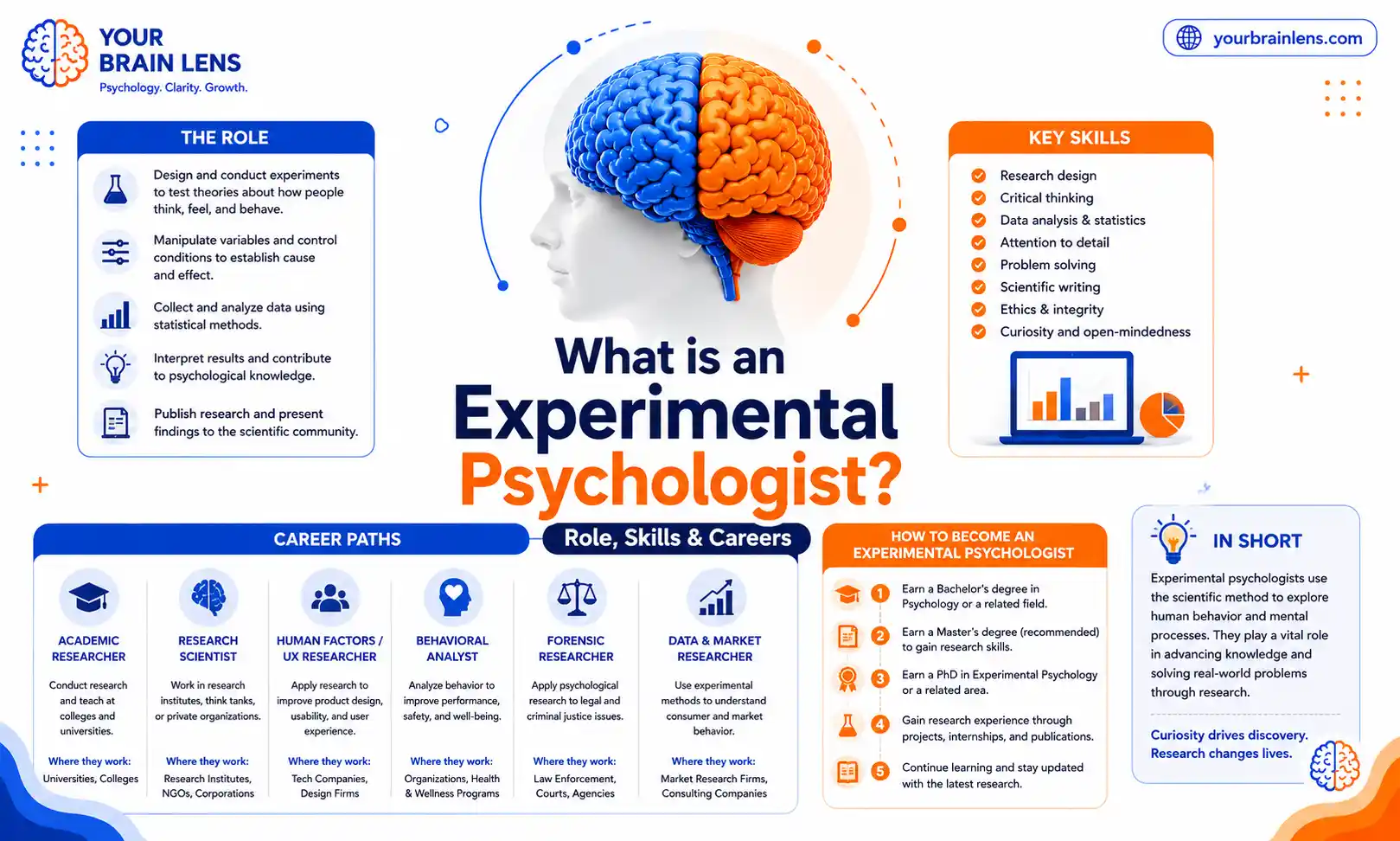
An experimental psychologist studies how people think, feel, and behave by running controlled scientific experiments rather than treating patients. If you’ve ever wondered who designs the memory tests, perception studies, or behavior experiments you read about in the news, this is the person behind the clipboard. This guide breaks down what experimental psychologists actually do, how much they earn, what training the job demands, and how the role differs from clinical practice.
What Is an Experimental Psychologist?
An experimental psychologist is a scientist who uses controlled experiments to study cognitive processes, emotions, and behavior. Unlike therapists, they rarely work one-on-one with clients. Instead, they design studies, collect quantitative data, and publish findings that explain how the human mind operates under specific conditions.
The field traces back to 1879, when Wilhelm Wundt opened the first formal psychology laboratory at the University of Leipzig, treating mental processes as something that could be measured the same way physicists measured light or motion. That founding idea — that behavior and cognition can be studied empirically — still defines the discipline today. Modern experimental psychologists work in labs, universities, hospitals, tech companies, and government agencies, always asking a version of the same question: what causes this behavior, and can we prove it? For a broader look at the field’s roots, see our guide on the formal definition of psychology.
Experimental Psychology Definition: The Short Version
Experimental psychology is the branch of psychology devoted to testing hypotheses about mental processes and behavior through structured, repeatable experiments. It relies on the scientific method: form a hypothesis, manipulate an independent variable, hold everything else constant, measure the outcome, and analyze the data. Researchers in this field study memory, perception, learning, motivation, attention, and decision-making, usually publishing their results in peer-reviewed journals rather than applying them directly in a clinic.
What Does an Experimental Psychologist Do Daily?
Most of an experimental psychologist’s week is spent designing studies, running participants through controlled tasks, and analyzing statistical data — not counseling anyone. A typical day looks less like a therapy session and more like a mix of lab work, spreadsheet analysis, and writing.
Here’s a realistic breakdown of daily responsibilities:
- Designing experiments — building study protocols, choosing which variables to manipulate, and deciding how to measure outcomes
- Recruiting and screening participants — often through university subject pools, online platforms, or community partnerships
- Running sessions — administering tasks, surveys, or reaction-time tests, sometimes using eye-tracking or EEG equipment.
- Cleaning and analyzing data — using statistical software such as SPSS, R, or Python to test whether results are significant
- Writing and submitting research — drafting manuscripts for peer review and applying for research grants
- Teaching or mentoring — many work in academic settings and supervise graduate students
- Presenting findings — sharing results at conferences or translating them into practical recommendations for industry partners
A researcher studying attention span, for example, might spend the morning running a computer-based reaction-time task with 20 participants, the afternoon cleaning the resulting dataset in R, and the evening drafting a section of a grant proposal explaining why the next phase of the study needs funding.
What Research Methods Do Experimental Psychologists Use?
Experimental psychologists rely on controlled experiments as their gold-standard method, but they also draw on quasi-experimental designs, observational studies, and psychometric testing depending on the question. The method chosen shapes how confidently a researcher can claim cause and effect.
A few core building blocks show up in nearly every study:
- Independent and dependent variables: The researcher manipulates one factor (the independent variable, such as sleep duration) and measures its effect on another (the dependent variable, such as reaction time).
- Control groups: A comparison group that doesn’t receive the manipulation, used to rule out other explanations for a result.
- Randomization: Assigning participants to conditions randomly to prevent bias from sneaking into the results.
- Operational definitions: Turning an abstract concept like “stress” into something measurable, such as cortisol levels or a validated self-report scale.
- Replication: Running a study again, often with a different sample, to confirm a finding wasn’t a fluke.
Take a simple example: a researcher wants to know whether background noise hurts memory recall. They’d randomly assign one group to study a word list in silence and another to study it with background chatter playing, then compare recall scores between the two groups afterward. Everything else — the word list, the room, the time limit — stays identical. That single controlled difference is what allows the researcher to say, with reasonable confidence, that the noise caused the performance gap.
Quantitative data dominates the field, but qualitative observation still plays a supporting role, particularly in early-stage exploratory work where a researcher is trying to figure out what’s even worth testing before designing a formal experiment.
What Skills Do Experimental Psychologists Need?
Strong statistical literacy and rigorous attention to research design are the two non-negotiable skills for this career, alongside the writing ability to turn dense findings into readable conclusions.
| Skill Category | Specific Skills | Why It Matters |
| Research Design | Hypothesis formation, control group design, variable isolation | Prevents confounding results and strengthens causal claims |
| Statistical Analysis | Regression, ANOVA, data visualization, R/SPSS/Python | Turns raw numbers into defensible conclusions |
| Scientific Writing | APA-style manuscript writing, grant proposals | Required for publication and funding |
| Ethical Judgment | Informed consent, data privacy, APA ethics compliance | Protects participants and keeps research legally sound |
| Technical Tools | Eye-tracking software, EEG, reaction-time platforms | Enables precise measurement of cognitive processes |
| Communication | Public speaking, science writing, teaching | Needed to present findings and mentor students |
Curiosity matters as much as technical skill. The best experimental psychologists tend to be the ones who keep asking “but why does that happen?” long after a study is finished, which is often what leads to the next research question.
How Do You Become an Experimental Psychologist?
Becoming an experimental psychologist almost always requires a PhD, a process that typically takes four to seven years after a bachelor’s degree. There’s no shortcut through a master’s program alone if independent research is the goal.
The typical pathway looks like this:
- Earn a bachelor’s degree in psychology, cognitive science, neuroscience, or a closely related field. Undergraduate research assistant positions matter enormously here — they’re often what separates competitive PhD applicants from the rest.
- Gain research experience by working in a professor’s lab, presenting at undergraduate research conferences, or co-authoring a publication if possible.
- Apply to PhD programs in experimental, cognitive, or behavioral psychology. Programs vary widely in research focus, so fit with a specific faculty advisor matters more than overall school ranking. Reviewing APA-accredited program listings is a useful starting point, though note that accreditation in this field is most formalized for clinical, counseling, and school psychology tracks — pure experimental programs are evaluated more on faculty research output and publication record.
- Complete coursework and comprehensive exams, usually within the first two to three years.
- Conduct and defend a dissertation, an original research project that typically takes two to four additional years.
- Pursue postdoctoral research or a faculty position, which is common before landing a permanent research role, since postdocs build the publication record needed for competitive academic jobs.
Unlike clinical psychologists, experimental psychologists generally don’t need a state license to practice, since they aren’t providing direct patient care. The credential that matters most is the PhD and the research record that comes with it.
What Is the Salary of an Experimental Psychologist?
Experimental psychologists earn a median salary of $94,000 to $102,000 per year, though pay varies sharply by sector and location. The U.S. Bureau of Labor Statistics groups this role under “Psychologists, All Other,” reporting a median annual wage of $94,310 in May 2024, with the lowest 10 percent earning less than $54,860 and the highest 10 percent earning more than $157,330.
A few factors move that number substantially:
- Sector: Positions in private industry, tech research, and pharmaceutical R&D tend to pay more than academic research roles.
- Location: New Jersey, California, Oregon, and Hawaii consistently rank as top-paying states for psychologists, with median salaries 15 to 25 percent above the national median.
- Experience and publication record: Senior researchers with strong grant histories and publication counts command higher pay than early-career postdocs.
- Degree specialization: Cognitive and neuropsychology-adjacent research roles sometimes pay above the median for general psychologists, particularly in corporate UX research or human factors work.
For context on how this compares across the wider field, psychology career pathways and salary breaks down pay by specialty, and our guide to psychologist hourly rates is useful if you’re comparing research pay against clinical hourly billing.
Is an Experimental Psychologist a Real Doctor?
An experimental psychologist typically holds a PhD, which makes them a doctor of philosophy in psychology, but not a medical doctor (MD). They cannot prescribe medication or diagnose clinical mental health disorders, since their doctorate is research-based rather than clinical.
This distinction trips people up constantly. A PhD in experimental psychology represents years of specialized training in research design and statistics — genuine scientific expertise. Still, it is not equivalent to a medical degree or a clinical psychology doctorate that includes supervised therapy hours and licensure. If someone needs diagnosis or treatment for a mental health condition, they should see a licensed clinical psychologist, psychiatrist, or counselor, not a research-focused experimental psychologist.
Where Do Experimental Psychologists Work?
Most experimental psychologists work in universities and colleges, though a growing share now work in private industry, government research agencies, and healthcare research divisions.
Common employers include:
- Universities and research institutes — the traditional academic path, combining teaching with grant-funded research
- Government agencies — including the National Institutes of Health and Department of Defense research branches, which fund and conduct behavioral studies, often under strict human subjects protection protocols
- Technology companies — UX research, human-computer interaction, and behavioral data science teams increasingly hire psychology PhDs
- Pharmaceutical and healthcare companies — clinical trial design and cognitive assessment research
- Market research and consumer insights firms — applying experimental methods to consumer behavior
- Nonprofit and policy research organizations — studying behavior change for public health or education initiatives.
If you’re weighing this career against other research-adjacent psychology paths, our guides on neuroscience jobs and abnormal psychology jobs cover adjacent fields that share overlapping skill sets but different day-to-day work.
Experimental vs. Clinical Psychology: What’s the Difference?
The core difference is purpose: experimental psychologists conduct research to understand behavior, while clinical psychologists apply psychological knowledge to diagnose and treat patients. Both fields share a scientific foundation, but their training, licensing, and daily work diverge sharply.
| Factor | Experimental Psychologist | Clinical Psychologist |
| Primary Goal | Discover how the mind and behavior work | Diagnose and treat mental health conditions |
| Typical Setting | Research lab, university, corporate R&D | Private practice, hospital, clinic |
| License Required | Generally no | Yes, state licensure required |
| Client Contact | Minimal to none | Extensive, direct patient care |
| Degree Focus | Research methods, statistics | Clinical training, supervised therapy hours |
| Career Outcome | Publications, grants, teaching | Diagnoses, treatment plans, therapy sessions |
Someone drawn to the puzzle-solving side of psychology — designing a study to isolate exactly why a memory failure happens — tends to gravitate toward the experimental path. Someone drawn to helping individual people work through personal struggles usually finds clinical work more fulfilling. Neither is “more scientific” than the other; they’re different applications of the same underlying discipline. For a deeper comparison of subfields, see our overview of types of psychology.
How Ethical Standards Shape Experimental Research
Every experimental psychologist operates under strict ethical guidelines designed to protect research participants, most notably the American Psychological Association’s Ethics Code and federal human-subjects regulations. These aren’t optional guidelines — violating them can end a research career and invalidate published work.
Key ethical requirements include:
- Informed consent — participants must understand what a study involves before agreeing to take part.
- Institutional Review Board (IRB) approval — nearly all university and federally funded research must pass an independent ethics review before data collection begins.
- Debriefing — participants must be told the true purpose of a study afterward, especially if any deception was used
- Data confidentiality — participant data must be stored and reported in ways that protect identity
- Minimizing harm — researchers must weigh the scientific value of a study against any physical or psychological risk to participants.
The APA’s Ethical Principles of Psychologists and Code of Conduct lays out five general principles guiding this work: beneficence, fidelity, integrity, justice, and respect for people’s rights. These principles exist because the field’s early history includes studies that would never pass review today, and they now serve as the backbone of every legitimate experimental study.
Job Outlook for Experimental Psychologists
Employment for psychologists is projected to grow 6 percent from 2024 to 2034, faster than the average for all occupations, according to Bureau of Labor Statistics projections, with about 12,900 openings expected each year over the decade. Growth in research-heavy specialties tends to track closely with funding cycles at universities and federal agencies, as well as rising demand for behavioral data in tech and healthcare.
The expanding use of behavioral science in product design, public health messaging, and AI training data has also opened corporate research paths that didn’t widely exist a decade ago — a shift worth watching if academic positions feel scarce in a given year.
Frequently Asked Questions
What is the difference between experimental and developmental psychology?
Experimental psychology is a method-driven field focused on testing hypotheses about cognition and behavior through controlled studies. Developmental psychology is a topic-driven field that studies how people change across the lifespan, from infancy through old age. A developmental psychologist can, and often does, use experimental methods to study their topic.
Do experimental psychologists see patients?
No. Experimental psychologists design and research studies rather than provide therapy or clinical treatment. Anyone seeking mental health care should look for a licensed clinical psychologist or counselor instead.
Can an experimental psychologist become a clinical psychologist?
Generally not without additional training. Clinical practice requires a clinically focused doctoral program with supervised therapy hours and state licensure, which a research-only PhD program does not include.
How long does it take to become an experimental psychologist?
Expect roughly eight to eleven years total: four years for a bachelor’s degree, plus four to seven years for a PhD, often followed by a postdoctoral research position before landing a permanent role.
What industries hire experimental psychologists outside academia?
Technology, pharmaceuticals, market research, government research agencies, and consumer behavior consulting all actively hire psychology PhDs for research and data-analysis roles.
Where can I find experimental psychologist jobs near me?
University research departments, government job boards, and industry-specific postings (particularly in UX research and behavioral data science) are the most reliable sources, since general job boards often mislabel research roles under generic “psychologist” titles.
Final Thoughts
Experimental psychology sits at the intersection of curiosity and discipline — it’s a career for people who want hard answers about why humans think and act the way they do, backed by data rather than assumption. The path runs through years of specialized training. Still, it opens doors across academia, healthcare, government, and a fast-growing corner of the tech industry that increasingly relies on rigorous behavioral research.
If you’re mapping out where this career fits against other paths in the field, explore our guides on psychological research methods, cognitive psychology, and psychologists’ salaries worldwide to see how this role stacks up. At yourbrainlens, we break down psychology careers like this one so you can make an informed decision before committing years of study to a specific path.





4 thoughts on “What Is an Experimental Psychologist? Role, Skills & Careers”