
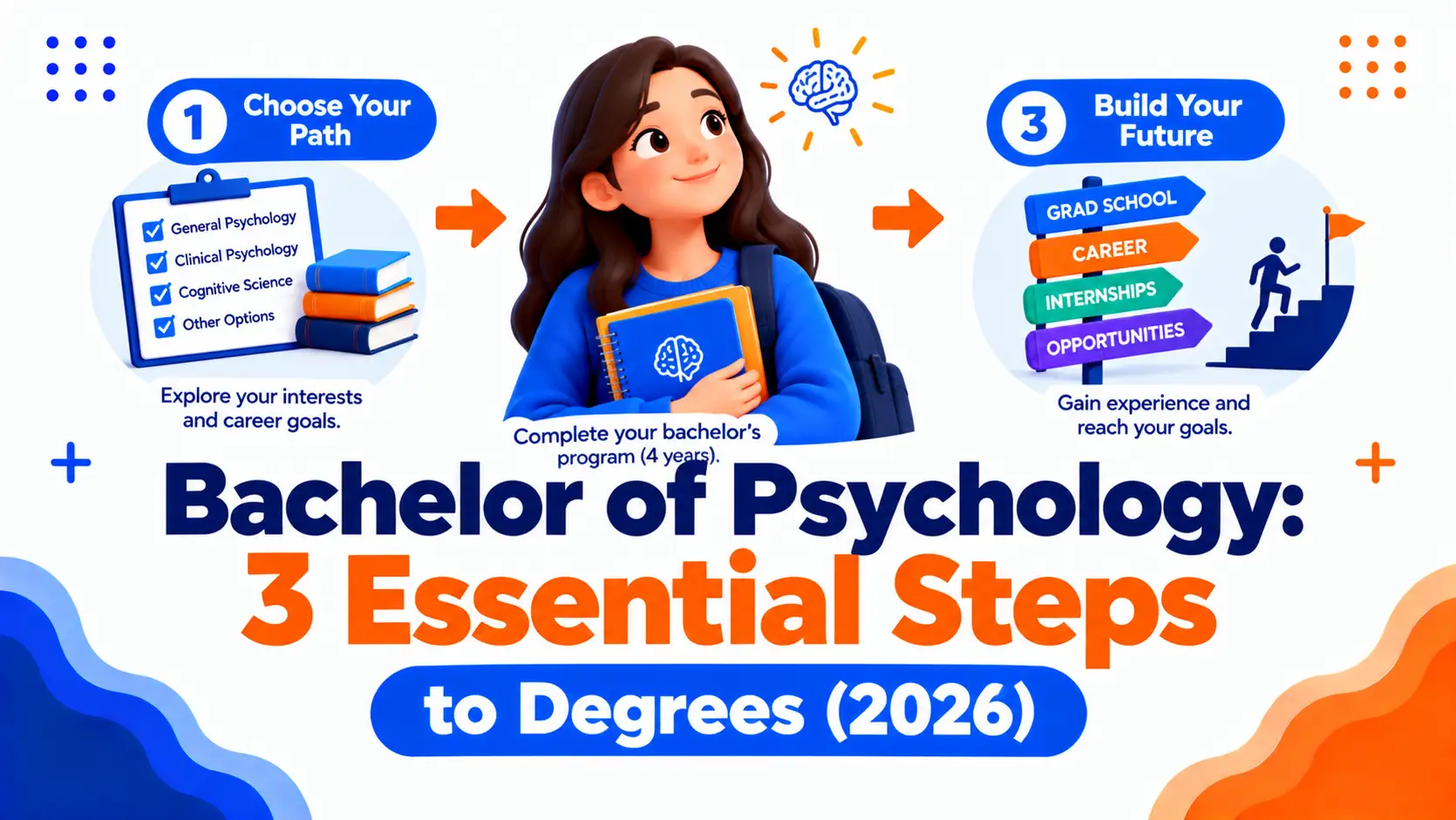
Choosing a psychology degree feels simple until you get into the details. BA or BS? What GPA do you need? How many years will it take? This guide answers all of that in plain English. You’ll get entry requirements for the US, UK, and Australia, a side-by-side track comparison, the courses you’ll actually take, and the jobs that follow. Follow the three steps below, and you’ll know how to get in, plan your years, and finish with a clear career path.
What Is a Bachelor of Psychology Degree?
A Bachelor of Psychology is an undergraduate degree, usually 3–4 years long, that teaches human behavior, cognitive processes, and research methods. It prepares you for entry-level jobs in business and human services. It is also the foundation for graduate study toward clinical licensure.
Think of it as a toolkit. You learn why people think, feel, and act the way they do. You also learn how researchers prove it, which is the part most students underestimate.
At yourbrainlens, we see the same confusion again and again. People assume “psychology degree” means “therapist.” It doesn’t, at least not by itself. If you want the big picture first, our What Is Psychology guide and types of psychology overview are good starting points.
Is It a BA, a BS, or a “Bachelor of Psychology”?
The name depends on the country. In the US, you’ll see a B.A. in Psychology or a B.S. in Psychology. In Australia, universities often use Bachelor of Psychological Science or a plain Bachelor of Psychology. In the UK, it’s usually a BSc in Psychology, sometimes a BA.
The label matters less than what’s inside. Check the course list, not the title.
Step 1: What Are the Entry Requirements for a Bachelor of Psychology?
Entry requirements vary by country, but most programs expect a secondary school diploma, a solid GPA or equivalent grades, and some background in math or science. In the US, that often means a 2.5–3.5 GPA. In the UK, it means A-level grades. In Australia it means an ATAR score.
Requirements shift by university and year, so treat the numbers below as typical ranges, not promises. Always confirm on the school’s admissions page.
What GPA Do You Need in the United States?
Most US colleges accept students with a 2.5 to 3.0 GPA into a psychology major. Selective universities want 3.5 or higher. Many schools also allow you to declare a major in your first or second year, once you’ve passed introductory courses with a B or better.
SAT or ACT scores are optional at a growing number of schools. Check each one. Community college is a legitimate route too. Many students finish two years there, then transfer into a four-year psychology program.
What Are the UK Requirements?
UK universities use UCAS tariff points and A-level grades. Typical offers range from BBB to AAA, which roughly correspond to 112–144 UCAS points. Some courses ask for a science or math subject. The UCAS course search lets you filter psychology degrees and compare offers side by side.
If you want a route to chartered status later, choose a course accredited by the British Psychological Society. That accreditation matters if you plan to become a practitioner in the UK.
What Are the Australian Requirements?
Australian universities rank applicants by ATAR. Psychology cutoffs commonly range from 70 to 90, depending on the institution. Some offer alternative entry through bridging courses or mature-age pathways.
What Are the Common Prerequisites?
Most programs want these before you start:
- English or writing at secondary level
- Basic math, often algebra, because you’ll use statistics
- Biology, helpful but rarely mandatory
- A personal statement at competitive schools
Missing one? Don’t panic. Many universities offer foundation or bridging units. If you’re weighing your whole route, our how to become a psychologist guide maps the full path from high school to licensure.
Step 2: How Is a Bachelor of Psychology Degree Structured?
A typical Bachelor of Psychology takes 3–4 years and about 120 US credit hours, split across general education, core psychology courses, and electives. The first year covers basics. The middle years build research skills. The final year adds specialization, a capstone, or a thesis.
Here’s the usual shape in the US:
| Component | Approx. Credits | What It Covers |
| General education | 40–50 | English, math, humanities, sciences |
| Core psychology | 30–40 | Intro, research methods, statistics, and foundational areas |
| Electives | 20–30 | Specialized topics like health or forensic psychology |
| Capstone / practicum | 3–9 | Thesis, internship, or supervised project |
In the UK and Australia, the timeline is tighter. Most UK degrees run three years (four in Scotland). Australian degrees run three years, with a fourth “honours” year for students headed to graduate study.
How Many Years Does a Bachelor of Psychology Take?
Three years in the UK and Australia. Four in the US and Canada. Part-time study can stretch that to six or more years. Transfer credits and summer classes can shave time off.
What Subjects Are Included in a Bachelor of Psychology?
Most programs teach these pillars:
- Introductory Psychology. The survey course that covers everything briefly.
- Research Methods. How to design studies and avoid bad conclusions. See our psychological research methods guide.
- Psychological Statistics. Often taught with SPSS or R.
- Cognitive Psychology. Memory, attention, and decision-making. Read more in the cognitive psychology guide.
- Developmental Psychology. How people change from infancy to old age. Here’s our developmental psychology guide.
- Social Psychology. Group behavior, conformity, and bias. Start with the social psychology guide.
- Abnormal Psychology. Mental disorders and how they’re classified.
- Biological Psychology. The brain, nervous system, and behavior.
Some students also take theory-heavy courses. Our overview of psychological theories helps you preview what’s coming.
Do You Need Statistics for a Bachelor’s in Psychology?
Yes. Nearly every accredited psychology program requires at least one statistics course and one research methods course. Psychology is a science, and science runs on data. You’ll learn to run tests, read graphs, and spot weak studies.
Don’t let that scare you. Most students find the course far less brutal than its reputation. Professors expect you to interpret results and use software, not do calculus by hand.
BA vs. BS in Psychology: What’s the Structural Difference?
A B.A. leans toward humanities and social context, while a B.S. leans toward biology, advanced statistics, and lab research. Both are full psychology degrees. Neither is “easier” or “better” in general.
| Feature | B.A. in Psychology | B.S. in Psychology |
| Core focus | Humanities, social context, liberal arts | Quantitative research, biology, natural sciences |
| Math and science | Basic statistics, introductory biology | Advanced statistics, chemistry, neuroscience |
| Best for | Counseling, HR, law, marketing, social work | Clinical research, neuropsychology, pre-med |
| Grad pathway | M.A., M.S.W., M.Ed., or J.D. | Ph.D., Psy.D., M.S. in Neuroscience, or M.D. |
| Foreign language | Often required | Usually not required |
Real-world example: a student who wants to become a school counselor might pick the B.A. and take extra child development electives. A student aiming for a neuroscience Ph.D. would choose the B.S. and load up on lab courses.
Does APA or BPS Accreditation Apply to Bachelor’s Degrees?
This one trips people up. The American Psychological Association does not accredit bachelor’s programs. It accredits doctoral programs, internships, and postdoctoral residencies, which matter later if you pursue licensure. In the US, you should focus on your university’s regional accreditation.
The UK works differently. The BPS accredits undergraduate degrees, and graduating from an accredited course gives you the Graduate Basis for Chartered Membership.
Step 3: How Do You Turn a Bachelor of Psychology Into a Career?
A Bachelor of Psychology opens doors to entry-level roles in human services, HR, marketing research, and education, and it’s the required first step toward becoming a licensed psychologist. Most clinical careers need graduate study. Plenty of good jobs don’t.
Your choices in years two and three shape this step more than graduation day does. Here’s how to build the right foundation.
How Do You Gain Experience Before Graduating?
Employers and grad schools want proof you can apply what you learned. Try these:
- Join a professor’s research lab. Even a volunteer role counts. Our list of psychology research assistant jobs shows what these positions look like.
- Complete a practicum or internship. Supervised placements in clinics, schools, or nonprofits are gold.
- Write an honors thesis. It signals serious research skills.
- Learn the tools. SPSS, R, and Excel show up in job postings constantly.
- Build relationships with faculty. You’ll need strong recommendation letters.
What Jobs Can You Get With a Bachelor of Psychology?
Common jobs include case manager, HR specialist, market research analyst, and mental health technician, with many roles paying $40,000–$65,000 depending on location and industry. Those figures are broad estimates, and pay varies widely.
- Human resources. Recruiting, training, and employee relations.
- Market and UX research. Companies pay well for people who understand user behavior.
- Social and community services. Case management, youth work, and advocacy.
- Education support. Teaching assistants, admissions counselors, and tutors.
- Mental health support roles. Behavioral technicians and residential counselors, usually under supervision.
For a deeper breakdown, read our guide to BA psychology jobs in 2026. Interested in the science side? Look at neuroscience jobs or abnormal psychology jobs.
Do You Need a Doctorate After a Bachelor of Psychology?
You need a doctorate to become a licensed clinical or counseling psychologist in most US states, but not for many psychology-related careers. Licensure rules differ by state and country, so check your local licensing board early.
Here’s how the graduate pathways compare:
| Pathway | Typical Length After Bachelor’s | Leads To |
| Master’s (M.A./M.S.) | 2 years | Counseling, school psychology, I/O roles |
| M.S.W. | 2 years | Clinical social work |
| Psy.D. | 4–6 years | Clinical practice |
| Ph.D. | 5–7 years | Research, academia, clinical practice |
The U.S. Bureau of Labor Statistics reports that psychologists earn a median annual wage above $90,000. Growth is projected to outpace the average for all occupations. Our breakdowns of the highest-paying psychology jobs and psychologists’ salaries worldwide show how much education changes pay.
Which Should You Choose: BA or BS in Psychology?
Choose a B.S. if you want to pursue research, medicine, or neuroscience, and a B.A. if you want to pursue counseling, business, law, or social work. If you’re unsure, pick the one at a school you can afford, then adjust your electives.
Ask yourself three quick questions:
- Do I enjoy lab work and data? Lean B.S.
- Do I care most about people, culture, and communication? Lean B.A.
- Do I plan to go to medical school? B.S., plus the pre-med prerequisites.
Many universities let you switch tracks in your second year. So don’t agonize. Your first-year courses will likely overlap.
What Are Frequently Asked Questions About the Bachelor of Psychology?
What is the structure of a Bachelor of Psychology degree?
Most programs combine general education, core psychology courses, electives, and a capstone or practicum in the US that’s roughly 120 credits over four years. UK and Australian degrees run about three years and focus almost entirely on psychology content.
What GPA is needed for a Bachelor of Psychology?
Most US universities accept a GPA between 2.5 and 3.0, while selective schools prefer 3.5 or above. Admissions committees also weigh essays, activities, and course rigor. Always check the specific program’s published cutoffs.
Is a BA or BS in Psychology better?
Neither is better overall. A B.S. suits research, neuroscience, and medical routes, while a B.A. suits counseling, HR, law, and social work. Your career goal should decide, not the label.
What jobs can you get with a Bachelor of Psychology degree?
Graduates work in HR, market research, case management, education support, and mental health technician roles. Licensed clinical practice requires graduate study. You can browse options in our psychology career pathways guide.
How long does it take to complete a Bachelor of Psychology?
It takes three years in the UK and Australia, and usually four in the US. Part-time students may need six years or more. Transfer credits, summer terms, and AP credits can shorten the timeline. Our AP psychology guide explains how high school credit can help.
Do I need a doctorate after earning a Bachelor of Psychology?
Only if you want to practice as a licensed psychologist in most places; many careers in business, education, and human services require only a bachelor’s degree. A master’s degree can open doors to counseling and specialist roles.
Conclusion: What Should You Do Next?
A Bachelor of Psychology rewards people who plan early. Here’s your short list:
- Check entry requirements for your country and target schools.
- Pick your track (B.A. or B.S.) based on the career you want.
- Get hands-on experience through research, practicums, and strong relationships with faculty.
- Map your next step, whether that’s a job, a master’s, or a doctorate.
Start by exploring three university programs this week and comparing their course lists side by side. Then explore more on yourbrainlens, where our guides walk you from your first psychology class to your first career move. Bookmark this page, share it with a friend who’s choosing a major, and take step one today.

2 thoughts on “Bachelor of Psychology: 3 Essential Steps to Degrees (2026)”