
Ever changed your answer in a meeting just because everyone else disagreed with you? Or looked around a room to figure out how to react to something confusing? Those two moments come from different psychological engines. One is about fitting in. The other is about figuring out what’s actually true. This guide breaks down normative and informational social influence, shows you the classic experiments behind them, and explains why the difference actually matters in daily life.
What Is Social Influence in Psychology?
Social influence is the process through which other people’s presence, opinions, or behavior change how we think, feel, or act. It’s a core concept in social psychology, covering everything from casual peer pressure to formal group decision-making. Researchers generally sort the underlying motivations into two buckets: wanting to belong, and wanting to be correct.
Psychologists Morton Deutsch and Harold Gerard first drew this line in 1955, and it’s still the framework used in every introductory social psychology course today. Their distinction gave researchers a way to explain why conformity happens, not just that it happens — and that “why” question turns out to matter a lot when you’re trying to predict whether a behavior change will stick.
Related entities worth knowing before you go further: conformity, compliance, internalization, group dynamics, social pressure, and social approval. You’ll see all of them referenced throughout this piece, so a quick working definition of each helps the rest click into place.
What Is Normative Social Influence?
Normative social influence occurs when a person goes along with a group to be liked or accepted, or to avoid standing out — not because they believe the group is right. It’s driven by social pressure and the desire to fit in. People experiencing it often know the group’s answer is wrong but say it anyway, because looking odd feels worse than being inaccurate.
This is compliance, not conviction. The person’s private opinion usually stays the same, even though their public behavior shifts. That’s the telltale sign of normative influence: an inner voice that disagrees with an outer mouth that goes along with the crowd.
The Asch Line Study: Where Normative Influence Was First Proven
Solomon Asch’s line judgment experiments in the 1950s are the textbook demonstration of normative influence. Participants were shown a line and asked to match it to one of three comparison lines — an easy, unambiguous task. But the room was full of actors instructed to give the same wrong answer out loud, one after another, before the real participant answered.
The result: roughly three-quarters of participants conformed to the incorrect group answer at least once, even though the correct line was obvious. According to a psychology course published through Texas’s public higher-education courseware system, because the line-judging task had an unambiguous correct answer, participants didn’t need the group for information — they conformed to avoid ridicule, which is the hallmark of normative influence rather than informational influence.
Post-study interviews backed this up. Most conforming participants privately admitted they knew the group was wrong. They didn’t want to be the lone dissenter in the room.
Real-Life Examples of Normative Social Influence
- Laughing at a joke you didn’t find funny because everyone else at the table is laughing.
- Agreeing with a coworker’s flawed idea in a meeting because pushing back feels socially risky.
- Dressing a certain way for a new job before you know the actual dress code, to blend in.
- Ordering what your friends order at a restaurant instead of what you actually want.
- Staying quiet about a disagreement with a popular opinion on social media to dodge backlash.
Each example shares the same fingerprint: public agreement, private doubt, and a motive rooted in belonging rather than accuracy.
What Is Informational Social Influence?
Informational social influence occurs when someone conforms because they genuinely believe the group has better or more accurate information than they do. It shows up most in ambiguous, unfamiliar, or high-stakes situations, where a person isn’t confident in their own judgment and turns to others as a shortcut to the right answer.
Unlike normative influence, this type produces real changes in internal belief. The person isn’t just performing agreement — they’ve actually updated what they think is true. Psychologists call this internalization, and it tends to be more durable than compliance because the new belief becomes genuinely the person’s own.
The Sherif Autokinetic Effect Study: Where Informational Influence Was First Proven
Muzafer Sherif’s experiments in the 1930s used a clever illusion called the autokinetic effect: a stationary pinpoint of light in a pitch-dark room appears to drift, because the eye has no fixed reference point to judge it against. There’s no correct answer, which makes it a perfect ambiguous stimulus.
Sherif first tested people alone, and each person settled into their own personal estimate of how far the light moved. Then he grouped participants and had them call out their estimates aloud. Over repeated trials, individual estimates drifted toward a shared group norm. As documented in a summary hosted by Cornell University, the light doesn’t actually move at all — the perceived motion is a byproduct of the brain lacking a stable reference point in total darkness, which is exactly why the task worked so well for measuring informational influence.
What made Sherif’s finding remarkable is how sticky it was. When participants were retested individually — sometimes up to a year later, and even without the original group present — many stuck with the group-influenced estimate. That’s internalization in action: the group’s answer had become the person’s own answer.
When Is Informational Social Influence Most Likely to Occur?
Informational influence tends to spike under a specific set of conditions. Recognizing them helps explain why some situations produce more conformity than others:
| Condition | Why It Increases Informational Influence |
| The situation is ambiguous or unclear | No obvious “correct” answer, so people look outward for cues |
| The task feels difficult or unfamiliar | Low personal confidence pushes people to trust the group |
| A crisis or emergency is unfolding | Time pressure limits independent verification |
| The group is seen as knowledgeable or expert | Perceived competence increases trust in the group’s judgment |
| The person lacks direct experience with the topic | No internal benchmark to compare the group’s answer against |
This is also why brain-imaging research on conformity, summarized in a review published in Frontiers in Neuroscience and hosted by the National Institutes of Health, points to reward-related brain regions activating differently depending on whether someone is conforming for social acceptance or genuinely updating a belief — the two processes aren’t just conceptually different; they’re measurably different in the brain.
What Are the Key Differences Between Normative and Informational Influence?
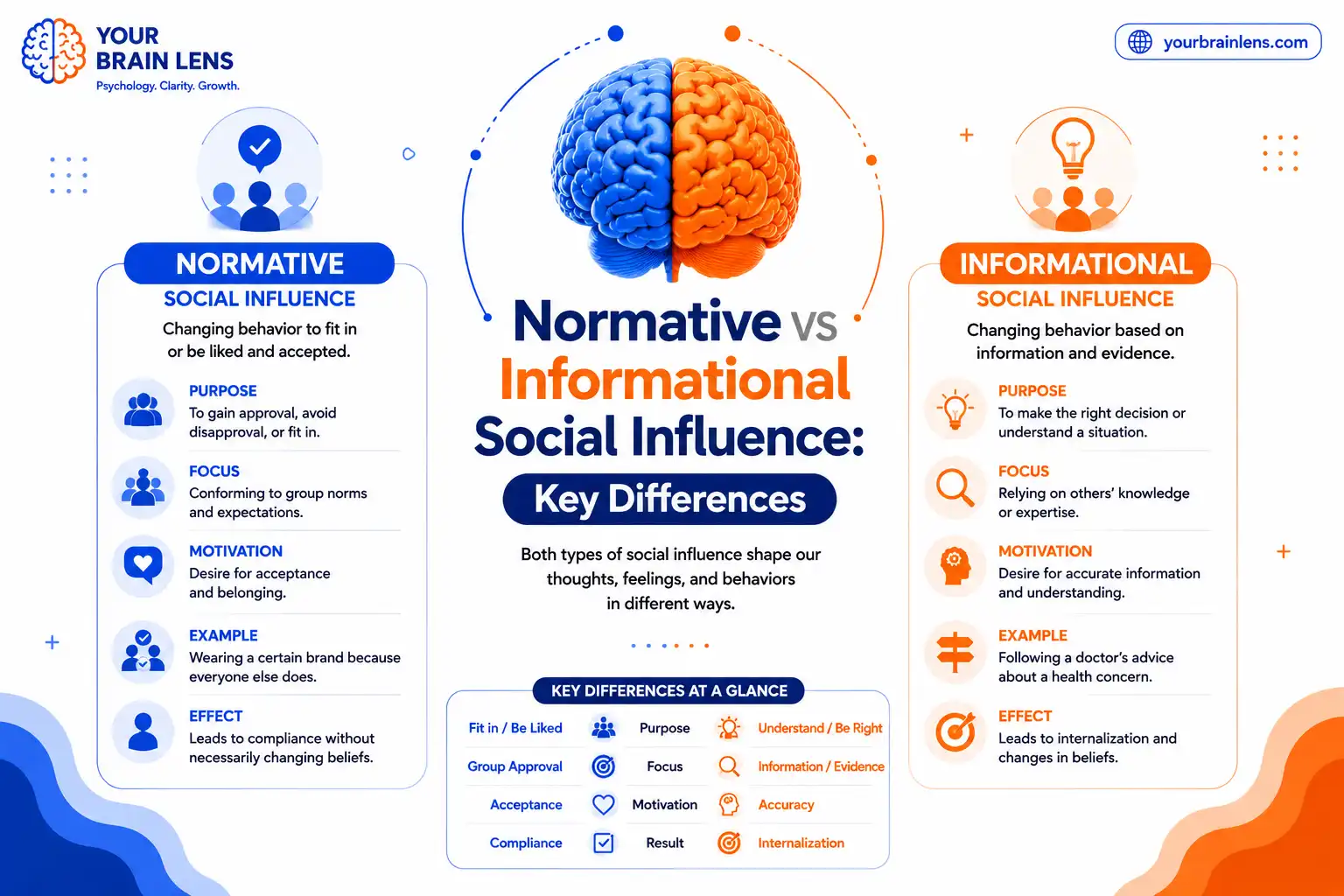
The core difference is motive: normative influence is driven by the desire to fit in, while informational influence is driven by the desire to be correct. One produces surface-level compliance; the other produces genuine belief change. Everything else — how long it lasts, which situations trigger it, and how it was studied — flows from that single distinction.
| Feature | Normative Social Influence | Informational Social Influence |
| Core motive | Desire to fit in / be accepted | Desire to be right / accurate |
| Underlying process | Compliance | Internalization |
| Belief change | Usually surface-level (public only) | Usually genuine (private and public) |
| Best-known study | Asch line judgment experiment | Sherif autokinetic effect experiment |
| Type of task | Unambiguous | Ambiguous |
| Typical trigger | Public settings, peer pressure, fear of rejection | Uncertainty, unfamiliar tasks, lack of expertise |
| Durability | Often fades once group pressure is removed | Often persists even after the group is gone |
| Everyday example | Agreeing with a group opinion you privately doubt | Following a crowd’s lead during an unfamiliar situation |
One useful shortcut for remembering the split: normative influence is about social comfort, informational influence is about cognitive confidence. If you’re asking “will people judge me?” that’s normative. If you’re asking “am I actually wrong here?” that’s informational.
It’s worth noting these two rarely operate in complete isolation. Real-world conformity — inside a jury room, a classroom, or a corporate boardroom — usually involves a blend of motives working simultaneously, in different proportions depending on the situation.
How Does Social Proof Relate to Informational Influence?
Social proof is informational social influence applied to consumer and digital behavior — people assume that what others do or choose reflects the correct or best decision. It’s the psychological engine behind star ratings, “bestseller” labels, and “10,000 people bought this” banners.
Marketers have leaned on this concept for decades because it works on the same mechanism Sherif documented. When a decision feels uncertain (which product is actually good?), people outsource judgment to the crowd. Research on e-commerce behavior published through the National Institutes of Health found that shoppers pay close attention to review content when forming purchase decisions, with negative reviews drawing especially strong scrutiny — a pattern consistent with people treating group feedback as genuine information rather than just noise.
This is informational influence, not normative influence, because the shopper isn’t trying to impress the reviewers. They’re trying to make an accurate choice under uncertainty, using strangers’ opinions as a stand-in for expertise they don’t personally have.
Which Social Influence Leads to Long-Term Behavioral Change?
Informational social influence is far more likely to produce lasting behavioral change, because it changes what a person actually believes rather than just what they say in public. Normative influence, by contrast, often evaporates the moment social pressure is removed — the person reverts because their private opinion never moved in the first place.
This distinction has practical stakes. A workplace safety rule enforced only through peer pressure (normative) may collapse the moment supervision disappears. A safety rule that employees genuinely understand and believe in (informational) tends to hold up even when no one’s watching. Public health campaigns, classroom management strategies, and habit-change programs all perform better when they target belief change instead of surface compliance.
That said, normative influence isn’t “weaker” in every sense — it can produce faster, more immediate shifts in group behavior, which matters in situations like emergency evacuations where speed counts more than personal conviction.
How Do Psychologists Study Social Influence?
Psychologists study social influence using controlled lab experiments, field studies, and structured surveys designed to isolate motive from behavior. Because normative and informational influence can look identical from the outside — both produce conformity — researchers rely on techniques such as private-response conditions, post-experiment interviews, and belief-persistence checks to distinguish between them.
A few common methodological tools:
- Private vs. public response comparisons — if conformity drops sharply when answers are given privately, that’s a signal the influence was normative.
- Delayed retesting — if a person still holds the group’s answer weeks later with no group present, that points to informational influence and internalization.
- Structured interviews and surveys — asking participants directly what they believed versus what they said helps separate compliance from genuine belief change. If you want to see how researchers build these kinds of instruments, our guide to psychology survey examples walks through real question formats used in social psychology research.
- Replication across group sizes — varying how many confederates are present tests whether influence scales with group pressure (normative) or stays flat regardless of numbers (informational).
If you’re studying this topic for a class or an exam, our AP Psychology study guide covers Deutsch and Gerard’s framework alongside the other major theorists you’ll need to know. Our broader psychological research methods resource explains the experimental design choices — like using confederates or ambiguous stimuli — that make studies like Asch’s and Sherif’s replicable and credible.
It also helps to understand how perception itself gets manipulated in these designs. Both studies relied on shaping what people literally saw or judged, which connects directly to broader research on cognitive perception and how the brain fills in gaps under uncertainty.
Why Does This Matter Beyond the Psychology Classroom?
Understanding the difference between these two forces has real value outside of a textbook. Managers use it to design onboarding processes that build genuine buy-in instead of surface-level rule-following. Marketers use it to decide whether a campaign should lean on peer pressure (“everyone’s doing it”) or expert credibility (“proven to work”). Parents and educators use it to figure out whether a child’s good behavior reflects real understanding or just a desire to avoid getting in trouble.
At yourbrainlens, we look at social psychology concepts like this one through a practical lens — not just as exam material, but as tools for reading the behavior happening around you every day. If you’re mapping out where this fits within the wider field, our overview of psychology types and our breakdown of major psychology theorists and key concepts are both useful next stops.
Frequently Asked Questions
What is the main difference between normative and informational social influence?
The desire for social acceptance drives normative influence and produces surface-level compliance. Informational influence is driven by the desire to be accurate and produces genuine belief change, known as internalization.
What is an example of normative social influence?
Agreeing out loud with a group opinion you privately disagree with — like laughing at a joke you don’t find funny — is a classic example. The goal is avoiding social discomfort, not accuracy.
Which social influence leads to long-term behavioral change?
Informational social influence tends to produce longer-lasting change because it alters private belief, not just public behavior. Normative influence often fades once social pressure is removed.
How does social proof relate to informational influence?
Social proof is essentially informational influence applied to shopping and digital decisions — people treat reviews, ratings, and crowd behavior as evidence of the correct choice when they’re personally uncertain.
Can both types of influence happen at the same time?
Yes. Real-world conformity, like in a jury deliberation or a classroom, often blends both motives — wanting to fit in and wanting to be right — rather than being driven by just one.
Who first identified normative and informational social influence?
Psychologists Morton Deutsch and Harold Gerard introduced the distinction in 1955, building on earlier conformity research by Solomon Asch and Muzafer Sherif.
Final Takeaway
Normative and informational social influence answer two different questions people ask themselves in a group: “Will I be judged?” and “Am I wrong?” Asch’s line study proved how far people will bend to avoid standing out. Sherif’s light experiment proved how deeply people will trust a group when they’re genuinely unsure. Knowing which one is driving a behavior — your own or someone else’s — is the first step to responding to it wisely, whether you’re managing a team, raising a kid, or just deciding whether to trust that five-star review.
Want to keep building your foundation in social psychology? Explore our full social psychology guide for more core concepts, studies, and real-world applications.







3 thoughts on “Normative vs Informational Social Influence: Key Differences”