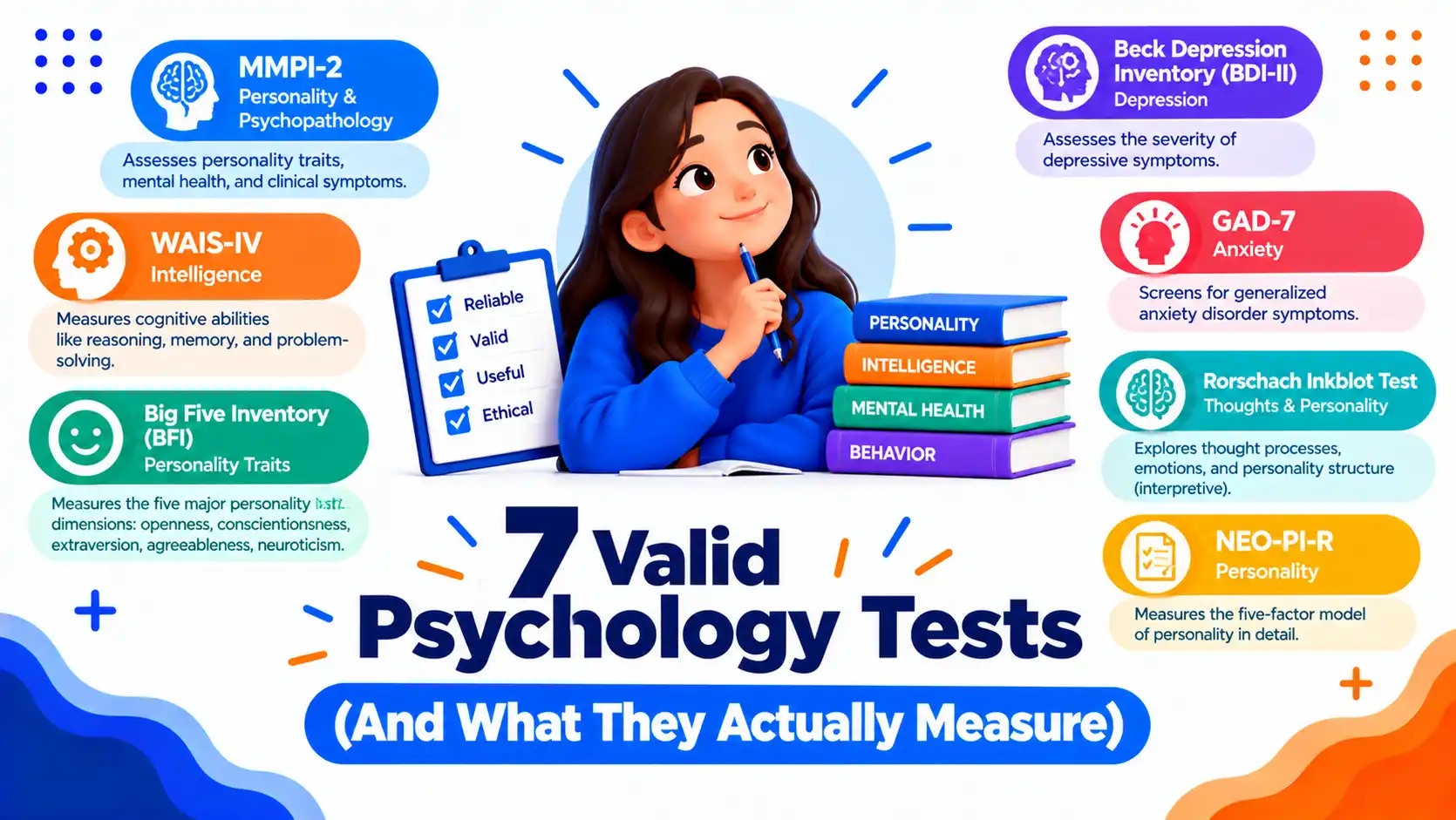
Most people take a personality quiz online and trust the result. Few ask whether the test measures anything real. Some psychology tests rest on decades of research. Others are closer to horoscopes. This guide explains what makes a test valid, walks through seven tests with strong evidence behind them, and shows why popular ones like the MBTI fall short. You’ll leave knowing what your scores mean.
What Makes a Psychological Test Scientifically Valid?
A psychological test is scientifically valid when it accurately measures the trait it claims to measure. Researchers prove this with evidence, not opinion. They check construct, criterion, and content validity, as well as consistency over time. A test needs all of these before professionals trust it.
Validity is a claim that must be earned. The American Psychological Association defines validity as the degree to which evidence supports the way a test’s scores are interpreted and used. Notice the wording. A test is not simply “valid” or “invalid” in the abstract. It is valid for a purpose.
A depression questionnaire may be valid for screening adults in a clinic. It may be useless for predicting who will succeed at a sales job. Same test, different purpose, different verdict.
What Is the Standardization Process?
Before a test reaches the public, its creators standardize it. That means every person takes it under the same rules: the same instructions, the same time limits, the same scoring.
Then comes the norming sample. Developers give the test to a large, carefully chosen group that mirrors the population by age, sex, region, and background. Your raw score gets compared to that group. This is called a norm-referenced score.
If a test says you scored in the 84th percentile, it means you scored higher than 84% of people in the norming sample. The score only has meaning because of that comparison group.
Why Does Statistical Significance Matter?
Researchers also test whether a pattern in the data could be a fluke. Statistical significance tells you how unlikely a result is to be due to chance alone. A test whose scores “predict” outcomes only in a tiny, shaky sample proves little. Strong tests show the same effects across many studies and many groups.
What Is the Difference Between Reliability and Validity?
Reliability is consistency; validity is accuracy. A reliable test gives similar results each time. A valid test measures the right thing. A test can be reliable without being valid, but it cannot be valid without being reliable. Both matter for any psychometric test.
Picture a bathroom scale that always reads five pounds too light. It’s perfectly consistent. It’s also wrong. That’s reliable but not valid.
Psychometricians, the scientists who build and study tests, use two common checks for reliability:
- Test-retest reliability: Do you get a similar score if you take the test again in a few weeks?
- Internal consistency (Cronbach’s alpha): Do the questions on one scale hang together? Alpha runs from 0 to 1. Scores above about .70 are usually considered acceptable. Scores near .90 or higher are considered excellent for clinical tools.
Together these are called a test’s psychometric properties. When a publisher won’t share them, be suspicious.
What Are the Main Types of Validity in Psychological Testing?
The main types of validity are construct, criterion, content, face, and ecological validity. Each answers a different question about a test. Construct validity asks whether it measures the intended construct. Criterion validity asks if scores predict real outcomes. Content validity assesses whether the questions cover the entire topic.
Here’s a quick comparison:
| Type of Validity | The Question It Answers | Simple Example |
|---|---|---|
| Construct validity | Does the test measure the underlying idea (like anxiety or intelligence)? | An anxiety scale correlates with other anxiety scales |
| Convergent validity | Does it match tests of the same idea? | Two depression tests give similar rankings |
| Discriminant validity | Does it differ from tests of unrelated ideas? | A depression test doesn’t just measure general shyness |
| Predictive validity | Do scores forecast future outcomes? | Cognitive scores predicting later school performance |
| Concurrent validity | Do scores match an existing standard right now? | A short screener matches a clinician’s diagnosis made the same week |
| Content validity | Do the questions cover the full topic? | A math exam that includes all taught units, not just one |
| Face validity | Does it look like it measures the right thing? | Questions about sadness on a depression scale |
| Ecological validity | Do results apply to real life? | A memory test that predicts everyday forgetting |
Face Validity vs. Empirical Validity: Why Looks Can Fool You
This is where many online quizzes fail. Face validity means a test looks sensible. Empirical validity means data proves it works. A quiz titled “What Type of Leader Are You?” might feel accurate. That feeling is face validity. It says nothing about whether the results predict anything.
Good tests need both. Face validity helps people take a test seriously. Empirical validity is what makes the scores useful.
What About Ecological Validity?
A test can work in a quiet lab and still miss real life. Ecological validity asks whether results carry over to messy, everyday settings. A concentration task done in a silent room may say little about focus in a busy classroom. Clinicians often pair test scores with interviews and observation for this reason.
How Do Psychologists Determine If a Test Is Valid?
Psychologists test validity by comparing scores against other measures, real-world outcomes, and expert review. They run many studies across different groups. One study never settles it. Validity builds slowly as evidence piles up and gets repeated by independent researchers.
Here’s the process in plain steps:
- Define the construct. What exactly is being measured? “Depression” must be spelled out clearly before writing a single question.
- Write and expert-review the items. Specialists check that questions cover the topic (content validity).
- Pilot test. A small group takes the test. Confusing or biased items get removed.
- Check reliability. Researchers calculate Cronbach’s alpha and run test-retest studies.
- Compare with other measures. Scores should line up with similar tests (convergent) and not with unrelated ones (discriminant).
- Test against real outcomes. Do scores match clinician diagnoses (concurrent) or later behavior (predictive)?
- Norm the test. A large, representative sample sets the scoring benchmarks.
- Replicate and update. Independent labs repeat the work. Tests get revised as science and society change.
For a deeper look at how researchers design these studies, see our guide to psychological research methods. The APA’s testing and assessment resources also explain professional standards for test use.
Which 7 Psychology Tests Are Scientifically Valid?
The seven best-supported tests are the MMPI-3, WAIS-IV, NEO-PI-R/Big Five, BDI-II, PHQ-9, Stanford-Binet 5, and the NEO-PI-3 facet model. All have large norming samples, published reliability data, and decades of validation research. They cover clinical, intelligence, and personality assessment.
Wait. That list repeats the NEO family, so here is the cleaner count. The seven below are the MMPI-3, WAIS-IV, NEO-PI-R (Big Five), BDI-II, PHQ-9, Stanford-Binet 5, and the Beck-style GAD-7 anxiety screener. Each one is tied to a specific purpose.
1. What Does the MMPI-3 Actually Measure?
The Minnesota Multiphasic Personality Inventory-3 (MMPI-3) measures psychological symptoms and personality-related problems. It has 335 true/false items and is published through the University of Minnesota Press.
It does not just ask “are you depressed?” It uses validity scales to catch people who exaggerate, hide problems, or answer randomly. That built-in lie detection is a major reason clinicians rely on it.
Used for: clinical diagnosis support, court evaluations, pre-employment screening for high-stakes jobs.
Scientific status: Strong. Decades of research and multiple revisions.
2. What Does the WAIS-IV Actually Measure?
The Wechsler Adult Intelligence Scale (WAIS-IV) measures cognitive ability. It produces an overall IQ plus four index scores: verbal comprehension, perceptual reasoning, working memory, and processing speed.
Scores are set so the average is 100, with most adults landing between 85 and 115. A trained psychologist gives it one-on-one, usually in 60 to 90 minutes. That’s very different from a free “IQ test” website.
Used for: learning disability evaluation, giftedness, brain injury assessment, ADHD workups.
Scientific status: Strong. One of the most studied IQ tests in the world.
3. What Does the NEO-PI-R (Big Five) Actually Measure?
The NEO Personality Inventory measures the Big Five traits, also called the Five-Factor Model: Openness, Conscientiousness, Extraversion, Agreeableness, and Neuroticism (the “OCEAN” traits). It has 240 items and breaks each trait into six facets.
Unlike type-based quizzes, it treats traits as a sliding scale. You aren’t an “introvert” or “extrovert.” You’re somewhere along a continuum that reflects how people really behave. The Big Five predicts job performance, relationship outcomes, and even some health behaviors better than most rival models.
Used for: research, career counseling, therapy planning.
Scientific status: Strong. The gold standard for personality assessment.
4. What Does the Beck Depression Inventory (BDI-II) Actually Measure?
The BDI-II is a 21-item self-report scale that measures how severe depression symptoms have been over the past two weeks. Each item is scored 0 to 3. Higher totals suggest more severe symptoms.
It is a screening and monitoring tool, not a diagnosis. A clinician still has to interview you. If you’re struggling, the National Institute of Mental Health offers reliable information on depression symptoms and treatment.
Used for: tracking therapy progress, initial screening.
Scientific status: Strong reliability; high alpha values across many studies.
5. What Does the PHQ-9 Actually Measure?
The Patient Health Questionnaire-9 (PHQ-9) is a nine-question depression screener. It’s free, quick, and widely used in primary care. Scores range from 0 to 27.
Its strength is simplicity. Doctors can use it in two minutes. It closely matches diagnostic criteria, supporting its content and concurrent validity.
Used for: primary care screening, tracking treatment.
Scientific status: Strong for screening. Not a stand-alone diagnosis.
6. What Does the Stanford-Binet 5 Actually Measure?
The Stanford-Binet Intelligence Scales, Fifth Edition (SB5) measures five cognitive factors: fluid reasoning, knowledge, quantitative reasoning, visual-spatial processing, and working memory. It covers ages 2 to 85 and beyond, making it useful for young children for whom the WAIS doesn’t apply.
Used for: child cognitive assessment, gifted program placement, developmental concerns.
Scientific status: Strong. Long history of norming and revision.
7. What Does the GAD-7 Actually Measure?
The Generalized Anxiety Disorder 7-item scale (GAD-7) measures how often someone has felt anxious or worried in the last two weeks. Like the PHQ-9, it’s short and clinically tested. It does well at flagging possible anxiety disorders for follow-up.
Used for: screening in clinics and research.
Scientific status: Strong for screening purposes.
Quick Comparison of the 7 Valid Tests
| Test | What It Measures | Who Gives It | Time | Best For |
|---|---|---|---|---|
| MMPI-3 | Symptoms and personality problems | Licensed psychologist | 25–50 min | Clinical and forensic work |
| WAIS-IV | Adult IQ and cognitive skills | Licensed psychologist | 60–90 min | Learning and brain evaluations |
| NEO-PI-R | Big Five traits | Psychologist or researcher | 30–40 min | Personality and career |
| BDI-II | Depression severity | Clinician | 5–10 min | Screening and progress |
| PHQ-9 | Depression symptoms | Doctor or clinician | 2–3 min | Primary care screening |
| Stanford-Binet 5 | Cognitive ability, ages 2+ | Licensed psychologist | 45–75 min | Children and adults |
| GAD-7 | Anxiety symptoms | Doctor or clinician | 2 min | Anxiety screening |
Are the Rorschach and Myers-Briggs Valid?
No, the MBTI lacks strong scientific validity, and the Rorschach has mixed evidence. Both remain popular. Neither meets the standards of the tests above for diagnosing or predicting behavior. Psychologists treat them with caution or use other tools.
Is the Myers-Briggs Type Indicator (MBTI) a Valid Psychological Test?
The Myers-Briggs Type Indicator sorts people into one of 16 types across four either/or categories. That’s the core problem. Real traits, like extraversion, follow a bell curve. Most people sit in the middle. The MBTI forces them into one box or the other.
Research also shows weak test-retest reliability. A sizable share of people get a different type when they retake it a few weeks later. A test that changes your identity from one sitting to the next can’t be measuring a stable trait.
Is it harmless fun? Mostly, in casual settings. It becomes a problem when employers use it for hiring or promotion decisions. Psychologists generally prefer the Big Five because it uses continuous scales and makes more predictions.
What About the Rorschach Inkblot Test?
The Rorschach asks you to describe what you see in ten inkblots. Scoring systems exist, such as the Exner Comprehensive System. Some scores show modest links to certain outcomes. But critics have long questioned whether it reliably diagnoses conditions, and it has produced false positives in research.
The fair verdict: limited. It shouldn’t be the only basis for any major decision. Clinicians who use it typically combine it with interviews and stronger tools.
Is the MBTI the Same as the Big Five?
No. They sound similar but work differently.
| Feature | MBTI | Big Five (NEO-PI-R) |
|---|---|---|
| Format | 16 fixed types | Five continuous traits |
| Test-retest reliability | Weak to moderate | Strong |
| Predicts job performance | Poor evidence | Good evidence |
| Used by researchers | Rarely | Widely |
| Scientific status | Not recommended for decisions | Gold standard |
To see how personality ideas connect to everyday patterns, read our guides on attachment styles and negative personality traits. You might also like our comparison of Type A vs. Type C personality, which shows how popular labels differ from measured traits.
Are Online Personality Tests Scientifically Valid?
Most free online personality tests are not scientifically valid. They rarely publish reliability data, norming samples, or validation studies. A few, based on the Big Five, can be reasonably informative. The majority are entertainment designed to be shared.
Use this quick checklist before trusting any online test:
- Does it publish its research? Look for reliability and validity numbers.
- Is it based on the Big Five or another tested model? Be wary of made-up types.
- Was it normed on a real sample? Vague claims like “millions have taken it” don’t count.
- Does it avoid sweeping promises? “Discover your true self” is a red flag.
- Is it checked against a database like PsycTESTS? The APA’s database catalogs thousands of tests and their development details.
- Does it say what it can’t do? Honest tests state their limits.
Here’s a practical example. Say an online quiz tells you you’re “an INFJ, rare and deeply intuitive.” Ask: would you get INFJ again next month? If you’re unsure, the result carries little weight. Compare that to a Big Five report showing you’re at the 70th percentile for conscientiousness. That number rests on a norming sample and stable scales.
How Do You Find a Valid Psychological Test Near You?
Look for a licensed clinical psychologist who uses standardized, published tests. Ask which tests they use and why. Reputable professionals are happy to explain. A real evaluation combines test scores with an interview, history, and observation, never a single score alone.
If you’re searching for a psychological testing center near you, or a psychological evaluation for adults in your city or state, use this approach:
- Check licensure. Look up the psychologist on your state licensing board’s website. Board certification adds another layer of credibility.
- Ask about the tests. For a valid ADHD assessment, a good evaluation includes clinical interviews, rating scales, and often cognitive testing. A single online checklist isn’t enough.
- Ask about their process. How long does it take? Will you get a written report?
- Confirm the purpose. Tell them why you want testing, so they pick the right tools.
- Check insurance and costs. Full evaluations can cost hundreds to thousands of dollars, so ask upfront.
Curious how psychologists turn test results into a written document? See our psychological report guide and this case profile example. If you’re interested in the profession itself, read how to become a psychologist.
What Do Your Test Scores Actually Mean?
A test score is an estimate, not a verdict. Every score carries some measurement error. It describes how you responded on one day, compared with a norming sample. It does not define you, and it does not predict your future with certainty.
Keep these ideas in mind:
- Scores are snapshots. Mood, sleep, and stress can shift results.
- Percentiles beat labels. “Higher than 70% of adults” says more than “high.”
- Screeners flag; clinicians decide. The PHQ-9, GAD-7, and BDI-II indicate the need for follow-up. They don’t diagnose.
- Context matters. Culture, language, and disability can affect how fair a test is for a given person.
At yourbrainlens, we aim to explain psychology clearly and honestly, including where the science is shaky. For broader background, start with our guide to the types of psychology or our overview of mental health and pathology.
Frequently Asked Questions
What makes a psychological test scientifically valid?
A psychological test is valid if it accurately measures the specific trait or construct it claims to assess. Scientific validity requires rigorous empirical testing, including high construct, criterion, and content validity, as well as strong test-retest reliability.
What is the difference between reliability and validity in psychology?
Reliability refers to the consistency of a test’s results over time, while validity measures whether the test accurately measures what it was designed to measure. A test can be reliable without being valid, but it cannot be valid without being reliable.
Which personality tests are considered scientifically valid?
The most scientifically valid personality assessments are the NEO Personality Inventory (Big Five/OCEAN) and the Minnesota Multiphasic Personality Inventory (MMPI). Both undergo rigorous empirical validation and standardization.
Is the Myers-Briggs Type Indicator (MBTI) a valid psychological test?
No, the MBTI lacks strong scientific validity and test-retest reliability according to modern psychometric standards. Psychologists generally prefer the Five-Factor Model (Big Five) because it relies on continuous traits rather than rigid categories.
What does the MMPI test actually measure?
The MMPI-3 measures psychological symptoms, emotional problems, and personality-related patterns through 335 true/false items. It also includes validity scales that detect exaggeration, hiding, or careless answers. Clinicians use it to support diagnosis, not to replace an interview.
How can I tell if an online personality test is valid?
Check whether the test reports reliability data, uses a norming sample, and is based on a tested model, such as the Big Five. If it only offers catchy type labels and big promises, treat it as entertainment rather than assessment.
Conclusion: What Should You Do Next?
Valid psychology tests share three things: they’re standardized, they’re reliable, and research shows they measure what they claim to measure. The MMPI-3, WAIS-IV, NEO-PI-R, BDI-II, PHQ-9, Stanford-Binet 5, and GAD-7 meet that bar. The MBTI and Rorschach don’t, at least not for serious decisions.
Your next steps:
- Treat free online quizzes as entertainment unless they publish their research.
- If you need a real assessment, find a licensed psychologist and ask which tests they use.
- Remember that a score is a snapshot, not a label.
Want to keep learning? Explore more science-based guides at yourbrainlens, and start with our breakdown of psychological research methods to see how these tests get built and checked.
This article is for education only. It isn’t medical or psychological advice. If you’re worried about your mental health, talk to a licensed professional.