Some people burst through life like a slammed door — competitive, wound tight, allergic to waiting rooms. Others go quiet, swallow their frustration, and keep the peace even when it costs them. Psychologists call these patterns Type A and Type C personality. Both were born from medical research, both shaped decades of thinking about stress and disease, and both remain widely misunderstood. This guide breaks down what separates them, where the science holds up, and where it doesn’t.
What Is the Difference Between Type A and Type C Personality?
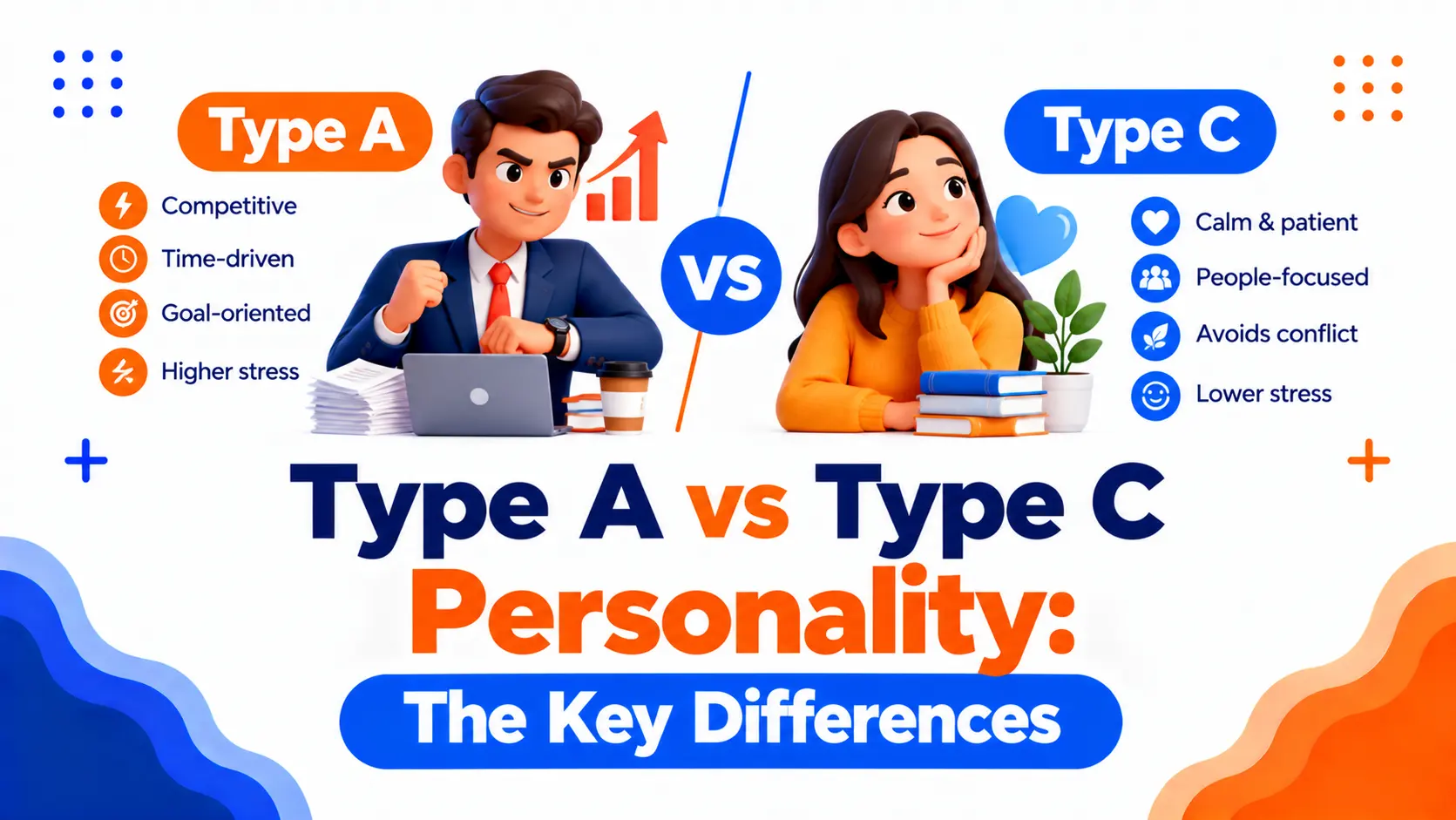
Type A personality describes a competitive, impatient, hostile-under-pressure behavior style, while Type C describes a passive, emotion-suppressing, harmony-seeking coping style. Type A people push outward — driving hard, racing clocks, getting irritated fast. Type C people push feelings inward, avoiding conflict and prioritizing others’ needs over their own, sometimes at a real personal cost.
Neither term describes a fixed, unchangeable identity. Both grew out of clinicians noticing behavioral patterns in patients and then trying (with mixed success) to connect those patterns to physical illness.
Who Discovered Type A Personality, and Why?
Cardiologists Meyer Friedman and Ray Rosenman coined “Type A behavior” in the late 1950s after noticing a strange pattern in their own waiting room. An upholsterer repairing their office chairs pointed out that only the front edges and armrests were worn down — as if patients couldn’t sit still. That observation led Friedman and Rosenman to study competitive, time-pressured, hostile behavior as a possible driver of heart disease.
Their 1959 paper in the Journal of the American Medical Association and their later book, Type A Behavior and Your Heart, turned the term into a household phrase. A long-running study of over 3,000 healthy men found that those with Type A traits developed coronary heart disease at notably higher rates than their more relaxed Type B counterparts.
The story got more complicated from there. Subsequent research, including a large NIH-funded review published in CMAJ, found the results were inconsistent when other scientists tried to replicate them. It also came out that some of the follow-up research into Type A and hostility was funded by tobacco companies eager to shift attention away from smoking as a cardiovascular risk factor. That funding history doesn’t erase the original findings, but it’s a reason researchers now treat sweeping claims about Type A and heart disease with more caution than the 1970s public did.
What survived the scrutiny is narrower and more specific: hostility, not ambition or competitiveness on its own, is the piece of the Type A pattern most consistently linked to cardiovascular strain.
What Is Type C Personality?
Type C personality, introduced by psychologist Lydia Temoshok in 1981, describes a coping style built around suppressing negative emotion, avoiding conflict, and prioritizing others’ comfort over one’s own. Temoshok developed the concept while studying melanoma patients who described themselves as calm, cooperative, and rarely angry — even in circumstances that would frustrate almost anyone.
The term got popularized as the “cancer-prone personality,” a label that stuck far harder than the research ever justified. Temoshok herself has pushed back on that framing, clarifying that Type C describes a way of coping with stress and illness, not a trait that causes cancer to develop in the first place. According to the National Cancer Institute’s fact sheet on psychological stress, there is no solid evidence that stress directly causes cancer. However, chronic stress can influence how the body responds once illness is present and can encourage habits — poor sleep, smoking, inactivity — that raise risk indirectly.
That distinction matters. Someone with Type C traits hasn’t done anything to bring illness on themselves. The research points to a coping style that can make it harder to notice and respond to their own needs during stressful periods, including medical ones.
Type A vs Type C: Comparison Table
| Trait Dimension | Type A Personality | Type C Personality |
| Core Trait | Highly competitive and driven | Detail-oriented and accommodating |
| Stress Response | Frustration, anger, impatience | Suppression, avoidance, stoicism |
| Primary Health Association | Cardiovascular risk, hypertension | Immune changes, chronic fatigue |
| Interpersonal Style | Dominant, assertive | Passive, overly agreeable |
| Emotional Expression | Outward, sometimes explosive | Inward, restrained |
| Relationship to Conflict | Seeks it out, sometimes creates it | Avoids it at almost any cost |
What Are the Core Traits of a Type A Personality?
Someone with strong Type A tendencies tends to show most of the following:
- Time urgency — a constant sense of racing the clock, even during low-stakes moments like standing in line
- Competitiveness — turning ordinary situations into contests, even ones nobody else is playing
- Hostility and impatience — quick frustration, low tolerance for delay, occasional outbursts
- High achievement drive — packing more into a day than is realistically possible
- Difficulty relaxing — treating downtime as wasted time
Not every Type A trait carries the same health weight. As noted above, hostility specifically — not ambition or drive — is the component most tied to cardiovascular strain in follow-up research.
What Are the Core Traits of a Type C Personality?
People with Type C patterns typically show:
- Emotional suppression — burying anger, sadness, or frustration rather than expressing it
- Excessive patience and appeasement — going along with others’ preferences even at personal cost
- Perfectionism paired with self-neglect — high internal standards, low self-advocacy
- Need for harmony — discomfort with conflict, sometimes to the point of avoiding necessary confrontations
- Outward calm — appearing composed or even cheerful while privately overwhelmed
The overlap with perfectionism is worth noting. A Type C individual isn’t simply “nice.” They’re often managing a great deal internally while presenting very little of it outwardly.
How Do Type A and Type C Handle Stress Differently?
Type A stress shows up outward as anger, urgency, and physical tension, while Type C stress turns inward as suppression, fatigue, and quiet endurance. Both patterns activate the body’s stress-hormone systems, including cortisol and adrenaline, but their behavioral expressions look almost opposite. A Type A person under pressure might snap at a coworker; a Type C person under the same pressure might smile, agree to take on more work, and say nothing.
Chronic activation of stress hormones affects the body regardless of whether the emotion flows in one direction or the other. For Type A individuals, that often shows up as elevated blood pressure and cardiovascular strain. For Type C individuals, researchers have hypothesized effects on immune regulation, though the evidence here is thinner and more contested than the Type A–cardiovascular link. If you’re looking for practical ways to interrupt either pattern, a good starting point is to build in structured practices to reduce daily stress rather than waiting for a crisis to force the issue.
What Are the Health Risks Associated with Each Personality Type?
Type A behavior has the longer research trail, largely because it grew out of cardiology rather than oncology. The strongest, most replicated finding is the hostility-to-cardiovascular-risk link — not a blanket claim that ambitious or driven people are doomed to heart trouble. Large studies, including the Western Collaborative Group Study that launched the whole field, found Type A men developed coronary heart disease at meaningfully higher rates, though most Type A individuals in that study never developed heart disease at all.
Type C’s health claims are shakier by comparison. The “cancer-prone personality” label oversold what the data supports. What some studies do suggest is that chronic emotional suppression may influence immune functioning and how people cope with an existing illness — not that personality alone determines who gets sick. The CDC’s National Institute for Occupational Safety and Health makes a related point about workplace stress more generally: organizational and behavioral factors compound one another, and no single trait operates in isolation from the environment, workload, or support systems.
Anyone reading this with health anxiety about their own personality style should take one thing away clearly: personality traits are patterns, not diagnoses, and they are not a sentence.
How Does the Big Five Model Compare to Type A and Type C?
Type A and Type C are older, category-based models, whereas the Big Five (Five-Factor Model) measures personality along five continuous dimensions rather than sorting people into boxes. The Big Five — openness, conscientiousness, extraversion, agreeableness, and neuroticism — is the model most contemporary personality researchers actually use, because it doesn’t force anyone into an either/or bucket.
Mapped loosely onto the Big Five, Type A traits overlap with low agreeableness and high neuroticism (particularly the hostility component). In contrast, Type C traits overlap with high agreeableness and high conscientiousness, and are paired with a tendency to suppress rather than express negative emotions. If you’re studying core psychological theories for a class or want a more precise self-assessment than “which letter am I,” the Big Five framework is worth exploring alongside the Type A and Type C frameworks.
Where Do Type B and Type D Personalities Fit In?
Type A and Type C don’t exist in a vacuum. Type B personality sits at the relaxed end of the Type A spectrum — patient, easygoing, less driven by clocks and competition. Type D personality (“distressed” personality) is a newer, more clinically grounded concept combining negative emotionality with social inhibition, and it has more consistent research support linking it to worse outcomes in existing cardiac patients than the original Type A model ever achieved. Readers building out a broader study guide on personality theories will run into all four labels — A, B, C, and D — often used loosely and sometimes inconsistently across sources.
Can Someone Be Both Type A and Type C?
Yes. These categories describe behavior tendencies, not fixed identities, and most people show a mix. Someone might be Type A at work — competitive, impatient, driven to win — and Type C at home, suppressing frustration to keep family peace. Context, relationship dynamics, and even specific life stages can shift which pattern dominates. A useful way to think about it: Type A and Type C describe how someone tends to handle pressure, and pressure looks different across different parts of a person’s life.
How Do You Know If You’re Type A or Type C?
A few honest self-check questions can point you in the right direction:
- Do you feel physically restless or irritated when forced to wait?
- Do you find yourself agreeing to things you don’t actually want to do, to avoid conflict?
- When something upsets you, do you say so immediately, or does it sit quietly until it builds up?
- Do coworkers or family members describe you as intense, or as unusually calm and accommodating?
- After a stressful day, do you feel wound up, or numb and depleted?
Answers clustering around competitiveness, urgency, and visible frustration point toward Type A. Answers clustering around suppression, appeasement, and quiet exhaustion point toward Type C. Many people will see themselves in both lists — that’s normal, and it’s part of why researchers increasingly favor dimensional models like the Big Five over rigid categories.
Type A vs Type C in the Workplace
Workplace behavior is where these two patterns show up most visibly. A Type A employee tends to drive projects forward fast, push back openly in meetings, and get frustrated by inefficiency or delay. A Type C employee tends to absorb extra work quietly, avoid pushing back even when overloaded, and keep team harmony intact — sometimes at the expense of their own bandwidth. Understanding which pattern dominates within a team can shape everything from how deadlines are set to how conflict is resolved. It’s a growing part of corporate wellness and occupational health conversations, an area covered in more depth by agencies like NIOSH.
If you’re weighing career paths where these traits play a bigger or smaller role, it’s worth browsing broader psychology career pathway resources to see where personality-aware roles like HR, coaching, or clinical psychology intersect with this kind of research.
Frequently Asked Questions
What is the main difference between Type A and Type C personality?
Type A is an outward, competitive, impatient behavior pattern historically linked to cardiovascular risk. Type C is an inward, emotion-suppressing coping style associated with appeasement and self-neglect, historically linked (more loosely) to immune and chronic illness patterns.
Is a Type C personality the opposite of a Type A personality?
In terms of emotional direction, yes — Type A expresses stress outward, Type C suppresses it inward. But they’re not perfect mirror opposites; someone can carry traits from both patterns depending on context.
What are the health risks associated with Type A personality?
The most consistently supported risk is cardiovascular, particularly tied to the hostility component of Type A rather than ambition or competitiveness alone.
What are the health risks associated with Type C personality?
Research has explored links to immune functioning and chronic fatigue. Still, evidence connecting Type C traits directly to disease onset, including cancer, is much weaker than popular use of the term suggests.
Can a person be both Type A and Type C?
Yes. Most people show a blend, often shifting between patterns depending on the setting — competitive at work, conflict-avoidant at home, for example.
How does Type B personality differ from Type A and Type C?
Type B describes a relaxed, low-urgency behavior style that sits at the calm end of the spectrum Type A occupies. It isn’t a suppression pattern like Type C — it’s simply an absence of the competitive urgency that defines Type A.
Final Thoughts
Type A and Type C aren’t diagnoses, and they were never meant to be destiny. They’re behavioral shorthand that grew out of decades of medical curiosity about how personality and health intersect — some of it well-supported, some of it overstated along the way. Understanding which patterns show up in your own reactions to stress is a useful first step, whether that means dialing back hostility that’s straining your relationships or learning to voice frustration instead of swallowing it. For more breakdowns of personality theory and the psychology behind daily behavior, explore the guides at yourbrainlens — and if any of what you read here sounded familiar, that’s worth a closer look, not a label to accept and move on from.