
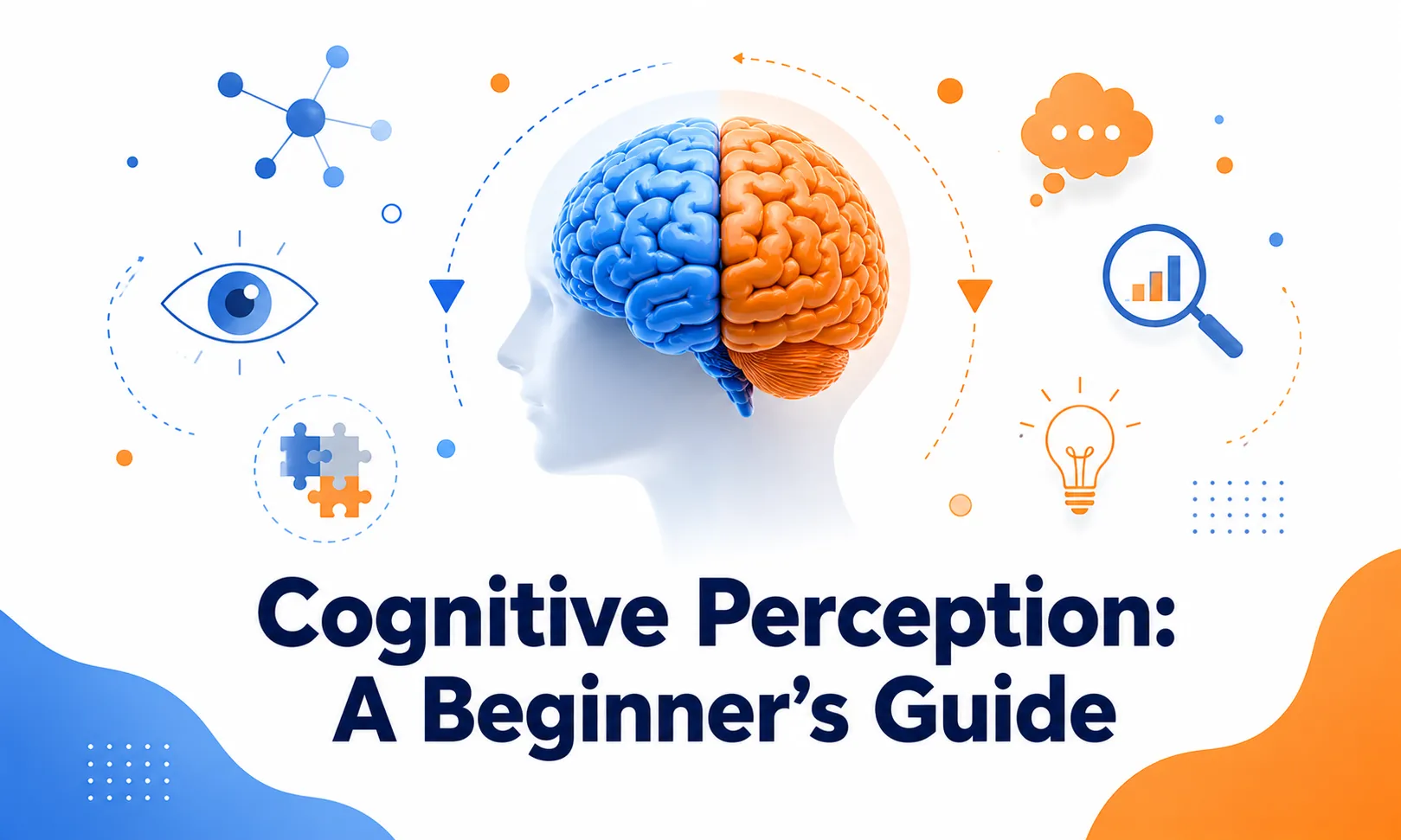
Look at any object near you right now. Your eyes are doing far less work than you think — most of what you “see” is your brain filling in gaps, matching patterns, and making educated guesses. That’s cognitive perception in action. Cognitive perception is the mental process of taking in raw sensory information and actively interpreting it into something meaningful, using memory, expectation, and context rather than just passively recording the world. This guide breaks the concept down from scratch: what it means, how it differs from simple sensation, the stages your brain moves through, and why understanding it changes how you think about everyday experience.
What Is Cognitive Perception, Exactly?
Cognitive perception is the brain’s active process of organizing, interpreting, and assigning meaning to sensory input, rather than a passive recording of the outside world. It sits at the intersection of two fields: sensory biology (how your eyes, ears, and skin detect physical energy) and cognitive psychology (how your brain uses memory, attention, and expectation to turn that raw data into an understanding).
Think of it this way. A camera captures light. It doesn’t “understand” what it’s capturing. Your brain does both — it captures the signal and constructs a meaningful interpretation of it, often within milliseconds and almost entirely outside conscious awareness.
Cognitive perception shows up in ordinary moments constantly:
- Recognizing a friend’s voice on a crowded phone line
- Reading messy handwriting by predicting the word from context
- Feeling like a room is “off” before you can say exactly why
- Instantly knowing a facial expression means someone is upset, before a word is spoken
Each of these examples involves the same underlying machinery: sensory input, filtered and reshaped by what your brain already expects to find.
What’s the Difference Between Sensation and Cognitive Perception?
Sensation is the raw physical detection of a stimulus by your sensory organs, while cognitive perception is the psychological process of interpreting that stimulus into something you understand. The distinction matters because the two processes can, and often do, diverge. You can sense something without perceiving it, and your perception of a stimulus can be inaccurate even when the sensory signal itself is clear.
| Aspect | Sensation | Cognitive Perception |
| Nature | Physical, mechanical | Psychological, interpretive |
| Location | Sensory receptors (eyes, ears, skin, nose, tongue) | Brain — primarily cortical processing regions |
| Process type | Passive detection | Active construction |
| Influenced by | Physical stimulus properties only | Memory, culture, mood, attention, expectation |
| Example | Light hitting the retina | Recognizing that shape as “a dog” |
A classic classroom demonstration of this split, drawn from introductory cognitive psychology coursework, involves an old analog clock ticking in a room. When you first walk in, you can clearly hear the ticking. Minutes later, mid-conversation, the ticking hasn’t stopped — but you’ve stopped perceiving it, a phenomenon researchers call sensory adaptation, documented in an open-access cognitive psychology textbook. The sound never left the room. Your perception of it did.
What Are the Stages of Perceptual Processing?
Perception generally unfolds in three core stages — sensation and selection, organization, and interpretation — with sensory information moving from raw physical detection to a fully formed, meaning-laden experience. Some researchers split this into four or five sub-stages, but nearly every model agrees on the same basic sequence.
- Selection (or attention). Your senses are bombarded with far more information than you can consciously process, so your brain filters aggressively. You notice your name spoken across a noisy room but miss dozens of other conversations happening at the same volume — a pattern often called the cocktail party effect.
- Organization. Once selected, raw sensory fragments get grouped into recognizable patterns. This is where Gestalt principles kick in — your brain groups nearby shapes together, completes broken outlines, and separates a “figure” from its “background” automatically.
- Interpretation. The organized pattern is finally assigned meaning, drawing on memory, prior experience, cultural background, mood, and context. Two people can look at an identical image and interpret it in genuinely different ways, because interpretation is where subjectivity enters the process most heavily.
Some models add memory and recall as later stages, since perception isn’t just about the initial moment of understanding — it also feeds into what gets stored and how it’s remembered later, shaping future perception in a continuous feedback loop.
How Does Top-Down and Bottom-Up Processing Work in Perception?
Bottom-up processing builds perception directly from sensory data with no outside influence. In contrast, top-down processing uses prior knowledge, expectations, and context to shape how that same sensory data gets interpreted — and most real-world perception uses a blend of both. Understanding this pair of concepts is arguably the single most useful thing a beginner can take from cognitive perception research, because it explains why two people can look at the same thing and see it differently.
Bottom-Up Processing
Bottom-up processing starts at the stimulus and works upward toward meaning. Nothing about it depends on what you already know. It’s purely data-driven: light hits the retina, sound waves hit the eardrum, and the brain builds a perception from that raw material alone, without added interpretation from memory or expectation.
Top-Down Processing
Top-down processing works in the opposite direction. Your existing knowledge, assumptions, and context actively shape what you perceive, sometimes before you’ve even fully registered the raw sensory details. A well-known classroom demonstration, described in coursework from Penn State’s cognitive psychology program, involves a hiker spotting a dark, motionless shape in the distance at a park known for wildlife. Because of prior knowledge about the location, the hiker’s brain briefly interprets the shape as a bear — until getting closer reveals it’s actually a large rock. The sensory input never changed. The interpretation did, because expectation was doing part of the work.
| Factor | Bottom-Up Processing | Top-Down Processing |
| Starting point | The stimulus itself | Existing knowledge and expectation |
| Direction of flow | Senses → brain | Brain (prior knowledge) → sensory interpretation |
| Speed | Can feel effortless, automatic | Can be faster for familiar patterns, but prone to bias |
| Risk | Struggles with ambiguous or degraded input | More vulnerable to misperception and assumption |
| Everyday example | Noticing a sudden loud noise | Reading a smudged word correctly because of sentence context |
Neither system runs in isolation. Most perception blends the two continuously, adjusting the balance depending on how clear the sensory input is and how strong your prior expectations are at that moment.
How Does Perception Influence Human Behavior?
Perception directly shapes behavior because people respond to their interpretation of a situation, not to the raw sensory data itself — which means two people can react completely differently to the same event. This is one of the more practically important ideas in all of cognitive psychology, and it shows up everywhere from workplace conflict to consumer decision-making.
A few real-world examples make this concrete:
- Communication. A flat tone of voice might be perceived as boredom by one listener and as calm confidence by another, producing entirely different reactions to the same speaker.
- Risk assessment. Two drivers see identical fog on a highway; one perceives it as manageable based on past driving experience, the other perceives it as dangerous and slows drastically.
- Consumer behavior. Packaging design, color, and word choice shape perceived product quality even when the underlying product is unchanged — a principle marketing researchers rely on constantly.
- Conflict. Ambiguous behavior (a delayed reply, a short comment) gets interpreted through the lens of a person’s mood, attachment patterns, or prior relationship history, often driving reactions that have little to do with the sender’s actual intent.
Because interpretation — not raw sensation — drives the response, understanding your own perceptual biases is a genuinely practical skill, not just an academic one. It’s part of why fields ranging from user-experience design to clinical psychology spend so much time studying how perception actually works, an approach reflected in interdisciplinary research summarized through the National Institutes of Health’s PubMed Central archive on how sensory and cognitive processing interact in real time.
What Is the Simple Definition of Cognitive Perception?
In the simplest terms, cognitive perception is how your brain turns raw sensory signals into a meaningful understanding of the world, using memory and expectation to fill in the gaps. If sensation is “what your senses pick up,” perception is “what your brain decides it means.” That single distinction resolves most of the confusion beginners run into when the two terms get used interchangeably.
This is also the foundational concept behind cognitive psychology as a broader field — nearly every topic in that discipline, from memory to problem-solving, connects back to how perception organizes incoming information. If you’re building a broader foundation, it’s worth pairing this topic with our guide on the difference between cognitive science and cognitive psychology, since the two fields overlap heavily but aren’t identical.
Why Does Cognitive Perception Matter for Everyday Life?
Cognitive perception matters because it determines your subjective reality — not “what happened,” but what you believe happened, which is what actually drives your emotions and decisions. Two coworkers can sit through the identical meeting and walk away with different conclusions about what was decided, not because either one is lying, but because their perceptual filters processed the same input differently.
This has practical implications worth taking seriously:
- In relationships, misperceiving a partner’s tone or intent is one of the most common sources of avoidable conflict.
- In learning, top-down processing explains why activating prior knowledge before a lesson helps students absorb new material faster.
- In mental health, perceptual distortions — interpreting neutral situations as threatening, for instance — are a known factor in anxiety and are frequently addressed directly in talk therapy approaches.
- In design and technology, understanding perceptual limits (how much information people can attend to at once) shapes everything from app interfaces to warning labels.
At yourbrainlens, the goal is to make concepts like this accessible without stripping out the nuance — perception isn’t a minor psychology footnote; it’s the mechanism standing between raw stimulation and every judgment you make about the world around you.
Frequently Asked Questions
What is the simple definition of cognitive perception?
Cognitive perception is the brain’s process of interpreting raw sensory information into a meaningful understanding, using memory, attention, and expectation rather than passively recording the world exactly as it is.
What are the stages of perceptual processing?
Most models describe three core stages: selection (attention filters what you notice), organization (the brain groups sensory fragments into patterns), and interpretation (meaning gets assigned based on memory and context).
How does perception influence human behavior?
People act based on their perception of a situation rather than its objective facts, which is why two people can respond very differently to identical events, conversations, or environments.
What’s the difference between sensation and cognitive perception?
Sensation is the physical detection of a stimulus by sensory organs like the eyes or ears. Cognitive perception is the psychological step that follows, in which the brain organizes and interprets the raw signal into something meaningful.
How does top-down and bottom-up processing work in perception?
Bottom-up processing builds perception purely from sensory data, while top-down processing uses prior knowledge and expectations to shape interpretation. Most everyday perception uses both simultaneously.
Is cognitive perception the same as cognitive science?
No. Cognitive perception is a specific mental process studied in cognitive psychology, whereas cognitive science is a broader interdisciplinary field encompassing perception, language, computation, neuroscience, and more.
Getting Started With the Basics of Cognitive Science
Cognitive perception is the entry point most beginners use to understand the wider field of cognitive science, and for good reason — it’s the one cognitive process you can observe in yourself constantly, in real time, without any special training. Next time something looks slightly off, sounds ambiguous, or gets misread, pause and ask which part of the process is doing the work: is it the raw sensory data, or is your brain filling in the gaps with expectation?
If this topic sparked your interest, keep building from here. Explore how these same perceptual principles connect to memory and learning in our cognitive psychology guide, or step back further and see how perception fits into the broader set of psychological theories that explain human thought and behavior.
This article is intended for educational purposes and provides a general introduction to psychological concepts. It isn’t a substitute for coursework, clinical assessment, or professional guidance.








5 thoughts on “Cognitive Perception: A Beginner’s Guide to the Mind”