You didn’t build your mind alone. Language, habits, beliefs, and even your sense of self came from other people. Understanding how society shapes the mind explains why you think, feel, and act the way you do. This guide covers seven well-studied social dynamics, the research behind each, and what the science says about brain change. You’ll also get practical steps and a ready-to-use LMS teaching plan. Let’s start with the basics.
How Does Society Shape the Mind?
Society shapes the mind through constant social interaction, language, cultural norms, and group membership. These forces teach us what to notice, what to value, and how to interpret the world. Over time, outside influences become internal habits of thought, a process psychologists call internalization.
Think about a toddler learning to point. Nobody is born knowing that pointing means “look at that.” A parent responds, the child repeats it, and a shared meaning forms. That small moment holds the whole idea. Thinking starts between people and moves inward.
Psychologists use several ideas to describe this:
- Socialization: learning the rules and roles of your community.
- Enculturation: absorbing the specific beliefs and customs of your culture.
- Internalization: turning outside guidance into private thought.
- Cognitive schemata: mental templates built from repeated social experience.
For a broader foundation, the social psychology guide at yourbrainlens maps the field. Here, we focus on one question: what exactly does society do to the mind?
What Is the Sociocultural Theory of Cognitive Development?
Sociocultural theory holds that higher thinking skills develop first between people, then inside the individual. Lev Vygotsky proposed this in the early 20th century. Children learn through guided interaction with parents, teachers, and peers before they can reason alone.
Vygotsky described two stages:
- Interpsychological: the skill appears in a shared activity, such as a parent helping with a puzzle.
- Intrapsychological: the child absorbs the skill and uses it independently.
His best-known concept is the Zone of Proximal Development (ZPD), the gap between what a learner can do alone and what they can do with help. A child who can’t solve a math problem alone but can with a hint is working within the ZPD. Good teachers aim there. The helping structure is called scaffolding, and you remove it as the learner improves.
You can read a short biography of the theorist in Encyclopaedia Britannica’s entry on Lev Vygotsky. For a wider comparison with other thinkers, see our psychology theorists and key concepts overview.
What Are the 7 Social Dynamics That Shape the Mind?
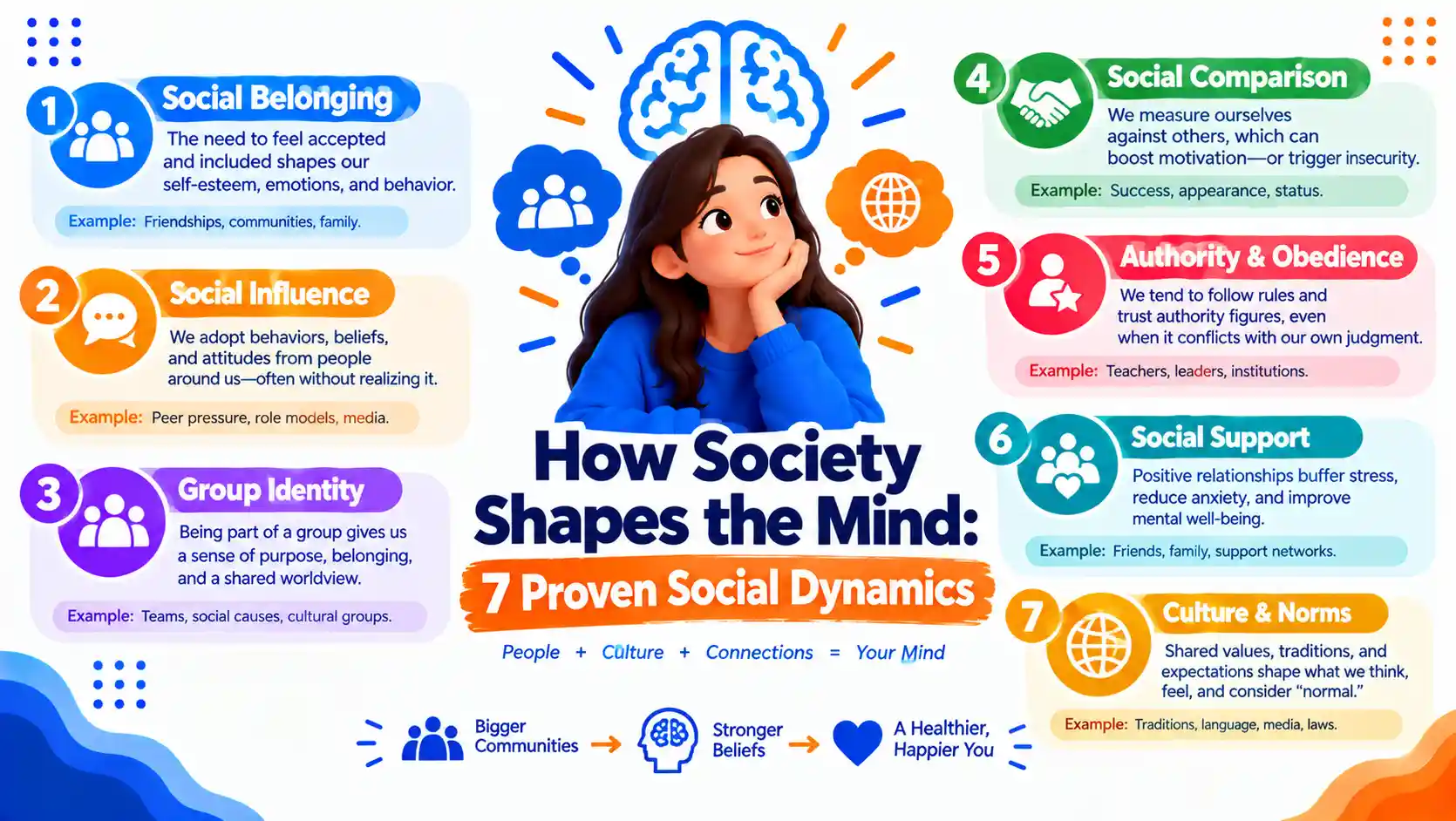
Seven dynamics do most of the work: guided interaction, observation, social norms, group identity, social roles, cultural thinking styles, and environmental conditioning. Each has decades of research behind it. Together, they explain how psychological and social influences operate in daily life.
1. How Does Language Shape Thought?
Language is the first and strongest social tool for thinking. Children learn words through conversation, and those words organize memory, attention, and reasoning. Vygotsky observed that kids talk to themselves while solving problems. That “private speech” gradually becomes silent inner thought.
Real-world example: a child who hears “Let’s check if it fits first” repeatedly will later say it aloud, then think it quietly. The adult’s voice becomes the child’s planning system.
2. How Does Observation Shape Behavior?
People learn by watching others, not just by doing. Albert Bandura’s 1961 Bobo doll experiment showed that children who watched an adult act aggressively toward an inflated doll were more likely to copy that aggression. His Social Learning Theory says attention, memory, imitation, and motivation drive the process.
This explains why role models matter. A teenager who sees adults handle conflict calmly tends to absorb that pattern. Our deeper breakdown of the social learning theory framework shows how Bandura’s ideas connect to other major theories.
3. How Do Social Norms Pull Our Thinking?
Social norms steer judgment through two forces: the wish to belong and the wish to be right. Psychologists call these normative and informational social influence. In Solomon Asch’s famous line experiments, roughly three-quarters of participants went along with an obviously wrong group answer at least once.
- Normative influence: you conform to be accepted.
- Informational influence: you conform because you assume the group knows more.
Both reshape what feels “normal” to you. Our article on normative vs. informational social influence explains the difference using everyday examples. Émile Durkheim called the shared beliefs of a community the collective consciousness, and you absorb it without noticing.
4. How Does Group Identity Change Perception?
Belonging to a group changes who you trust, who you blame, and how you see yourself. Henri Tajfel’s Social Identity Theory shows that even random group labels trigger in-group favoritism. In his minimal group studies, people assigned to arbitrary groups still gave more rewards to their own side.
That sounds small, but it scales. Sports rivalries, school cliques, and national identities all run on the same mechanism. Your self-concept becomes partly “who we are,” rather than only “who I am.” The social characteristics guide shows how these traits form.
5. How Do Social Roles Shape the Self?
We act out roles, and over time the roles become part of us. Erving Goffman compared daily life to theater. In his dramaturgical analysis, we perform different “front stage” selves for different audiences, such as a confident presenter at work and a relaxed friend at home.
Here’s the catch. Repeat a performance long enough, and it stops feeling like a performance. A new manager who “acts” decisive for six months often starts to feel decisive. The role rewrites the self.
6. How Does Culture Change the Way We Think?
Culture trains attention and reasoning habits. Research in cultural psychology, including work by Richard Nisbett and colleagues, suggests that many people in Western societies tend toward analytic thinking (a focus on objects and categories). In contrast, many in East Asian societies lean toward holistic thinking (focus on context and relationships). These are tendencies, not rules.
| Feature | Common Western tendency | Common East Asian tendency |
| Attention | Focal objects | Whole scene and context |
| Self-concept | Independent | Interdependent |
| Explaining behavior | Personal traits | Situation and relationships |
| Decision style | Individual choice | Group harmony |
Treat the table as a starting point. Individuals vary widely inside every culture. Still, the pattern shows that “normal” thinking is partly a cultural product. Our cognitive perception guide covers how perception itself gets trained.
7. How Does the Environment Condition Development?
Early surroundings set the conditions for brain and behavior growth. Urie Bronfenbrenner’s ecological model describes nested layers of influence: family, school, neighborhood, and broader culture. A child sits in the middle of them all.
The Bucharest Early Intervention Project, which followed children raised in institutions in Romania, found that children who moved into caring foster homes earlier generally showed better cognitive and emotional outcomes than those who stayed in institutional care. Environment is not a side detail. It is raw material.
Can Social Culture Change Brain Function?
Yes. Social experience changes the brain through neuroplasticity, the brain’s ability to rewire itself based on experience. The brain isn’t a fixed machine that society merely decorates. It physically adapts to what you repeat, learn, and live in.
A classic example: a well-known study of London taxi drivers found that experienced drivers had a larger posterior hippocampus, a region tied to spatial memory, than non-drivers. Years of navigating a complex city reshaped a brain region. You can browse the underlying biomedical literature through the National Library of Medicine’s PubMed database.
Social settings work the same way. Chronic stress, supportive relationships, and rich learning environments leave measurable marks. If you want a practical take on this, read our piece on how positive thinking affects the brain, which ties into ongoing research on neuroplasticity.
Epigenetics adds another layer. Experience can influence which genes switch on or off without changing the DNA sequence itself. The National Human Genome Research Institute offers plain-language explanations of how this works. The takeaway: biology and society are partners, not rivals.
What Is the Difference Between Psychological and Social Influence?
Psychological influence focuses on internal mental processes, while social influence examines the outside forces that condition them. One looks inward at perception, emotion, and reasoning. The other looks outward at groups, culture, and institutions. Real life blends both.
| Aspect | Psychological influence | Social influence |
| Focus | Inner mental processes | External group and cultural forces |
| Example | A fear response to a dog | Learning dogs are “dangerous” from family |
| Level of study | Individual | Group, community, culture |
| Typical field | Cognitive psychology | Social and cultural psychology |
Neither explains the mind alone. A person’s anxiety might involve brain chemistry (psychological) and a competitive school culture (social) at once. Our cognitive psychology guide covers the inner side in depth.
How Does Social Media Shape Modern Human Psychology?
Social media shapes the mind by speeding up social comparison, feedback loops, and norm-setting. Likes, shares, and comments act as instant social rewards. They tell users what the group approves of, which accelerates conformity and identity formation.
Three effects stand out:
- Comparison pressure: constant exposure to curated lives can distort self-image.
- Echo effects: algorithms show content similar to what you already engage with, reinforcing existing beliefs.
- Norm acceleration: trends spread globally in hours, so group norms shift faster than ever.
Teens are especially sensitive because identity formation peaks in adolescence. Peer groups shape cognitive self-concept at this stage, and online peers count. For public-health guidance on young people’s mental health, the National Institute of Mental Health provides research-backed resources. Not every effect is negative, though. Online communities also provide isolated people with support and a sense of belonging.
How Does Social Isolation Affect Cognitive Development?
Social isolation can slow cognitive and emotional development, especially in childhood. Children need responsive interaction to build language, attention, and emotional regulation. Without it, the scaffolding Vygotsky described never gets built.
Harry Harlow’s mid-century research on rhesus monkeys showed that animals raised without social contact developed serious social and emotional difficulties. Human evidence points in the same direction. Severe early neglect is linked to language delays and attention problems. In adults, long-term loneliness is associated with poorer health and mental wellbeing.
Our article, “Attachment Styles Explained,” shows how early relationships form lasting patterns. The developmental psychology guide lays out the stages that make early social contact so important.
Does Society or Biology Matter More?
Neither wins. Biology sets possibilities, and society determines which ones develop. Cultural determinism, the idea that culture alone makes us who we are, goes too far. Genetic determinism does too. Modern science favors interaction.
A simple way to picture it: genes load the deck, and environment decides how the hand is played. Two people with similar genetic tendencies toward shyness can grow up very differently depending on family, school, and culture. Behavioral plasticity, our ability to adapt behavior to new conditions, is the proof.
How Can Educators Teach This Topic in an LMS?
Educators can teach this topic in an LMS such as Canvas, Moodle, or Blackboard by creating modules on social cognition, adding discussion boards, and using self-graded quizzes. Short, scaffolded units mirror Vygotsky’s own idea of guided learning. Platforms such as Moodle and Canvas both support these tools.
Here’s a simple four-module plan for a social psychology LMS course module:
| Module | Focus | Activity | Assessment |
| 1 | Sociocultural theory and the ZPD | Short video + reading | 5-question self-graded quiz |
| 2 | Observation and norms (Bandura, Asch) | Discussion board: “Where did you learn a habit?” | Peer-reviewed post |
| 3 | Identity and roles (Tajfel, Goffman) | Case-study analysis | Short written response |
| 4 | Culture and the brain | Compare two cultural examples | Final cognitive assessment |
Tips that work in practice:
- Keep discussion prompts personal and concrete. Students engage when they can use their own lives as evidence.
- Add a “scaffold” file with sentence starters for students who need support, then remove it in later modules.
- Pair every theory with one real-world scenario.
Looking for companion material? Our LMS cognitive psychology lessons and the psychological theories guide fit neatly into modules 1 and 4.
How Can You Use This Knowledge in Daily Life?
You can use it by intentionally choosing your environments, models, and groups. Since the mind adapts to its surroundings, small changes in your social setup can shift your habits. This isn’t about blame. It’s about leverage.
Try these five steps:
- Audit your inputs. List the five people and three online sources you spend the most time with. Ask what each one teaches you to believe.
- Pick better models. Find someone who handles a skill you want, such as patience or focus, and observe how they do it.
- Spot the norm. Next time you feel pressure to agree, ask: am I conforming to belong or because I think they’re right?
- Build your own ZPD. Find a mentor or study partner slightly ahead of you. Growth happens in that gap.
- Question your labels. Notice when “that’s just how people like me are” is really “that’s how my group taught me.”
For a wider look at behavior patterns, our guide to why humans act the way they do pairs well with these steps. If you’re new to the field, start with what psychology is.
Frequently Asked Questions
How does society shape individual human cognition?
Society shapes cognition through enculturation, language acquisition, and social norms. In Vygotsky’s sociocultural theory, higher mental functions develop first through social interaction (interpsychological) and then become internalized within the individual mind (intrapsychological).
What is the difference between psychological and social influence?
Psychological influence focuses on internal mental processes, cognitive perception, and emotional reactions within an individual. Social influence examines external factors, such as group dynamics, cultural expectations, and institutional structures, that condition those mental processes.
How can educators implement this topic into an LMS curriculum?
Educators can integrate it into an LMS such as Canvas, Moodle, or Blackboard by structuring modules around social cognition, adding interactive discussion boards on social learning theory, and using self-graded quizzes on sociocultural development.
Can social culture change brain function?
Yes. Through neuroplasticity, repeated social and cultural experiences can change brain structure and activity. Studies of experienced London taxi drivers, for example, found differences in the hippocampus, a memory-related region linked to years of navigating a complex city.
What are the main ways society shapes our identity?
Four ways stand out: group membership (social identity), social roles and performance, cultural values, and feedback from peers and family. Together they form your self-concept, the story you tell about who you are.
How does social isolation affect cognitive development?
Isolation limits the guided interaction children need to build language, attention, and emotional regulation. Severe early neglect is linked to developmental delays, while supportive caregiving and early intervention can improve outcomes.
Conclusion: What Should You Do Next?
Your mind is a shared project. Language, models, norms, groups, roles, culture, and environment all feed into it. The good news is that the same plasticity that lets society shape you also lets you reshape your inputs.
Here’s your next step. Pick one dynamic from this guide and test it this week. Change one model, one group, or one habit of attention, then note what shifts. Educators can copy the four-module LMS plan above and adapt it for their class.
Want to keep learning? Explore more research-backed guides at yourbrainlens, starting with the social psychology guide, and share this article with someone curious about how society shapes the mind.