
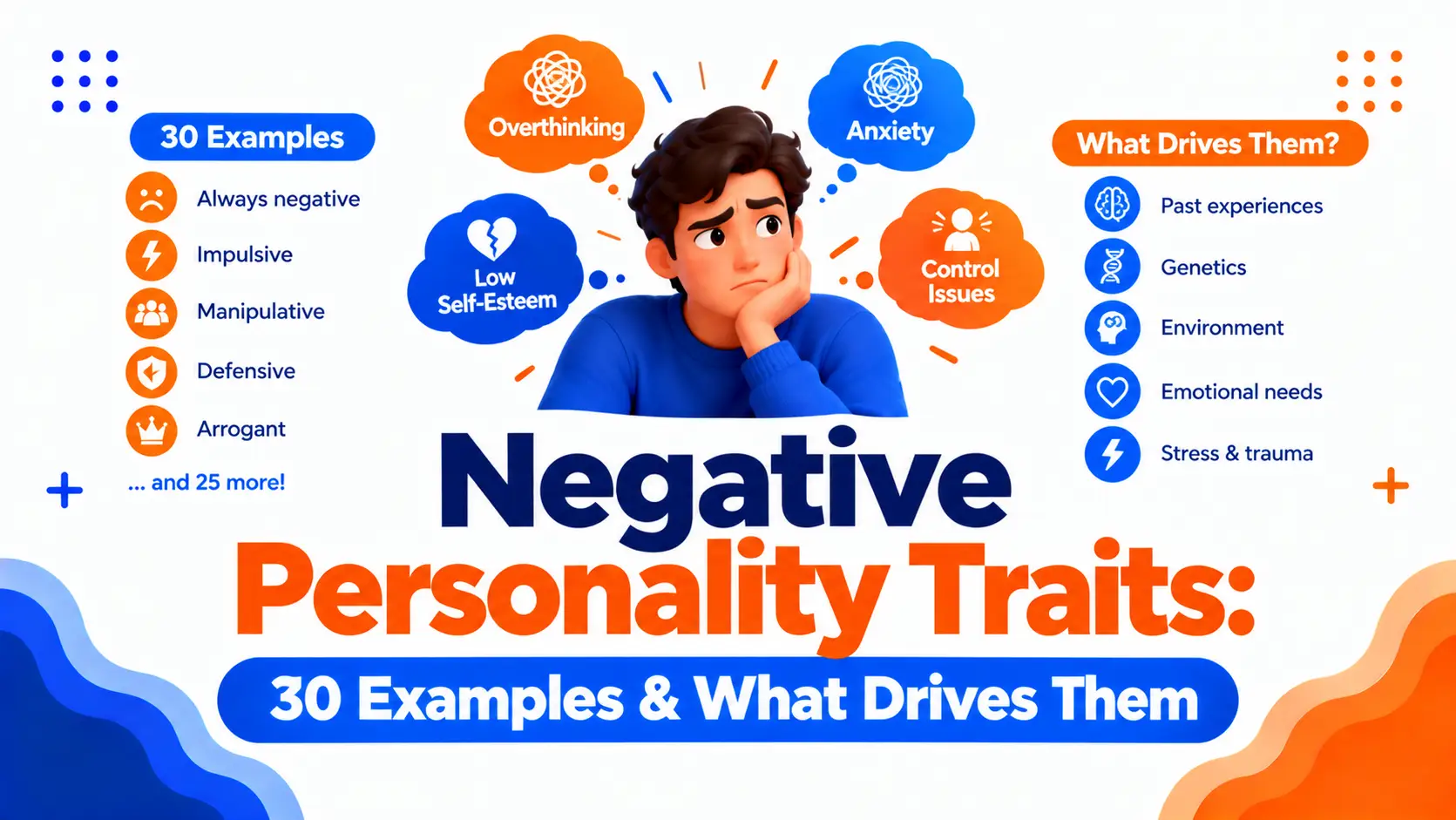
You may have worked with, lived with or been the one displaying one of these behaviours. Negative personality traits are behaviour patterns that destroy relationships, careers and peace of mind. Most have comprehensible origins in childhood experience or native disposition. In this book, we examine 30 frequent examples, what’s behind each one, how psychologists explain them, and what really helps individuals change.
What Are Negative Personality Traits?
Negative personality traits are enduring, maladaptive patterns of thinking, feeling, and behaving that disrupt relationships and personal well-being. A mix of genetics, early experiences, and defensive coping habits usually drives them. They are not the same as a diagnosed personality disorder.
The American Psychological Association defines personality as the relatively stable pattern of characteristics that shapes how a person thinks, feels, and acts. A trait becomes “negative” when it is rigid, repeated across situations, and costly to you or the people around you.
Everyone has flaws. One bad day of snapping at a coworker isn’t a trait. Snapping at people every week for ten years is. Three things separate a passing mood from a real pattern:
- Frequency: it shows up repeatedly.
- Consistency: it appears at work, at home, and with friends.
- Cost: it damages relationships or your own goals.
To go deeper on how personality forms in the first place, see our guide to psychological theories.
What Is the Difference Between a Character Flaw and a Personality Disorder?
A character flaw is an occasional or moderate weakness, while a personality disorder is a rigid, pervasive pattern that causes significant distress or impairment. Only a licensed clinician can diagnose a disorder. Character flaws sit on a spectrum and are usually easier to change.
| Feature | Character Flaw / Negative Trait | Personality Disorder |
| Severity | Mild to moderate | Severe and pervasive |
| Flexibility | Person can adapt with effort | Pattern feels fixed and automatic |
| Insight | Often aware of the problem | Often little awareness |
| Impact | Some friction in relationships | Major damage to work, family, and daily life |
| Who assesses it | Self-reflection, feedback | Licensed psychologist or psychiatrist |
MedlinePlus, from the U.S. National Library of Medicine, explains that personality disorders involve long-term patterns that differ sharply from cultural expectations and cause real problems in daily life. If you recognize yourself in the more extreme descriptions below, that is a reason to talk to a professional, not a reason to feel ashamed. Our mental health pathology guide explains how clinicians distinguish among them.
What Drives Negative Personality Traits?
Negative personality traits are driven by a combination of genetics, childhood environment, trauma, and learned defense mechanisms. No single cause explains them. Temperament sets the starting point, and life experience shapes how that temperament turns out.
Here are the five main drivers psychologists point to.
Are Negative Personality Traits Genetic or Learned?
Both. Twin studies imply that personality traits are modestly heritable, commonly estimated at around 40 to 50 percent. That leaves lots of room for surroundings. The naturally anxious youngster reared in a calm and supportive family will grow up to be a cautious adult. The same child raised in turmoil may develop controlling or avoidance habits.
How Do Defense Mechanisms Create Bad Traits?
Defense mechanisms are automatic mental tricks that protect us from painful feelings. Projection, denial, and rationalization are common ones. They work in the short term. Over the years, they harden into personality traits: the person who can’t tolerate feeling small becomes arrogant, and the person who can’t tolerate conflict becomes passive-aggressive.
What Role Does Attachment Play?
Attachment theory holds that early bonds with caregivers serve as a template for later relationships. Children with inconsistent or cold caregivers often develop insecure attachment. That can show up as clinginess, jealousy, emotional distance, or distrust. Read more in our breakdown of attachment styles.
How Do Trauma and Stress Shape Personality?
Chronic stress, neglect, and abuse can rewire how the brain handles threat. Some people become hypervigilant and hostile. Others go numb and detached. These are often survival strategies that outlived the danger that created them.
What Does the Big Five Model Say?
The Five-Factor Model measures openness, conscientiousness, extraversion, agreeableness, and neuroticism. Most “negative” traits map onto extremes: low agreeableness (hostility, selfishness), high neuroticism (worry, moodiness, envy), and low conscientiousness (impulsivity, irresponsibility). The APA’s overview of personality covers this framework in more detail.
What Is the Dark Triad in Personality Psychology?
The Dark Triad is a set of three related malevolent traits: narcissism, Machiavellianism, and psychopathy. Researchers Delroy Paulhus and Kevin Williams named the cluster in 2002. People high on these traits tend to be manipulative, callous, and self-serving. The APA Dictionary entry on the Dark Triad gives the formal definition.
- Narcissism: grandiosity, entitlement, and a constant hunger for admiration.
- Machiavellianism: cold, strategic manipulation and a belief that the ends justify the means.
- Psychopathy: low empathy, impulsivity, and shallow emotions.
Most people with these traits are not criminals or clinical cases. The traits exist on a spectrum, and many of the 30 examples below overlap with them.
What Are 30 Examples of Negative Personality Traits?
Here are 30 negative personality traits, grouped into three clusters: interpersonal, emotional, and behavioral or cognitive. Each entry shows what the trait looks like in real life and what usually drives it. Grouping them this way makes patterns easier to spot.
Which Interpersonal Traits Damage Relationships?
These traits show up in how we treat other people.
- Arrogance: Acting superior and dismissing other people’s input. Driver: often overcompensation for deep-seated insecurity.
- Entitlement: Expecting special treatment without earning it. Driver: over-indulgent parenting or narcissistic wounds.
- Manipulation: Steering people through guilt, lies, or pressure. Driver: learned early that direct requests don’t work.
- Passive-aggression: Expressing anger through sarcasm, sulking, or “forgetting.” Driver: fear of direct conflict and repressed hostility.
- Hostility: Reacting to others with irritability or anger by default. Driver: threat sensitivity, often from trauma or a harsh upbringing.
- Dishonesty: Lying, exaggerating, or hiding the truth. Driver: fear of consequences or a need to look better than reality allows.
- Controlling behavior: Micromanaging people and outcomes. Driver: anxiety and a deep need for certainty.
- Condescension: Talking down to others. Driver: a fragile ego that needs someone below it.
- Selfishness: Putting your needs first, always. Driver: low empathy or a scarcity mindset from early deprivation.
- Vindictiveness: Holding grudges and seeking payback. Driver: unresolved hurt and a poor sense of justice.
Which Emotional Traits Cause Inner Turmoil?
These traits live in how we feel and regulate emotion.
- Chronic envy: Feeling bitter about other people’s success. Driver: low self-esteem and constant social comparison.
- Jealousy: Fearing the loss of someone’s attention or loyalty. Driver: anxious attachment and past betrayal.
- Emotional volatility: Rapid mood swings. Driver: emotional dysregulation, sometimes linked to high neuroticism.
- Pessimism: Expecting the worst as a default. Driver: learned helplessness or repeated disappointment.
- Cynicism: Assuming other people’s motives are selfish. Driver: betrayal or a chronically unsafe environment.
- Resentment: Carrying long-term bitterness about past events. Driver: unspoken needs and unprocessed anger.
- Neuroticism: Worrying excessively and reacting strongly to stress. Driver: a sensitive nervous system plus stressful conditions.
- Self-pity: Focusing on your own suffering while ignoring your own agency. Driver: an external locus of control.
- Insecurity: Constantly doubting your worth. Driver: criticism, comparison, or neglect in childhood.
- Emotional coldness: Staying distant and unresponsive. Driver: avoidant attachment or learned emotional suppression.
Which Behavioral and Cognitive Traits Hold People Back?
These traits show up in habits and thinking styles.
- Impulsivity: Acting before thinking. Driver: poor executive function and emotional dysregulation.
- Stubbornness: Refusing to change your mind even when wrong. Driver: fear that giving in equals losing.
- Perfectionism: Demanding flawless results and punishing mistakes. Driver: conditional love or approval earlier in life.
- Self-sabotage: Undermining your own goals. Driver: fear of failure, or a belief that success isn’t deserved.
- Procrastination: Avoiding tasks until the last moment. Driver: often emotion avoidance, not laziness.
- Closed-mindedness: Rejecting new ideas or perspectives. Driver: discomfort with uncertainty.
- Judgmentalism: Quickly criticizing others. Driver: projection of your own insecurities.
- Recklessness: Taking risks without regard for consequences. Driver: sensation-seeking and low fear response.
- Irresponsibility: Avoiding obligations and blaming others. Driver: low conscientiousness and weak consequences early on.
- Black-and-white thinking: Seeing everything as all good or all bad. Driver: a cognitive distortion that offers false simplicity under stress.
Many of these thinking patterns connect to how we interpret the world. Our cognitive perception guide explains how mental shortcuts shape behavior.
Which Traits Link to Which Psychological Drivers?
Most negative traits trace back to a small set of drivers: insecurity, fear, emotional dysregulation, and learned defenses. This table pulls the patterns together so you can see how different behaviors often share one root.
| Category | Negative Trait | Primary Psychological Driver |
| Interpersonal | Arrogance | Overcompensation for deep-seated insecurity |
| Interpersonal | Passive-aggression | Fear of direct conflict and repressed hostility |
| Interpersonal | Manipulation | Learned strategy for getting needs met |
| Emotional | Chronic envy | Low self-esteem and external locus of control |
| Emotional | Cynicism | Betrayal or chronic unsafe environment |
| Emotional | Emotional volatility | Emotional dysregulation, high neuroticism |
| Behavioral | Impulsivity | Poor executive function and emotional dysregulation |
| Behavioral | Perfectionism | Conditional approval in childhood |
| Cognitive | Black-and-white thinking | Cognitive distortion under stress |
Notice the pattern. Arrogance and insecurity look like opposites but often come from the same wound. That is why simply telling an arrogant person to “be humble” rarely works. The fix has to target the root.
How Can You Spot Negative Traits in Yourself?
Spotting negative traits in yourself starts with tracking patterns, not single events. Ask what keeps repeating in your relationships and work. Feedback from trusted people, plus honest journaling, reveals blind spots that self-reflection alone often misses.
Self-awareness is hard because defense mechanisms exist to hide the truth from us. Try these steps:
- Look for repeats. If three different bosses or partners gave you similar feedback, take it seriously.
- Notice your triggers. What situations make you defensive, angry, or withdrawn?
- Track your reactions for two weeks. Write down what happened, what you felt, and what you did.
- Ask two trusted people for one honest observation each. Say you won’t argue.
- Watch your excuses. “That’s just how I am” often signals a trait you haven’t examined.
Carl Jung called the hidden parts of ourselves the shadow self: the traits we deny and project onto others. If certain people irritate you intensely, the trait annoying you may be one you carry. A useful question is “What would it mean if I did this too?”
Can a Person Overcome Negative Personality Traits?
Yes, most undesirable qualities may be decreased by steady work, introspection, and often, expert help. Personality is stable, but not set in stone. Studies suggest that as we get older, we tend to get more agreeable and conscientious—and you may speed it up by taking intentional actions in your work.
Change works best when it targets the driver, not just the behavior.
What Steps Actually Help?
- Name the trait without shaming yourself. Shame makes people hide. Curiosity makes them change.
- Find the driver. Ask what you’re protecting yourself from. As for arrogance, it may be a fear of being ordinary.
- Replace the behavior with a small alternative. Instead of sarcasm, practice saying one direct sentence about what you need.
- Pause before reacting. A ten-second pause noticeably reduces impulsive responses.
- Reframe distorted thoughts. Catch “always” and “never” and test them against evidence.
- Reduce your baseline stress. Tired, overloaded people fall back on old habits. Our 7 easy ways to reduce stress are a practical place to start.
When Is Therapy Worth Considering?
If a trait keeps damaging your relationships, job, or health despite your honest effort, therapy can help. Cognitive behavioral therapy targets distorted thinking. Schema therapy addresses deep patterns from childhood. Attachment-focused work helps with jealousy and emotional distance. Learn what to expect in our talk therapy guide.
How Should You Deal With Someone Who Has Negative Traits?
Set clear boundaries, stay calm, and focus on behavior rather than character. You can’t change another person, but you can decide what you’ll tolerate and how you’ll respond. Protecting your own well-being comes first.
- Describe the behavior, not the person. “You interrupted me three times” lands better than “You’re rude.”
- Set consequences you’ll actually follow. An empty threat teaches people to ignore you.
- Don’t take it personally. Their trait usually says more about their inner world than about you.
- Limit contact if needed. Manipulative or hostile people may not change, and distance is a valid choice.
- Get support. A therapist or trusted friend can help you keep perspective.
If someone’s behavior involves threats, abuse, or control, safety matters more than understanding. Reach out to local support services or a mental health professional.
Understanding why people behave as they do also helps here. Our article on why humans act the way they do and our social psychology guide explore how situations and social pressure shape behavior.
Why Does Understanding Negative Traits Matter?
Understanding negative traits builds empathy, improves relationships, and helps you take responsibility for change. It also teaches you that behavior has causes. Explaining a trait is not excusing it, but it makes compassion and boundaries both easier.
Students studying personality and individual differences encounter these ideas in courses like AP Psychology, and clinicians apply the same concepts in real-world assessment. Managers use them to understand team conflict. Parents use them to spot early patterns in kids. Everyday readers use them to make sense of the people around them.
At yourbrainlens, we translate psychology research into plain language so these ideas are usable, not just academic. Explore our developmental psychology guide to see how childhood shapes adult personality.
Frequently Asked Questions
What are negative personality traits?
Negative personality traits are lasting patterns of thinking, feeling, and acting that harm relationships and well-being. Examples include arrogance, manipulation, envy, and impulsivity. They are usually shaped by genetics, upbringing, and defense mechanisms.
What are 5 examples of negative personality traits?
Five common examples are arrogance, passive-aggression, chronic envy, impulsivity, and cynicism. Each has a distinct psychological driver, such as insecurity, fear of conflict, low self-esteem, poor self-control, or past betrayal.
What causes someone to develop negative personality traits?
Causes usually combine inherited temperament, childhood experiences, trauma, insecure attachment, and learned defense mechanisms. No single factor explains everything. Environment can amplify or soften genetic tendencies.
Are negative personality traits genetic or learned?
Both play a role. Research suggests that roughly 40 to 50 percent of personality variation is heritable, with the rest attributable to environment and experience. That is why change is possible even for deeply rooted traits.
What is the Dark Triad in personality psychology?
The Dark Triad is a cluster of three traits: narcissism, Machiavellianism, and psychopathy. Together they describe manipulative, self-serving, and callous behavior. Most people show mild versions, and only extreme cases reach clinical levels.
Can a person overcome negative personality traits?
Yes, in most cases. Self-awareness, consistent practice, stress reduction, and therapy can shift long-standing patterns. Progress is usually gradual, and identifying the underlying driver makes it more lasting.
What Should You Do Next?
Start small. Pick one trait from the list that you recognize in yourself or someone close to you. Write down what triggers it, what it protects, and one alternative response to try this week. Small, repeated changes beat dramatic resolutions.
Remember the key points:
- Negative traits have causes, and most can be changed.
- Character flaws and personality disorders are different things.
- Targeting the driver works better than fighting the behavior.
- Professional help is a strength, not a failure.
Ready to keep learning? Browse yourbrainlens psychology library for more plain-English guides on personality, behavior, and mental health, and share this article with someone who would find it useful.








One thought on “Negative Personality Traits: 30 Examples & Their Causes”