
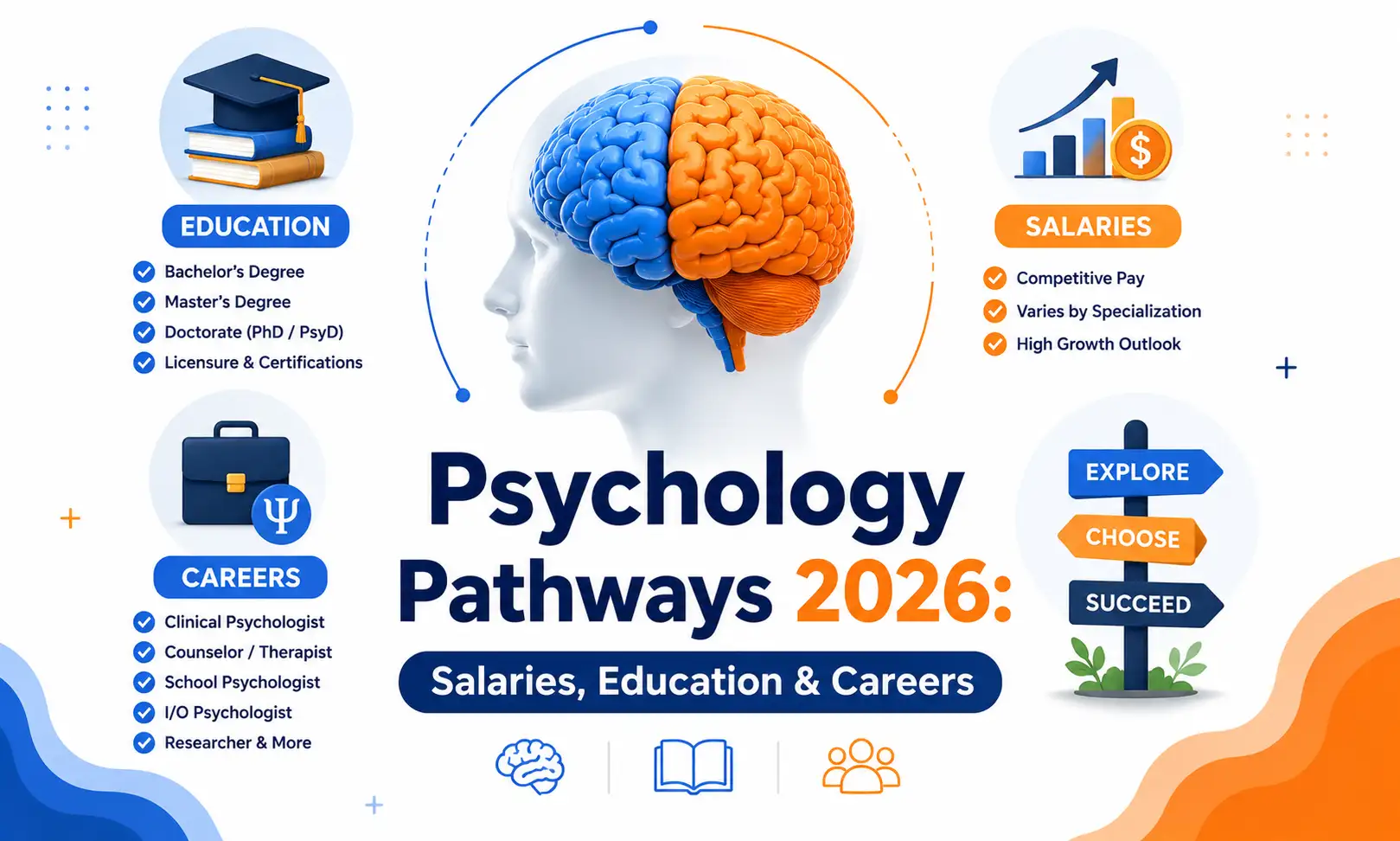
Picking a psychology career means choosing between years of study and very different paychecks depending on the path. A licensed psychologist needs a doctoral degree, thousands of supervised hours, and a passing EPPP score, while master’s-level roles open doors in three to four years. This guide breaks down every stop on that road: degree options, PsyD vs. PhD, state licensing steps, and 2026 salary numbers by specialty and state, so you can map out a realistic timeline before you enroll anywhere.
What Degree Do You Need for a Career in Psychology?
Most psychology jobs fall into three degree tiers: bachelor’s, master’s, and doctoral, and the tier you choose determines both your job title and your ceiling on independent practice. A bachelor’s degree opens the door to entry-level roles in research support and case management. A master’s degree qualifies you for counseling, school psychology in some states, and applied research jobs. Only a doctorate (PhD or PsyD) lets you call yourself a licensed psychologist and practice independently.
| Degree Level | Typical Time to Complete | Common Job Titles | Independent Practice? |
| Bachelor’s (BA/BS) | 4 years | Research assistant, case manager, psychiatric technician | No |
| Master’s (MA/MS) | 2–3 years after bachelor’s | Licensed professional counselor, industrial-organizational associate, school psychologist (some states) | Limited, varies by state |
| Doctorate (PhD/PsyD) | 5–7 years after bachelor’s | Clinical psychologist, counseling psychologist, research psychologist | Yes, after full licensure |
If you’re still narrowing down which branch of the field fits you, it helps to first understand the different specializations within psychology before committing to a graduate program, since clinical, developmental, social, and cognitive tracks each lead to distinct career paths.
What Is the Difference Between a PsyD and a PhD in Psychology?
A PsyD (Doctor of Psychology) is built around clinical practice, while a PhD (Doctor of Philosophy) is built around research, though both qualify graduates for licensure. Roughly 80% of a typical PsyD curriculum centers on clinical training and assessment, compared with a roughly even split between coursework and original research in most PhD programs. Neither degree pays more than the other by default — specialty, setting, and location matter more than the letters after your name.
| Factor | PsyD | PhD |
| Primary focus | Clinical practice and assessment | Research and scholarship |
| Typical length | 4–6 years | 5–7 years |
| Capstone project | Clinical dissertation or doctoral project | Original research dissertation |
| Funding availability | Less common; often self-funded | More common through assistantships and grants |
| Career fit | Private practice, hospitals, clinics | Academia, research institutions, some clinical roles |
| Admission competitiveness | Moderate | High (8–12% acceptance at many APA-accredited programs) |
Accreditation matters more than the letters after the degree. The American Psychological Association (APA) accredits doctoral programs in clinical, counseling, and school psychology, and most state licensing boards require or strongly prefer a degree from an APA-accredited program. If your interests lean toward how the brain processes information rather than treating clients directly, it’s worth comparing this path against a cognitive psychology track, which draws more on lab-based research methods.
How Do You Become a Licensed Psychologist in 2026?
Licensure requires a doctoral degree from an accredited program, thousands of hours of supervised clinical experience, and a passing score on the Examination for Professional Practice in Psychology (EPPP). The full process, from starting a bachelor’s degree to holding an independent license, typically runs eight to twelve years. Requirements vary by state, but the core sequence stays consistent nationwide.
- Earn a bachelor’s degree. A psychology major isn’t strictly required everywhere, but it covers prerequisite coursework most graduate programs expect.
- Complete a doctoral program (PhD or PsyD). Choose an APA-accredited program if your target state requires or prefers one, since most do.
- Complete a predoctoral internship. Most states require 1,500 to 2,000 hours of supervised practicum work built into the doctoral program itself.
- Finish postdoctoral supervised hours. Many states still require an additional 1,000 to 2,000 postdoctoral hours, though a growing number of states are trimming or waiving this step for candidates who complete a strong predoctoral internship.
- Pass the EPPP. This 225-question exam, administered through the Association of State and Provincial Psychology Boards, tests eight core content areas. Most states set a passing scaled score around 500.
- Pass any state-specific exam. Many boards also require a jurisprudence or oral exam covering local law and ethics.
- Apply for full licensure and maintain continuing education units (CEUs). Renewal cycles typically require ongoing CE credits, including ethics-specific hours.
What Is PSYPACT and Why Does It Matter?
PSYPACT (the Psychology Interjurisdictional Compact) allows licensed psychologists to provide telehealth and short-term in-person care across state lines without a separate license in each state. As of 2026, more than 40 states participate. If you plan to build a telehealth practice or expect to relocate, checking whether your target states are PSYPACT members before you commit to a licensing state can save years of redundant paperwork later.
Understanding how supervised hours translate into real clinical competence is easier once you’ve looked at how research methods shape clinical assessment, since practicum and internship hours are graded against those same standards.
What Is the Salary Outlook for Psychologists in 2026?
Psychologists earn a national median salary of roughly $99,000 a year, with clinical and counseling psychologists slightly above that and school psychologists slightly below, according to the U.S. Bureau of Labor Statistics. Pay varies sharply by specialty, setting, and state, and the overall field is projected to grow about 6% between 2024 and 2034, faster than the average occupation, driven largely by rising demand for mental health services and the expansion of telehealth.
| Specialty | Median Annual Salary | 90th Percentile |
| Clinical and counseling psychologists | ~$100,580 | $180,960+ |
| School psychologists | ~$95,990 | $142,330 |
| Industrial-organizational psychologists | Highly variable (small sample size) | Can exceed $190,000 |
| All other psychology specialties (forensic, neuropsychology, etc.) | ~$110,000 | Varies by setting |
Location changes the math substantially. States like Washington, Oregon, and New Jersey report some of the highest mean wages for clinical and counseling psychologists, while several Southern states report the lowest published medians. Metro areas with a high cost of living, particularly the San Francisco Bay Area, post some of the highest local averages in the country. For the most current, location-specific numbers, the BLS Occupational Outlook Handbook for psychologists publishes updated wage tables every year.
Early-career pay looks very different from these headline numbers. Postdoctoral fellows commonly earn $45,000 to $65,000 during their final supervised hours, with income climbing steadily once full licensure kicks in and again around the five-year mark as experience and referral networks build.
What Are the Highest-Paying Psychology Subfields?
Industrial-organizational psychology and specialized clinical niches such as neuropsychology and forensic psychology tend to top the pay charts. However, sample sizes for some of these categories are small and swing year to year. Beyond raw salary, these subfields also differ enormously in day-to-day work.
- Industrial-organizational (I-O) psychology: Applies behavioral science to hiring, training, and workplace performance. Often the highest-median subfield, though the reporting sample is small.
- Neuropsychology: Assesses brain-behavior relationships, often working with stroke, dementia, or traumatic brain injury patients. If this draws you in, a broader look at how psychologists study the brain is a useful next stop.
- Forensic psychology: Combines clinical assessment with legal work, including competency evaluations and expert testimony.
- Clinical psychology in private practice: Offers the widest income range, since earnings depend heavily on caseload, specialization, and geographic market.
- Health/behavioral psychology: Works alongside medical teams on chronic illness management and behavior change, a fast-growing niche as healthcare systems integrate mental health into primary care.
What Psychology Careers Can You Get With a Master’s Degree?
A master’s degree in psychology qualifies you for counseling, applied research, and some school-based roles without the six-plus years a doctorate demands. This is often the more practical entry point for people who want client-facing work sooner and are comfortable with a narrower scope of independent practice.
- Licensed professional counselor (LPC) or licensed clinical social worker (LCSW): Common master’s-level clinical roles, typically requiring their own state licensure exam separate from the EPPP.
- School psychologist: Many states accept a specialist-level degree (EdS) or master’s-plus-additional-coursework for school-based practice, distinct from doctoral-level clinical licensure.
- Human resources and I-O associate roles: Master’s-level industrial-organizational psychology graduates frequently move into talent assessment, employee engagement, and organizational development positions in the private sector.
- Applied behavior analyst: With additional board certification, master’s graduates can specialize in behavior analysis, a fast-growing niche tied closely to developmental psychology and early intervention work.
If you’re drawn to the human-connection side of the field rather than assessment and diagnosis, it’s worth comparing this route against careers built around talk therapy, many of which are reachable at the master’s level.
What Does the Full Psychology Career Timeline Look Like?
Most psychology careers take four years for entry-level work, six to seven years for a master’s-level clinical role, and eight to twelve years for a fully licensed doctoral-level psychologist. Planning around this timeline early prevents a lot of wasted semesters.
| Stage | Years From Start | What You Can Do |
| Bachelor’s degree | Year 4 | Research assistant, case aide, psychiatric technician |
| Master’s degree | Years 6–7 | Counseling (with state license), HR/I-O associate roles |
| Doctoral coursework + internship | Years 9–11 | Supervised clinical work under a licensed psychologist |
| Postdoctoral hours + EPPP | Years 10–12 | Final supervised practice before full licensure |
| Full licensure | Year 8–12 | Independent clinical practice, private practice ownership |
Real-world example: a student who enters an APA-accredited PhD program straight out of a bachelor’s degree, completes a five-year program with an embedded internship, and needs one postdoctoral year before sitting for the EPPP, reaches full licensure in roughly nine years. A student who takes a gap year for a master’s degree first, then moves into a PsyD program, might land closer to eleven years, but often graduates with more direct clinical hours already banked.
At yourbrainlens, we hear from readers at every stage of this timeline, from undergraduates weighing their first psychology elective to postdocs studying for the EPPP, and the number one regret we hear about is picking a graduate program before checking whether it’s accredited for the state where they actually want to practice.
Where Do Psychologists Actually Work?
Most licensed psychologists split between private practice, hospitals and healthcare systems, schools, and government or research institutions, and the setting you choose shapes both your income and your day-to-day workload. Private practice offers the highest earning ceiling but comes with business overhead: billing, marketing, and liability insurance. Hospital and integrated healthcare settings pay more predictably and often include benefits, but caseloads run heavier. School districts offer stable hours and summers off in exchange for somewhat lower median pay. Government roles, including the VA system, tend to offer strong benefits and loan repayment programs in exchange for a defined pay scale rather than open-ended earning potential.
- Private practice: Highest income variability; full autonomy over caseload and specialization.
- Hospitals and integrated care: Steadier hours, team-based work, often includes health psychology and behavioral medicine roles.
- Schools and universities: Academic calendar, lower median pay, strong work-life balance.
- Government and military: Includes VA hospitals and correctional facilities; often ties into forensic psychology work.
- Research institutions: PhD-heavy, grant-funded, closer to the research methods side of the field than direct clinical care.
Do You Need Board Certification or Continuing Education After Licensure?
Licensure is not the finish line — most states require ongoing continuing education units (CEUs) to renew a license, and voluntary board certification through the American Board of Professional Psychology (ABPP) can boost both credibility and pay in competitive specialties. Renewal cycles typically run every two years and often mandate a set number of ethics-specific hours alongside general clinical CEUs. Board certification is optional almost everywhere, but it signals advanced competency in a specific area, such as clinical neuropsychology or forensic psychology, and some employers and insurance panels weigh it when setting reimbursement rates.
Staying current also means keeping up with the diagnostic frameworks that shape daily practice, including updates to the Diagnostic and Statistical Manual of Mental Disorders (DSM-5-TR), which most CEU providers build directly into their renewal coursework. Clinicians working with mood, anxiety, or personality-based presentations often pair this ongoing training with frameworks like attachment theory, since case conceptualization increasingly draws on both diagnostic criteria and developmental history together.
How Does Psychometric Testing Fit Into a Psychology Career?
Psychometric and psychological assessment work — administering and interpreting standardized tests for cognitive function, personality, or diagnostic clarification — is a core skill across almost every doctoral-level psychology career, not just neuropsychology. Clinical psychologists use assessment batteries to support diagnosis and treatment planning. School psychologists rely on cognitive and achievement testing to qualify students for special education services. Industrial-organizational psychologists use personality and aptitude instruments in hiring and Leadership development. Graduate programs typically require dedicated coursework and supervised practicum hours specifically in assessment before a student can sit for internship, and it remains one of the more technical, exam-tested domains on the EPPP itself.
Frequently Asked Questions
What degree is best for a career in psychology?
It depends on your goal. A doctorate (PhD or PsyD) is required for the title “licensed psychologist” and independent clinical practice in nearly every state. A master’s degree is enough for many counseling, school-based, and I-O roles.
What is the salary outlook for psychologists in 2026?
The national median sits around $99,000 a year, with clinical and counseling psychologists slightly higher and school psychologists slightly lower. The field is projected to grow about 6% through 2034, faster than average.
What is the difference between a PsyD and a PhD in psychology?
A PsyD emphasizes clinical practice and typically takes four to six years. A PhD emphasizes research and typically takes five to seven years, with a heavier dissertation requirement. Both lead to licensure eligibility.
How many internship hours are required for psychology licensure?
Most states require 1,500 to 2,000 predoctoral internship hours, often paired with another 1,000 to 2,000 postdoctoral hours, though some states are reducing or waiving the postdoctoral requirement.
Can a psychologist practice in multiple states?
Yes, if both states participate in PSYPACT, which allows licensed psychologists to provide telehealth and short-term in-person services across state lines without a separate license in each one.
Is a PsyD or PhD better for a private practice career?
Neither has a built-in salary advantage. PsyD graduates often enter private practice with slightly more clinical hours banked upon graduation, but PhD graduates run successful private practices too. Setting, specialty, and location drive income more than degree type.
Final Takeaway
Every psychology career runs through the same checkpoints: pick a degree level that matches how much independent practice you want, confirm your program’s accreditation before you enroll, and budget realistically for the years of supervised hours ahead. Salary numbers look attractive at the top end, but the honest picture includes a lean postdoctoral stretch before the payoff arrives. Start by mapping your target state’s specific licensing requirements against the timeline above, and revisit yourbrainlens’s psychology career library as you narrow down a specialization.







10 thoughts on “Psychology Career Pathways 2026: Salary & Steps”