
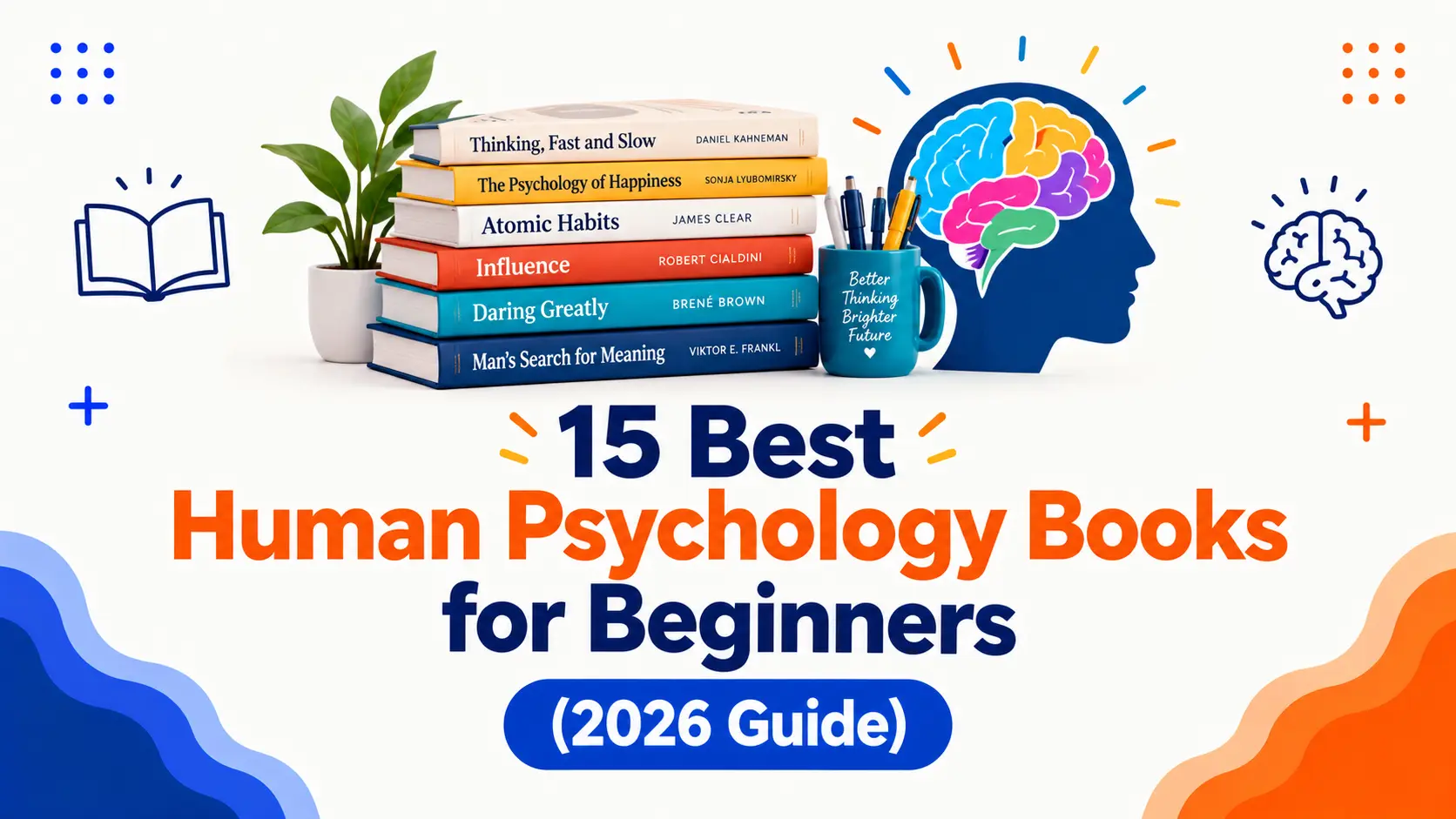
Ever wonder why you yelled at a coworker for no reason? Or why you bought something you didn’t need because a salesperson said it was “limited time only”? Most of us have never learnt to name the patterns that drive human behaviour. The quickest approach to get a grip on these patterns without a psychology degree is to read top quality, research-based books on human psychology geared for the general reader. This article breaks down 15 beginner-friendly options spanning five main disciplines of psychology so you can pick a starting point that best fits what you’re wanting to learn out about yourself or the people around you.
What Makes a Psychology Book Great for Beginners?
A beginner’s psychology book that explains real research in simple language, tells tales you can relate to (instead of stats), and provides you something you can use the same day you finish a chapter. The best entrance points are virtually completely devoid of academic jargon. They don’t use citation-heavy literature reviews. They use case studies, personal stories, and basic thinking experiments. Good test: if you can communicate to a buddy the primary idea of the book in a few phrases after reading a chapter, then it’s performing its job.
Three qualities separate a genuinely useful starter book from a bloated bestseller:
- Narrative clarity — concepts are taught through stories, not lecture-style prose
- Practical takeaways — you finish with at least one behavior change or mental model
- Credible sourcing — the author is a working psychologist, researcher, or science journalist working directly with primary research
How Do You Choose a Psychology Book Based on Your Goal?
Your starting book should match the specific question you’re trying to answer, not just the author’s popularity. Someone trying to stop procrastinating needs a different book than someone trying to understand a difficult relationship. Use the table below to match your goal to a category, then jump to that section in the list.
| Your Goal | Best Category | Starting Book |
| Understand why I make bad decisions | Cognitive Psychology | Thinking, Fast and Slow |
| Resist manipulation and sales tactics | Social Psychology | Influence |
| Find purpose after a hard life event | Humanistic Psychology | Man’s Search for Meaning |
| Manage anxiety, stress, or past trauma | Biological & Trauma Psychology | The Body Keeps the Score |
| Build better habits and routines | Behavioral Economics | Atomic Habits |
If you’re still not sure where you fit, our breakdown of the main types of psychology covers how these branches differ and why they overlap more than most reading lists admit.
What Are the Best Psychology Books on Cognitive Science and Decision-Making?
Cognitive psychology books explain how your brain processes information, forms judgments, and falls into predictable thinking errors. This branch sits at the center of behavioral science, and it’s the natural entry point for readers who want to understand their own decision-making before anything else.
1. Thinking, Fast and Slow — Daniel Kahneman
Kahneman, a Nobel Prize-winning psychologist, splits the mind into two systems: fast, intuitive System 1 and slow, deliberate System 2. The book walks through decades of research on cognitive bias, showing exactly where intuition helps and where it quietly sabotages you. It’s dense in places, but every chapter pays off with a concrete example you’ll recognize from your own life. The American Psychological Association’s own research on how bias affects expert judgment echoes the core framework on which Kahneman built his career.
2. Predictably Irrational — Dan Ariely
Ariely, a behavioral economist, runs playful experiments to show that irrational choices aren’t random — they’re systematic and predictable. Chapters on pricing, procrastination, and dishonesty translate directly into everyday decisions like why “buy one, get one free” feels irresistible even when you don’t need two.
3. Blink — Malcolm Gladwell
Gladwell examines snap judgments and the unconscious reasoning behind them. It’s the lightest read on this list, built almost entirely around stories rather than data tables, which makes it a strong first pick if denser cognitive science texts feel intimidating.
Readers who want a deeper technical grounding after these three should check our cognitive psychology guide for how memory, attention, and perception connect to decision-making at a mechanical level.
What Are the Best Psychology Books on Social Influence and Persuasion?
Social psychology books reveal how group dynamics, authority, and subtle social cues shape behavior far more than people assume. This branch matters to anyone who negotiates, sells, manages a team, or wants to stop being an easy target for manipulation.
4. Influence: The Psychology of Persuasion — Robert Cialdini
Cialdini identifies six persuasion triggers: reciprocity, commitment, social proof, liking, authority, and scarcity. Cialdini’s original research was later adapted into a widely cited Harvard Business Review article on applying the six principles of persuasion, and it remains one of the most practically useful frameworks in applied psychology. This book is the single most cited entry point for understanding why people say “yes.”
5. The Social Animal — Elliot Aronson
A narrative-driven overview of social behavior covering conformity, prejudice, attraction, and group dynamics. Aronson uses a fictional case study that runs through the chapters, keeping the pacing closer to a novel than a textbook.
6. Mistakes Were Made (But Not by Me) — Carol Tavris & Elliot Aronson
This book tackles cognitive dissonance and self-justification — why people double down on bad decisions rather than admit fault. It pairs well with material on normative versus informational social influence if you want to understand the mechanics behind group conformity in more depth.
What Are the Best Psychology Books on Humanistic and Existential Psychology?
Humanistic psychology books focus on meaning, motivation, and self-actualization rather than pathology or bias. This branch offers the most emotionally resonant reading on the list, and it’s often the category readers return to during major life transitions.
7. Man’s Search for Meaning — Viktor Frankl
Frankl, a psychiatrist and Holocaust survivor, developed logotherapy — the idea that finding meaning, even in suffering, is a central human drive. It’s short, under 200 pages, and consistently ranks among the most recommended psychology books of the last century for a reason: it reframes hardship without minimizing it.
8. Toward a Psychology of Being — Abraham Maslow
Maslow expands on his hierarchy of needs, arguing that self-actualization is a natural, achievable human drive rather than a rare exception. Readers already familiar with Maslow’s pyramid from school will find far more nuance here than the simplified diagram usually shown in classrooms.
9. Flow — Mihaly Csikszentmihalyi
Csikszentmihalyi defines “flow” — the state of complete absorption in an activity — and explains the conditions that produce it. It’s especially useful for readers trying to understand motivation and creativity, and why certain tasks feel effortless while others drag on.
What Are the Best Psychology Books on the Brain, Body, and Trauma?
Biological and trauma psychology books connect nervous system function to emotional regulation, explaining why stress and trauma live in the body as much as the mind. This branch has grown rapidly as neuroscience research has caught up with clinical observation.
10. The Body Keeps the Score — Bessel van der Kolk
Van der Kolk, a psychiatrist specializing in trauma, argues that traumatic experiences reshape the nervous system in ways talk therapy alone can’t always reach. The National Institute of Mental Health’s resources on coping with traumatic events reinforce the biological framing van der Kolk builds his entire argument around.
11. Emotional Intelligence — Daniel Goleman
Goleman popularized the concept of EQ, arguing that self-awareness and emotional regulation predict life success as much as raw intelligence. A recent integrative review of the neuroscience of emotional intelligence describes it as a construct that links affective processing, social behavior, and adaptive functioning across genetic and neurophysiological domains — giving Goleman’s decades-old theory fresh scientific backing.
12. The Brain That Changes Itself — Norman Doidge
Doidge covers neuroplasticity through real patient case studies, showing how the brain physically rewires itself after injury, habit change, or intensive practice. For readers who want the underlying biology explained more directly, our guide on how the brain is studied in psychology breaks down the research methods behind these findings.
What Are the Best Psychology Books on Habits and Behavioral Economics?
Behavioral economics books explain why humans consistently make irrational financial and personal choices, and how small environmental nudges can correct for those patterns. This is the most immediately actionable category on the list — most readers finish these books and change something within a week.
13. Nudge — Richard Thaler & Cass Sunstein
Thaler, a Nobel laureate in economics, and Sunstein, a legal scholar, argue that small changes in how choices are presented (“choice architecture”) can steer people toward better decisions without restricting freedom. It’s the foundational text behind most modern behavioral-design policy work.
14. Atomic Habits — James Clear
Clear breaks habit formation into four stages — cue, craving, response, reward — and gives concrete, testable strategies for each. It’s the most practical, checklist-friendly book on this entire list, which explains its long-running bestseller status.
15. The Power of Habit — Charles Duhigg
Duhigg, a journalist, traces the neuroscience of habit loops through corporate and personal case studies, including how major companies engineered consumer routines. It complements Clear’s book well: Duhigg explains why habits form, and Clear explains how to change them.
How Should a Beginner Structure a Psychology Reading List?
A good beginner’s reading list should follow a five pillar sequence: cognitive psychology, social psychology, humanistic psychology, biological/trauma psychology, and behavioural economics. This order of reading fits with most beginning psychology classes, typically going from “how I think” to “how I relate to others” to “why I struggle to change.”
- Cognitive Psychology — how we think, pay attention, and make decisions
- Social Psychology — how group dynamics, authority, and culture alter behavior
- Humanistic & Existential Psychology — how humans find purpose and motivation
- Biological & Trauma Psychology — how the brain and nervous system process stress
- Behavioral Economics — why humans make irrational financial and personal choices
If you’re curious how these five pillars map onto formal academic training, our psychological theories guide and psychology theorists and key concepts breakdown go deeper into the researchers behind each framework.
What Mistakes Do Beginners Make When Starting a Psychology Reading List?
The most common beginner mistake is trying to read across all five branches at once rather than finishing one category before moving on to the next. Jumping between a cognitive science book, a trauma-focused book, and a social psychology book in the same week scatters the concepts before any of them stick. A few other patterns show up repeatedly among first-time readers:
- Treating the book as entertainment instead of a working tool — nothing changes if you don’t pause and apply at least one idea per chapter
- Skipping the “boring” chapters — foundational chapters on research methods usually explain why a concept works, and skipping them weakens everything that follows
- Confusing a popular book with settled science — even well-sourced authors simplify nuance for readability, so treat a single book as a starting point, not a final answer
- Ignoring how concepts connect — cognitive bias, social influence, and habit formation constantly overlap in practice, even though books tend to isolate them for clarity
If you notice yourself nodding along to a chapter on decision fatigue and then immediately connecting it to a stressful pattern at home, that overlap is worth following. Our piece on why humans act the way they do maps several of these cross-branch connections directly, and the 10 interesting psychology facts roundup is a lighter way to test whether a topic is worth a full book before committing to one.
How Do These Books Apply to Relationships and Everyday Interactions?
Most of what these books teach shows up first in relationships, not in abstract decision-making. Cialdini’s persuasion principles explain why a friend’s request feels harder to refuse in person than over text. Van der Kolk’s trauma research explains why certain conversations trigger a physical stress response before you’ve consciously registered why. Even simple nonverbal cues, covered in our guide on how to read body language, draw directly from the same social psychology research base as The Social Animal and Influence.
Readers working through attachment patterns in a relationship often pair this reading list with material specifically on attachment styles, since Maslow’s and Frankl’s work on motivation intersects heavily with how people bond and seek security. And if stress management is the immediate goal rather than long-term theory, our seven easy ways to reduce stress offers a faster, more tactical companion to the deeper biological framing in The Body Keeps the Score.
How Does Your Brain Lens Approach Beginner Psychology Education?
Yourbrainlens is about bringing academic psychology into everyday use, yet without losing the nuance that makes research genuinely valuable. Each book on this list was picked because it holds up to actual life, not because it was a bestseller. If a title made our list, it’s because a newbie may pick up a chapter on a Tuesday nite and by Wednesday morning notice a change in how they read a discussion.
Frequently Asked Questions
What is the best psychology book to read first as a beginner?
Thinking, Fast and Slow by Daniel Kahneman and The Social Animal by Elliot Aronson are widely considered the strongest entry points. Kahneman breaks down how decisions actually get made, while Aronson offers a narrative overview of social behavior and human interaction that reads more like fiction than research.
Can I learn human psychology by reading popular books?
Yes. Popular psychology books written by working psychologists, neuroscientists, and behavioral economists translate academic research into everyday language. They cover cognitive bias, emotional regulation, and social influence without requiring a background in statistics first.
What core topics should a beginner’s psychology reading list cover?
A solid beginner list covers five pillars: cognitive psychology (thinking and decision-making), social psychology (group dynamics and influence), behavioral economics (irrational financial and personal choices), biological and trauma psychology (brain and nervous system responses to stress), and humanistic psychology (motivation and self-actualization).
Do I need a psychology degree to understand these books?
No. Every book on this list was deliberately chosen for a general audience with no academic background required. Authors like Kahneman, Cialdini, and Goleman built their reputations specifically on translating dense research into plain-language books for non-specialists.
How long does it take to read through a beginner psychology reading list?
Most readers finish one book every two to three weeks at a casual pace, meaning a full 15-book list realistically spans six to nine months. Reading within a single category before moving to the next — rather than jumping between branches — tends to improve retention.
Does real scientific research back these psychology books?
Yes, though the depth varies by author. Kahneman, Cialdini, van der Kolk, and Thaler all built their books directly on peer-reviewed research and, in several cases, their own published studies. Gladwell and Duhigg lean more heavily on journalism and case studies, which makes them easier reads but slightly less rigorous than the academic-authored titles.
Final Thoughts: Where Should You Start?
Fifteen books is a lot to look at all at once, so filter it down by the question that’s genuinely affecting you right now. If you persist on making the same terrible decision, start with Kahneman. If someone is coaxing you into things you don’t want, start with Cialdini. If you have some serious stuff from your history, start with van der Kolk. Choose one book, read it to the end before acquiring the next. Allow yourself to skip books that don’t fit in with what you are actually working through. Once you’ve knocked off your first option from this list, our what is psychology guide is a fantastic next trip for a bigger picture of how these ideas fit into the discipline at large.







One thought on “15 Best Human Psychology Books for Beginners (2026 Guide)”