Summary: Descriptive personality words are adjectives used to define an individual’s distinct character, temperament, and social behaviors. They fall into three primary categories: Positive (e.g., empathetic, resilient, charismatic), Negative (e.g., arrogant, cynical, manipulative), and Neutral (e.g., reserved, pragmatic, unconventional).
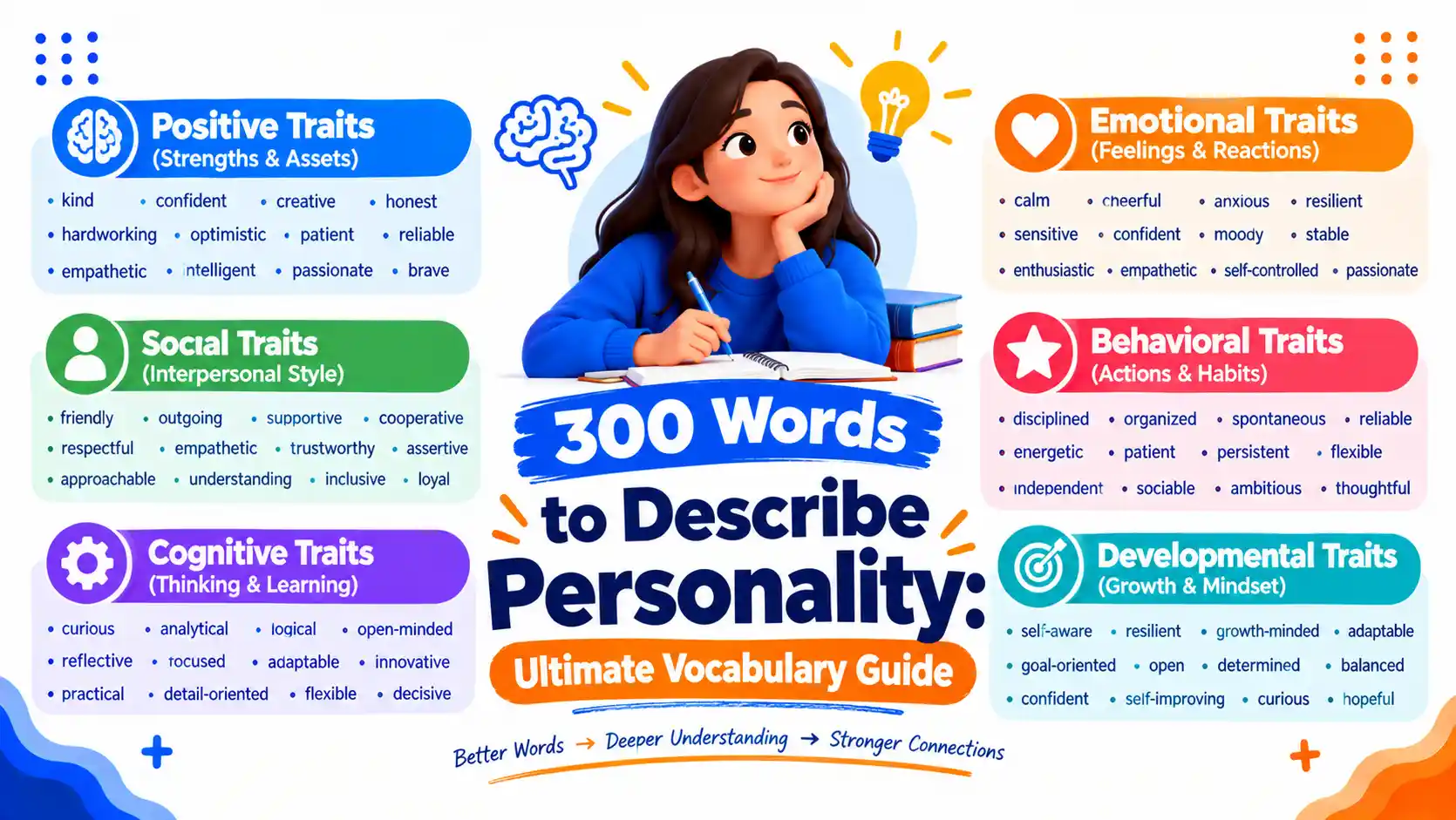
Most people know about ten personality words. Few can name fifty. That gap shows up when you write a character sketch, a resume, or a birthday card and every adjective feels flat. This guide provides 300 words to describe personality, grouped into positive, negative, and neutral categories. You’ll also see how psychologists classify traits and how to use each word in a real sentence. Finally, you’ll learn how to pick the right word for writing, work, and everyday conversation.
What Are Words to Describe Personality?
Words to describe personality are adjectives that name a person’s lasting patterns of thinking, feeling, and behaving. Psychologists call these patterns traits. Writers call them character. Everyday speakers say “what someone is like.” Most of these words fall into positive, negative, or neutral groups.
The American Psychological Association defines personality as the enduring characteristics and behavior that make up a person’s unique way of adjusting to life. Traits are the building blocks of that definition. When you call someone “patient,” you are making a prediction. You are saying they will probably stay calm the next time something goes wrong.
English has a huge trait vocabulary. Researchers Gordon Allport and Henry Odbert went through an English dictionary in the 1930s and found roughly 4,500 words that describe personality. That work led to the Lexical Hypothesis, the idea that the traits people care about most end up encoded in everyday language. Later researchers boiled those thousands of words down into broad dimensions, which we’ll cover below.
Want the wider picture first? Our guide to what psychology is explains how the field studies behavior, and our overview of psychological theories shows where trait theory fits within it.
What Are the Best Positive Words to Describe Someone’s Personality?
The best positive personality words are empathetic, resilient, articulate, dependable, and resourceful. They describe traits people value in friends, partners, coworkers, and leaders. Positive words work best when paired with evidence, such as an action or a moment that proves the trait.
Here are 100 positive words, grouped by theme so you can find the right one fast.
| Theme | Words |
| Warm and social (20) | empathetic, compassionate, kind, caring, warm, generous, friendly, approachable, considerate, supportive, gracious, tactful, affectionate, loyal, patient, forgiving, sincere, charismatic, cheerful, welcoming |
| Strong and driven (20) | resilient, determined, ambitious, persistent, courageous, disciplined, focused, motivated, tenacious, bold, confident, decisive, driven, fearless, hardworking, independent, self-reliant, steadfast, proactive, assertive |
| Smart and creative (20) | articulate, curious, insightful, creative, imaginative, resourceful, perceptive, thoughtful, inventive, intelligent, wise, observant, open-minded, innovative, knowledgeable, witty, quick-witted, adaptable, original, visionary |
| Reliable and ethical (20) | dependable, honest, trustworthy, responsible, reliable, principled, ethical, fair, humble, modest, authentic, genuine, conscientious, punctual, accountable, respectful, dignified, diligent, thorough, honorable |
| Positive energy (20) | optimistic, enthusiastic, upbeat, energetic, playful, humorous, easygoing, lively, adventurous, spontaneous, passionate, hopeful, joyful, good-natured, level-headed, calm, composed, grounded, balanced, serene |
How do you use these words in a sentence?
Show the trait in action. “Maya is empathetic” tells the reader very little. “Maya noticed her coworker skipping lunch and quietly left a sandwich on his desk” proves it. Use the adjective as a label and the behavior as the evidence.
Research on mindset supports the idea that this matters. The way you frame people and situations shapes how you feel about them. Our piece on how positive thinking affects the brain explains the science behind it.
What Are Negative Words to Describe a Character?
Negative personality words describe traits that harm relationships, block growth, or cause distress to others. Examples include arrogant, cynical, manipulative, and unreliable. Used carefully, they help writers build believable flawed characters and help people name behavior patterns they want to change.
Here are 100 negative words, grouped by the kind of behavior they describe.
| Theme | Words |
| Ego and pride (20) | arrogant, conceited, boastful, vain, selfish, entitled, pompous, egotistical, smug, condescending, snobbish, self-absorbed, haughty, bossy, domineering, controlling, pushy, overbearing, cocky, self-righteous |
| Dishonest or harmful (20) | manipulative, deceitful, dishonest, devious, sneaky, cunning, treacherous, hypocritical, two-faced, scheming, unscrupulous, exploitative, ruthless, vindictive, spiteful, malicious, cruel, callous, heartless, vengeful |
| Mood and attitude (20) | cynical, pessimistic, bitter, moody, irritable, grumpy, hostile, resentful, sullen, gloomy, sarcastic, judgmental, petty, whiny, jealous, envious, temperamental, short-tempered, volatile, cranky |
| Work and reliability (20) | lazy, careless, irresponsible, unreliable, negligent, sloppy, apathetic, indifferent, disorganized, unmotivated, passive, flaky, impulsive, reckless, rude, stubborn, inflexible, closed-minded, defensive, undisciplined |
| Social and emotional (20) | clingy, needy, insecure, anxious, timid, withdrawn, awkward, gullible, naive, dependent, helpless, fearful, spineless, submissive, dramatic, attention-seeking, nosy, gossipy, intrusive, tactless |
Are negative words the same as personality disorders?
No. Calling someone “cold” or “self-absorbed” describes everyday behavior. A personality disorder is a clinical diagnosis made by a trained professional after a careful evaluation. Never use these adjectives as medical labels for yourself or others.
Want a deeper look at difficult traits and their origins? Read our full breakdown of negative personality traits.
What Are Neutral Personality Traits?
Neutral personality traits are characteristics that are neither inherently good nor bad, and their value depends on context. A cautious person is a great safety inspector and a frustrating skydiving partner. Words like reserved, analytical, intense, and unconventional all live in this middle zone.
Here are 100 neutral words.
| Theme | Words |
| Reserved and quiet (20) | reserved, introverted, quiet, private, shy, reflective, solitary, serious, formal, understated, low-key, soft-spoken, contemplative, self-contained, detached, guarded, deliberate, laid-back, mellow, traditional |
| Thinking style (20) | analytical, pragmatic, logical, rational, practical, cautious, skeptical, methodical, meticulous, detail-oriented, systematic, objective, realistic, frugal, strategic, inquisitive, competitive, perfectionistic, sensible, matter-of-fact |
| Social style (20) | outgoing, extroverted, talkative, blunt, direct, outspoken, opinionated, intense, unconventional, eccentric, quirky, sensitive, emotional, expressive, demonstrative, informal, casual, spirited, animated, theatrical |
| Values and outlook (20) | flexible, idealistic, sentimental, nostalgic, ambivalent, unhurried, thrifty, protective, pensive, dreamy, whimsical, nonconformist, rebellious, free-spirited, rule-abiding, self-directed, old-fashioned, worldly, philosophical, unpredictable |
| Work style (20) | task-focused, goal-oriented, hands-on, outcome-driven, deadline-driven, team-oriented, autonomous, structured, organized, orderly, demanding, exacting, high-energy, no-nonsense, businesslike, strong-willed, headstrong, persuasive, tough-minded, single-minded |
Why does context change the meaning of a neutral word?
Take “blunt.” In a medical emergency, a blunt doctor saves time. At a funeral, a blunt guest hurts feelings. The trait stays the same, but the setting flips the verdict. Here’s a quick reframing table that shows the idea.
| Neutral trait | Where it helps | Where it hurts |
| Cautious | Financial planning, safety checks | Fast-moving creative projects |
| Reserved | Listening, confidential roles | Networking events, team brainstorms |
| Intense | Sports, research, deep focus | Casual friendships, relaxed teams |
| Unconventional | Design, startups, art | Rule-heavy compliance jobs |
| Opinionated | Debate, advocacy | Collaborative decision-making |
What Is the Difference Between Personality Traits and Character Traits?
Personality traits describe how a person typically behaves and reacts, while character traits describe the moral values behind those behaviors. Outgoing and lively are personality traits. Honest, loyal, and trustworthy are character traits. The two overlap, but they aren’t identical.
| Feature | Personality traits | Character traits |
| Focus | Behavior and emotional style | Morals and ethics |
| Examples | outgoing, calm, talkative, shy | honest, loyal, fair, brave |
| Visible to others? | Usually quickly | Usually over time and under pressure |
| Judged as good or bad? | Often neutral | Often moral (good or bad) |
| Can change? | Slowly, with effort | Through choices and habits |
Here’s a simple test. A shy person can be honest. A loud person can be dishonest. Shyness is personality. Honesty is character. If you’re writing fiction, this is gold. Giving a character a personality that contradicts their character creates instant depth, like a cheerful, friendly con artist.
How Do the Big Five Personality Traits Connect to These Words?
The Big Five model groups most personality traits into five broad dimensions: openness, conscientiousness, extraversion, agreeableness, and neuroticism. It grew out of the Lexical Hypothesis and is the most widely accepted framework for traits in modern research. You can read the formal definition in the APA’s entry on the five-factor model.
Here is how many of the 300 words map onto each dimension.
| Big Five trait | High-end words | Low-end words |
| Openness | curious, imaginative, inventive, unconventional | traditional, practical, old-fashioned, cautious |
| Conscientiousness | disciplined, organized, dependable, thorough | careless, disorganized, flaky, undisciplined |
| Extraversion | outgoing, talkative, energetic, assertive | reserved, quiet, solitary, low-key |
| Agreeableness | empathetic, kind, cooperative, forgiving | hostile, spiteful, ruthless, callous |
| Neuroticism | anxious, moody, sensitive, volatile | calm, composed, level-headed, grounded |
Where do introversion and extroversion fit?
Introversion and extroversion sit at opposite ends of the extraversion scale. An introvert recharges alone. An extrovert recharges around people. Neither is better. Both appear in our neutral list for that reason.
What about Myers-Briggs (MBTI)?
The Myers-Briggs Type Indicator sorts people into 16 types using four preference pairs. It’s popular in workplaces and for self-reflection, though researchers generally prefer the Big Five for scientific work. Both systems give you useful vocabulary. MBTI gives you shorthand like “introverted” and “judging,” while the Big Five gives you a continuum.
Curious how personality shapes stress and health? Compare Type A and Type C personalities. To see how early relationships shape the way we connect, read about attachment styles.
How Do You Describe Someone’s Character in Writing?
To describe character in writing, pair one precise adjective with a specific action that proves it. Don’t stack five adjectives in a row. Pick the strongest word, then show the trait through behavior, dialogue, or a small physical detail.
Follow these five steps.
- Choose one core trait. Start with a single word from the lists above, such as “meticulous.”
- Add a contradiction. Real people are not one-note. A meticulous person who forgets birthdays feels human.
- Show it through action. Don’t write “Dan was meticulous.” Write “Dan realigned the pencils on his desk before answering the phone.”
- Use dialogue. How someone talks reveals temperament faster than any label.
- Let others react. A coworker rolling her eyes at the pencils tells the reader more than a paragraph of description.
For general writing guidance on word choice and clarity, the Purdue Online Writing Lab is a trusted free resource.
Weak versus strong character description
| Weak | Strong |
| She was generous. | She paid for the stranger’s groceries and walked out before he could say thanks. |
| He was arrogant. | He corrected the professor in front of the whole class, then checked who was watching. |
| They were anxious. | They rechecked the locked door three times and still sat by the window. |
Notice that each strong example uses no adjective at all. The best personality vocabulary often lives in your head while the reader only sees the behavior.
What Are Good Words to Describe a Friend’s Personality?
Good words to describe a friend’s personality are loyal, supportive, funny, genuine, and thoughtful. Friendship traits tend to focus on warmth, trust, and shared humor. Choose words that match what you actually value about that person, not just generic compliments.
Try these combinations for different moments:
- Birthday card: “You’re the most generous and hilarious person I know.”
- Wedding toast: “Sam is loyal to a fault and endlessly patient with all of us.”
- Recommendation or tribute: “She is perceptive, reliable, and quietly courageous.”
- Honest but kind: “He’s opinionated, and that’s why I trust his advice.”
That last example shows a neat trick. A neutral word can deliver honest feedback without sounding like an insult. If you want to read people better in person, our body language guide shows how behavior reveals personality, and our article on social characteristics explains how people behave in groups.
What Words Describe a Professional Personality at Work?
The best professional personality traits are adaptability, attention to detail, proactivity, strategic thinking, and collaboration. They signal skills employers can verify. Use them in resumes, cover letters, and interviews, but always back them up with a result or example.
Which words work best on a resume?
On US resumes, hiring managers favor action-oriented, measurable language. On UK CVs, a slightly more understated tone is common, so “diligent,” “methodical,” and “organised” (with an s) fit well. Whichever market you target, avoid empty claims. “Detail-oriented” means little alone. “Caught a pricing error that saved $12,000” means a lot.
| Goal | Strong words | Example line |
| Show leadership | decisive, strategic, motivating | “Led a team of 8 through a product relaunch.” |
| Show teamwork | collaborative, supportive, approachable | “Partnered with sales and design to cut turnaround time.” |
| Show reliability | dependable, punctual, accountable | “Met every deadline across 14 client projects.” |
| Show growth | adaptable, curious, proactive | “Taught myself SQL to automate weekly reports.” |
| Show communication | articulate, tactful, persuasive | “Presented quarterly results to executive leadership.” |
Which words should you avoid in interviews?
Skip words that are vague or boastful, like “perfectionist” or “workaholic.” Interviewers have heard them thousands of times. Pick a real strength and tell a short story. If asked about a weakness, choose a neutral trait like “cautious” and explain how you manage it.
What about ESL learners?
If English is your second language, learn words in families. Study “dependable, reliable, trustworthy” together, then notice how they differ slightly. “Reliable” fits tools and people. “Trustworthy” is about honesty. Short example sentences beat long definitions every time.
How Can You Build a Stronger Personality Vocabulary?
You build a stronger personality vocabulary by learning words in context, grouping them by shade of meaning, and using them within 24 hours. Memorizing lists alone rarely works. You need to attach each word to a real person, scene, or memory.
Try these habits:
- Sort synonyms by intensity. “Annoyed, irritable, hostile, furious” is a ladder. Know which rung you mean.
- Learn antonym pairs. Learning “generous” next to “stingy” doubles your recall.
- Describe one person daily. Pick a coworker, character, or celebrity and write two sentences using two new words.
- Notice emotional intelligence in action. People with strong emotional awareness tend to describe others with more precision. They can separate “shy” from “stuck-up” or “assertive” from “aggressive.”
- Watch your self-image words. The adjectives you use about yourself shape how you act. Calling yourself “lazy” is different from saying you “struggle with starting tasks.”
If everyday stress affects how you see yourself and others, these easy ways to reduce stress can help. To explore the thinking behind your own habits, our guide to the mind and thoughts is a good next read. For a deeper look at why people act the way they do, see “Why Humans Act.”
Frequently Asked Questions
What are 5 positive words to describe a person’s personality?
Five strong positive words are empathetic, resilient, articulate, dependable, and resourceful. Each one points to a specific strength: understanding others, bouncing back, communicating clearly, being reliable, and solving problems.
What are neutral personality traits?
Neutral personality traits are characteristics that are neither inherently good nor bad, and their perception depends on context. Examples include cautious, reserved, analytical, unconventional, and intense. A trait that helps in one situation may hurt in another.
What is the difference between character traits and personality traits?
Personality traits represent outward behavioral patterns and emotional responses, such as being outgoing or lively. Character traits reflect internal moral and ethical values, such as honesty, loyalty, and trustworthiness. A person can be shy (personality) and still be deeply honest (character).
How do you describe a strong personality on a resume?
Use professional, action-oriented adjectives such as adaptable, detail-oriented, proactive, strategic, and collaborative. Back each word with a measurable result or short example so it reads as evidence rather than a claim.
How many words describe personality in English?
Researchers in the 1930s counted about 4,500 trait-related terms in an English dictionary. Modern psychology compresses these into five broad dimensions known as the Big Five. The 300 words in this guide cover the most useful everyday terms across all five.
Conclusion: Put These 300 Words to Work
Good personality words are precise, honest, and backed by behavior. Start small. Choose five words from each list (positive, negative, and neutral) and use them this week in a message, a journal entry, or a story. Then sort the rest by Big Five dimension, and you’ll see patterns in people you hadn’t noticed before.
At yourbrainlens, we turn psychology into plain-English guides you can actually use. Ready for your next step? Read our breakdown of negative personality traits, then explore human psychology books to keep learning. Bookmark this page, share it with a writer or job seeker you know, and come back whenever you need the right word.