
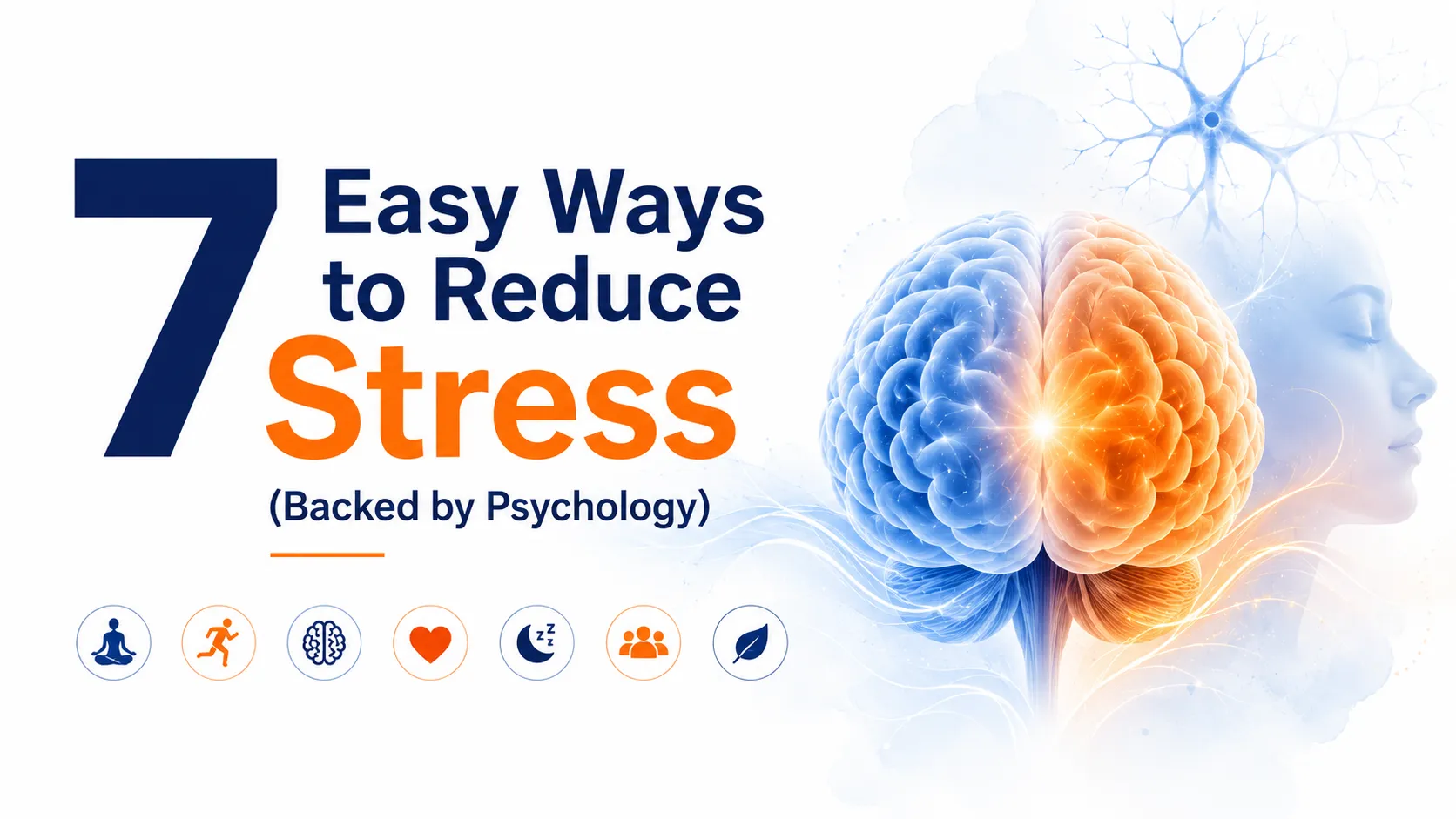
Stress isn’t a character flaw. It’s biology. Your Brain is doing exactly what it evolved to do — scanning for threats and firing up your body to deal with them. The problem is that a looming deadline, a blunt message from your boss, or an unpaid bill triggers almost the same alarm system that once helped humans escape predators.
The good news? Psychology has spent decades studying what actually works. Not vague advice like “just relax,” but tested, repeatable stress reduction techniques you can use in the next five minutes.
This guide walks through 7 easy, psychology-backed ways to reduce stress — why each one works, how to do it properly, and the small mistakes that cause people to give up too early. No medication. No expensive equipment. Just methods grounded in how your nervous system genuinely operates.
Let’s get into it.
What Is Stress? A Simple Psychological Definition
Stress is your body’s automatic response to any demand that feels bigger than you can handle. That gap — between demand and perceived resources — is the whole story. Psychologists call this the transactional model of stress, developed by Richard Lazarus and Susan Folkman in the 1980s.
Two people can face the same situation. One feels energized, the other feels crushed. The difference isn’t the event. It’s the appraisal — how the mind sizes up the threat versus its own coping ability.
The Stress Response, Step by Step
When your Brain flags a stress trigger, a chain reaction fires:
- The amygdala (your Brain’s smoke detector) spots a threat — real or imagined.
- The hypothalamus signals the alarm.
- The sympathetic nervous system activates the fight-or-flight response.
- Stress hormones flood in — adrenaline first, then cortisol.
- Your body shifts: heart rate climbs, breathing shortens, muscles tighten, digestion pauses, blood sugar spikes.
This is brilliant engineering for a short emergency. It’s terrible as a permanent setting.
Acute Stress vs Chronic Stress
| Acute Stress | Chronic Stress | |
|---|---|---|
| Duration | Minutes to hours | Weeks to years |
| Cortisol levels | Spike, then return to baseline | Stay elevated |
| Feeling | Alert, focused, urgent | Drained, foggy, irritable |
| Effect | Often helpful | Damaging over time |
| Example | Job interview | Toxic workplace |
Acute stress can sharpen you. Chronic stress erodes you—understanding which one you’re dealing with changes which technique you reach for.
Stress vs Anxiety: What’s the Difference?
Stress usually has an identifiable external trigger and fades when the trigger is removed. Anxiety often persists without a clear cause and involves anticipating future threats. You get stressed about the presentation on Friday. You feel anxious about a vague sense that something will go wrong.
They overlap significantly and share the same physical machinery, which is why the techniques below apply to both. If you’re curious about how the mind builds these patterns in the first place, our complete guide to what psychology is breaks down the foundations in plain language.
Why Learning How to Reduce Stress Actually Matters
We’ve normalized being frazzled. “Busy” became a personality. But chronic stress effects aren’t cosmetic — they’re structural.
What Chronic Stress Does to Your Brain
Sustained high cortisol has been linked to measurable changes:
- Hippocampus shrinkage — the memory hub takes damage, which is why stressed people forget things constantly.
- Amygdala enlargement — the threat detector gets louder and more reactive.
- Weakened prefrontal cortex activity — your rational, planning, impulse-control region goes offline exactly when you need it most.
That last point explains a lot. Ever made a terrible decision while stressed and thought, “What was I thinking?” You weren’t, really. Not with the part of the Brain that does careful thinking.
What It Does to Your Body
The World Health Organization and major health bodies connect prolonged stress to:
- Elevated blood pressure and cardiovascular strain
- Suppressed immune function (more colds, slower healing)
- Digestive problems — IBS, reflux, appetite chaos
- Disrupted sleep architecture
- Tension headaches and chronic muscle pain
- Higher risk of depression and anxiety disorders
- Burnout — now formally recognized by the WHO as an occupational phenomenon
The Cost Nobody Talks About
Stress doesn’t only hurt you. It leaks. It makes you snappier with people you love, less patient with your kids, and more withdrawn from friends who’d actually help. It quietly shrinks your world.
That’s the real argument for stress management techniques. Not productivity. Not “optimizing.” Just getting your life back.
What Does Psychology Say About Managing Stress?
Psychology says stress is managed at two points: the trigger and the response. You can either change the situation (problem-focused coping) or change your relationship to it (emotion-focused coping). Effective stress management uses both, matched to whether the stressor is controllable.
Here’s the rule of thumb researchers keep landing on:
- Controllable stressor? → Take action. Problem-focused coping wins.
- Uncontrollable stressor? → Regulate your response. Emotion-focused coping wins.
Applying the wrong one is why people burn out. Trying to “control” a family member’s illness through frantic effort is exhausting. Trying to “accept” a fixable bad process at work is just avoidance.
The seven techniques below cover both categories. Use them accordingly.
The 7 Psychology-Backed Ways to Reduce Stress
1. Extended-Exhale Breathing (The Fastest Off-Switch You Own)
Can breathing exercises reduce stress instantly? Yes. Slow breathing with a longer exhale than inhale activates the parasympathetic nervous system within 60–90 seconds, lowering heart rate and reducing the physical intensity of the stress response.
This is the single fastest way to reduce stress, and it’s free.
Why it works: Your vagus nerve monitors your breathing. Short, shallow, chest-based breaths signal danger. Slow breaths with an extended exhale signal safety. Critically, the signal travels upward — from body to Brain. You don’t have to convince yourself you’re calm. You have to breathe in a way that only a calm person breathes, and the Brain follows.
This is nervous system regulation at its most literal.
How to do it — the 4-7-8 method:
- Exhale fully through your mouth.
- Inhale quietly through your nose for 4 counts.
- Hold for 7 counts.
- Exhale slowly through your mouth for 8 counts.
- Repeat 4 cycles. That’s it.
Simpler version — physiological sigh: Two quick inhales through the nose (one big, one small top-up), then one long, slow exhale through the mouth. Do it 2–3 times. Stanford researchers found this to be one of the most efficient real-time stress reducers studied.
Common mistake: Breathing into your chest. Put a hand on your belly — it should rise before your chest does. If only your shoulders move, you’re doing the anxious version of breathing.
Best for: Panic moments, pre-presentation nerves, mid-argument, 3 a.m. wake-ups.
2. The 5-4-3-2-1 Grounding Technique
What is the 3-3-3 rule for anxiety? Name 3 things you can see, 3 sounds you can hear, and move 3 parts of your body. It interrupts anxious spiraling by forcing attention onto immediate sensory reality.
The 5-4-3-2-1 method is its bigger cousin, and it’s a staple of trauma-informed therapy.
Why it works: Stress lives in time travel. You’re either replaying the past or rehearsing a catastrophic future. Neither exists right now. Grounding techniques hijack your attention and drag it into the present, where the threat usually isn’t. It also occupies working memory — leaving less bandwidth for rumination.
How to do it:
- 5 things you can see (the chipped mug, a cable, dust on the shelf)
- 4 things you can feel (chair against your back, fabric on your wrist)
- 3 things you can hear (fan hum, distant traffic, your own breath)
- 2 things you can smell (coffee, soap)
- 1 thing you can taste (or one thing you’re grateful for)
Go slowly. Actually, notice each one. Rushing it defeats the point.
Pro tip: Add a physical anchor — cold water on your wrists, an ice cube in your palm, feet pressed hard into the floor. Intense sensory input works even faster.
Best for: Anxiety spikes, dissociation, overwhelm, that “I can’t think straight” feeling.
3. Cognitive Reframing (Change the Thought, Change the Chemistry)
This is the heart of cognitive behavioral therapy, and it’s arguably the most powerful long-term tool on this list.
Why it works: Remember the Lazarus model — stress comes from appraisal, not events. Change the appraisal, change the stress. CBT consistently ranks among the most evidence-based stress management techniques in clinical research, with strong support from organizations such as the American Psychological Association.
The trap: Your Brain runs automatic thoughts you never consented to. They feel like facts. They’re usually distortions:
- Catastrophizing — “If this goes badly, my career is finished.”
- Mind reading — “She thinks I’m incompetent.”
- All-or-nothing — “If it’s not perfect, it’s worthless.”
- Should statements — “I should be handling this better.”
- Overgeneralizing — “I always mess this up.”
How to do it — the 4-question reframe:
- What exactly am I telling myself? (Write the thought down. Verbatim.)
- What’s the evidence for and against it? (Real evidence. Not feelings.)
- What would I say to a friend thinking this? (Notice how much kinder you get.)
- What’s a more accurate — not just more positive — thought?
Example in action:
Automatic thought: “I bombed that meeting. Everyone thinks I’m useless.” Evidence against: Two people nodded. One asked a follow-up. My manager said “good point” once. No one has said anything negative. Reframe: “I stumbled on one section and I’m embarrassed. It was an average meeting, not a career event. I’ll tighten that section next time.”
Notice the reframe isn’t “It was amazing!” Toxic positivity doesn’t work — your Brain knows you’re lying. Accuracy is the goal, not optimism.
Best for: Rumination, self-criticism, work stress, chronic worry. This is the long game.
4. Movement — Especially the Kind You Don’t Hate
Exercise reduces stress by metabolizing excess stress hormones, releasing endorphins, and improving sleep quality. Even a 10-minute brisk walk produces measurable improvements in mood.
Why it works: The fight-or-flight response prepares your body to move. When you don’t, the chemistry has nowhere to go. Exercise completes the loop — it’s the physical resolution your nervous system was expecting.
The research here is strong. Harvard Health notes that aerobic exercise reduces stress hormones over time and stimulates endorphin production. Some studies find that regular moderate exercise rivals medication for mild-to-moderate depression.
How to do it:
- Minimum effective dose: 10 minutes of brisk walking. Seriously.
- Ideal: 20–30 minutes, 3–5 times a week, at a pace where talking is possible but singing isn’t.
- Outdoors beats indoors. Green space adds a measurable bonus — sometimes called the “green exercise effect.”
- Rhythmic beats are especially intense for stress, walking, swimming, cycling, and dancing.
Yoga deserves its own mention. Yoga for stress management combines movement, breath control, and present-moment focus — it hits three mechanisms at once. Poses like child’s pose, legs-up-the-wall, and cat-cow are accessible to complete beginners and directly target relaxation.
Common mistake: Deciding you need a gym membership, a plan, and new shoes. You need a door and 10 minutes. Start embarrassingly small.
Best for: Chronic stress, low mood, sleep problems, pent-up frustration.
5. Expressive Writing (Journaling That Actually Does Something)
Why it works: Psychologist James Pennebaker’s research at UT Austin found that people who wrote about stressful experiences for 15–20 minutes across a few days showed improved immune function, fewer doctor visits, and better psychological outcomes — sometimes months later.
The mechanism is called affect labeling. Putting feelings into words reduces amygdala activity and increases prefrontal cortex engagement. Naming it tames it. Vague dread is unmanageable; a written sentence is a problem you can look at.
How to do it — expressive writing protocol:
- Set a timer for 15 minutes.
- Write about what’s stressing you and how you feel about it.
- Don’t stop. Don’t edit. Don’t worry about grammar.
- Nobody reads this. Not even you. You can delete it.
- Do it for 3–4 consecutive days on the same issue.
Two variations worth knowing:
The brain dump. Stressed at 11 p.m. with a racing mind? Write every single open loop — tasks, worries, half-thoughts — until the page is empty and your head isn’t. Your Brain holds onto unfinished things (the Zeigarnik effect). Externalizing them lets it release.
Gratitude practice. Three specific good things from today, plus why each happened. Specificity matters — “my friend texted to check in because she remembered my interview” beats “friends.” Gratitude research by Robert Emmons and others links it to better sleep, lower stress, and improved wellbeing. It takes 90 seconds.
Best for: Rumination, emotional overwhelm, decision paralysis, sleep-blocking thoughts.
6. Real Social Connection (Not the Scrolling Kind)
Why it works: Social support is one of the strongest protective factors against stress in the entire psychological literature. Being with a trusted person releases oxytocin, which directly buffers cortisol. Some studies show physical touch — a hug, a hand on the shoulder — lowering blood pressure within seconds.
There’s a fascinating finding here: in one study, people facing a hill judged it as less steep when standing next to a friend. Support literally changes how hard things look.
Meanwhile, scrolling social media while feeling isolated tends to make it worse. Passive consumption is not connected. Your nervous system knows the difference.
How to do it:
- Send one message. Not a plan. Just: “Hey, been thinking about you.”
- Call instead of text when it matters. Voice carries emotional information that text strips out.
- Say the actual thing. “I’ve been struggling” opens doors that “I’m fine, busy!” welds shut.
- Offer support too. Helping others reliably reduces your own stress — it’s one of the most consistent findings in prosocial research.
- Prioritize depth over breadth. Two people who really know you beat 400 contacts.
A note on asking: Most people wildly underestimate how willing others are to help. Studies on “the underestimation of compliance” show we predict rejection far more often than it happens. Ask anyway.
If you want to get better at reading the people around you — including spotting when they’re struggling — our guide to reading body language covers the nonverbal signals most people miss entirely.
Best for: Loneliness, grief, chronic stress, feeling stuck.
7. Protect Your Sleep Like It’s a Job
Why it works: Sleep and stress form a vicious cycle. Stress wrecks sleep. Poor sleep raises cortisol and cripples emotional regulation: round and round.
Research from Matthew Walker’s lab at UC Berkeley found that a single night of sleep deprivation increased amygdala reactivity to negative images by around 60%, while weakening the prefrontal cortex’s ability to regulate it. Translation: sleep-deprived, you are a different, more reactive person — and you won’t notice, because self-assessment is one of the first things to go.
How to do it — the non-negotiables:
- Fixed wake time. More important than bedtime. It anchors your circadian rhythm.
- No caffeine after 2 p.m. Its half-life is 5–6 hours. That 4 p.m. coffee is still 25% active at midnight.
- Cool, dark, quiet. Around 18–19°C (65°F) is the research-backed sweet spot.
- Screens out of the bedroom. It’s less about blue light than about the content keeping your Brain in problem-solving mode.
- Bed = sleep only. Working or doom-scrolling in bed teaches your Brain that bed is an alert zone.
- Can’t sleep after 20 minutes? Get up. Sit somewhere dim and boring until you’re sleepy. Lying there, frustrated, builds an association you don’t want.
- Alcohol is a sleep destroyer. It knocks you out, then shreds REM sleep in the second half of the night.
Best for: Everything. Genuinely. If you fix only one item on this list, fix this one.
Quick Stress Relief Techniques for Busy People
No time? Here’s the emergency kit:
| Time available | Technique |
|---|---|
| 30 seconds | Two physiological sighs |
| 1 minute | Cold water on wrists + 5-4-3-2-1 grounding |
| 2 minutes | 4-7-8 breathing, 4 cycles |
| 5 minutes | Walk outside, no phone |
| 10 minutes | Brain dump on paper |
| 15 minutes | Expressive writing or brisk walk |
Pin this somewhere. The whole point is to have a plan before you need it — because when you’re stressed, you won’t make good decisions.
How to Reduce Stress at Work Using Psychology
Occupational stress deserves its own section, because it’s where most people live.
The 4 A’s of Stress Management
A classic framework that’s genuinely useful:
- Avoid — Can you eliminate the stressor? Decline the optional meeting. Say no.
- Alter — Can you change it? Renegotiate the deadline. Ask for clarity.
- Adapt — Can you change your standards? Lower the bar for the low-stakes task.
- Accept — Can you release what you can’t control? Some things just are.
Run stressors through this in order. Most people jump straight to “accept” and quietly resent everything, or stay stuck in “alter” trying to fix the unfixable.
Practical Workplace Tactics
- Batch communications. Constant notification checking keeps your nervous system in a low-grade state of alert all day.
- Take the actual break. Attention Restoration Theory suggests that brief natural-environment breaks measurably restore cognitive resources. Eating at your desk isn’t a break.
- Build a shutdown ritual. A defined end-of-day sequence (close tabs, write tomorrow’s list, say a closing phrase) signals to your Brain that work is over. Without it, work bleeds into the evening.
- Name the controllables—two columns: what you control, what you don’t. Act on column one. Practice acceptance on column two.
- Watch for burnout-prevention signals — cynicism, exhaustion, and a reduced sense of accomplishment are the three classic markers. If all three show up, this stopped being a “push through it” problem.
Work-life balance isn’t a scheduling problem. It’s a boundary problem — and boundaries are psychological before they’re practical.
Do Foods Reduce Stress Naturally?
Some foods support stress resilience. Magnesium-rich foods (leafy greens, nuts, dark chocolate), omega-3 fatty acids (fatty fish, walnuts), and fermented foods that support gut health have research links to lower stress markers. No food eliminates stress on its own.
Worth knowing:
- Magnesium — involved in regulating the stress response; many people run low on it.
- Omega-3s — associated with reduced inflammation and lower anxiety markers in several trials.
- Gut health — the gut-brain axis is real. Roughly 90% of serotonin is produced in the gut.
- Blood sugar stability — sharp crashes mimic and amplify anxiety symptoms. Protein with each meal helps more than you’d expect.
- Hydration — mild dehydration measurably worsens mood and concentration.
What to be careful with: excess caffeine (it is a stress hormone amplifier), alcohol (short relief, worse rebound anxiety), and heavily processed sugar spikes.
Nutrition supports stress management. It doesn’t replace it.
Real-World Examples: What This Looks Like in Practice
Sara, 29, marketing executive. Constant tension headaches, waking at 4 a.m. She started with one thing: a fixed 6:45 a.m. wake time, seven days a week. Weeks 2–3 were rough. By week four, the 4 a.m. wake-ups stopped. Then she added a 10-minute walk after lunch. Headaches dropped from near-daily to roughly weekly. She never did meditate. Two changes. That’s it.
Bilal, 41, small business owner. Financial stress, snapping at his family. His tool was cognitive reframing — writing down catastrophic thoughts and testing them. “We’ll go under by March” became “revenue is down 15%, I have four months of runway, and here are three things I can try.” The situation didn’t change for another six months. His sleep improved within two weeks. The stress was in the appraisal, not just the numbers.
Ayesha, 22, university student. Exam stress and paralysis. She used 5-4-3-2-1 grounding before entering the exam hall and a 15-minute brain dump every night. Her grades improved — but more importantly, she stopped dreading the walk to campus.
Notice the pattern: nobody did all seven. Everyone did one or two consistently. That’s the whole trick.
Common Mistakes That Keep People Stuck
- Trying everything at once. Pick one. Do it for two weeks. Then add.
- Expecting instant results from long-term tools. Breathing works in 90 seconds. Cognitive reframing takes weeks: different tools, different timelines.
- Quitting because it felt awkward. Every psychological technique feels artificial at first. That’s normal, not evidence that it’s failing.
- Using avoidance and calling it self-care. A bath is lovely. It isn’t a substitute for the difficult conversation you’re avoiding.
- Believing stress is a personal failing. It’s a physiological response. Shame adds a second stressor on top of the first.
- Ignoring the source. All the breathing in the world won’t fix a genuinely unsustainable job. Sometimes the answer is to change the situation, not your response to it.
Why Choose Your Brain Lens
There’s no shortage of stress advice online. Most of it is recycled listicles written by people who’ve never read a study.
Your Brain Lens exists because psychology deserves better translation. We take the actual research — Lazarus, Pennebaker, Walker, Emmons, the CBT literature — and turn it into something you can use on a Tuesday afternoon without a psychology degree.
What makes us different:
- Research-first, always. Every claim traces back to something real.
- Plain language. No jargon walls. No academic hedging where a straight answer exists.
- Practical over theoretical. If you can’t use it this week, we’d rather not publish it.
- Honest limits. We’ll tell you when something needs a professional. Articles aren’t therapy.
Curious about the wider field? Start with our 10 interesting psychology facts — a quick, genuinely surprising look at how the mind actually operates. Or explore the full library at Your Brain Lens, where we cover behavior, cognition, and everyday psychology you can apply immediately.
How to Learn More: Free and Paid Resources
Free
- American Psychological Association — Stress topics — clinical-grade, plainly written.
- Mayo Clinic — Stress management — reliable medical grounding.
- NHS — Coping with stress — practical, no-nonsense guidance.
- Harvard Health Publishing — accessible research summaries.
- Free apps — Insight Timer (huge free Meditation library), Medito (fully free).
Paid
- Coursera — Yale’s “The Science of Wellbeing” — one of the most-taken online courses ever, free to audit.
- Coursera — De-Mystifying Mindfulness (Leiden University) — rigorous, not fluffy.
- CBT workbooks — David Burns’ Feeling Good and Mind Over Mood are clinician-recommended for a reason.
- Therapy — the highest-leverage option if stress is affecting daily functioning. Not a last resort. A tool.
Career and Future Opportunities in Stress Psychology
If reading this made you curious about the field itself, the demand is real and growing.
Where the work is:
- Clinical & counselling psychology — direct therapeutic practice
- Organizational psychology — workplace wellbeing, burnout prevention, culture design
- Health psychology — behavior change in medical settings
- Corporate wellness consulting — a fast-expanding market globally
- Content and communication — translating research for public audiences (this field is badly underserved)
- Coaching and training — stress management workshops for schools and companies
Why demand is rising: Employers now quantify the cost of burnout. Schools are building mental health into curricula. Remote work blurred boundaries and created new categories of stress. And in Pakistan specifically, mental health awareness has climbed sharply in the last few years — while the supply of qualified, credible practitioners hasn’t kept pace. That’s a gap.
Skills that matter: research literacy, empathy, clear communication, ethical judgment, and the ability to explain complex ideas simply — the last one being rarer than you’d think.
Start with the fundamentals in our ” What is Psychology ” guide, then follow your curiosity.
Frequently Asked Questions
What is the fastest way to reduce stress?
Slow breathing with a longer exhale than inhale. It activates the parasympathetic nervous system in 60–90 seconds. Try 4-7-8 breathing (inhale 4, hold 7, exhale 8, repeat 4 times) or two physiological sighs — a double inhale through the nose followed by one long exhale through the mouth.
What are 5 ways to relieve stress?
- Slow, extended-exhale breathing
- 5-4-3-2-1 grounding through your senses
- A 10-minute brisk walk, ideally outdoors
- Writing your thoughts down for 15 minutes
- Talking to someone you trust
All five are free, need no equipment, and have research support.
How does psychology help reduce stress?
Psychology identifies the mechanisms behind stress — appraisal, nervous system activation, and cortisol response — then targets each with tested interventions. CBT changes the thoughts that generate stress, breathing techniques regulate the physical response, and behavioral changes, such as exercise and sleep hygiene, rebuild baseline resilience.
What are 3 simple stress management techniques?
Deep breathing, cognitive reframing, and regular movement. Breathing calms your body in under two minutes. Reframing challenges the distorted thoughts driving the stress. Movement burns off stress hormones and improves sleep. Together,r they cover the physical, mental, and behavioral sides.
What is the 3-3-3 rule for anxiety?
Name 3 things you can see, 3 sounds you can hear, and move 3 parts of your body. It’s a grounding technique that interrupts anxious rumination by redirecting attention to immediate sensory experience. It works because the anxious Brain is time-traveling — this drags it back to now.
How can I calm my mind in 5 minutes?
Do 4 cycles of 4-7-8 breathing (about 2 minutes), then 5-4-3-2-1 grounding (about 2 minutes), then name one thing you can control right now and one thing you can—physical calm first, mental clarity second — the order matters.
Why is stress bad for your Brain?
Chronic stress keeps cortisol elevated, which is associated with hippocampus shrinkage (memory problems), amygdala enlargement (heightened threat sensitivity), and reduced prefrontal cortex function (poor decisions and impulse control). Short-term stress is fine — even useful. It’s the sustained, unresolved version that causes structural harm.
What is the best long-term way to manage stress?
Consistent sleep, regular movement, real social connection, and cognitive reframing — practiced as habits rather than emergency measures. Quick techniques treat symptoms. These four change your baseline, so fewer things register as threats in the first place.
How do psychologists recommend dealing with stress?
Match the strategy to the stressor. If it’s controllable, use problem-focused coping — take action, change the situation. If it’s uncontrollable, use emotion-focused coping — regulate your response through reframing, acceptance, and support. Applying the wrong one is a major source of burnout.
Conclusion: Start With One
You just read about seven psychology-backed stress relief methods. Here’s the honest advice: don’t do seven.
Pick one. The one that made youthinkn,k Okayy, I could actually do that.” Do it for two weeks. Not perfectly — just often enough that it becomes automatic. Then, if it’s working, add a second.
Stress isn’t something you defeat once. It’s a system you learn to work with. Your nervous system is doing its job. Your task isn’t to shut it down — it’s to give it better information about when the danger is real.
The people who get free of chronic stress aren’t the ones with the best plans. They’re the ones who did one small thing, consistently, long after it stopped feeling novel.
Start today. Pick one. Two weeks.
Take the Next Step
If this changed how you think about stress, there’s more where it came from.
👉 Read Advanced Blogs written by Your Brain Lens — and get research-backed psychology that’s actually usable, delivered without the jargon.
Continue reading:



4 thoughts on “7 Easy Ways to Reduce Stress (Backed by Psychology)”