
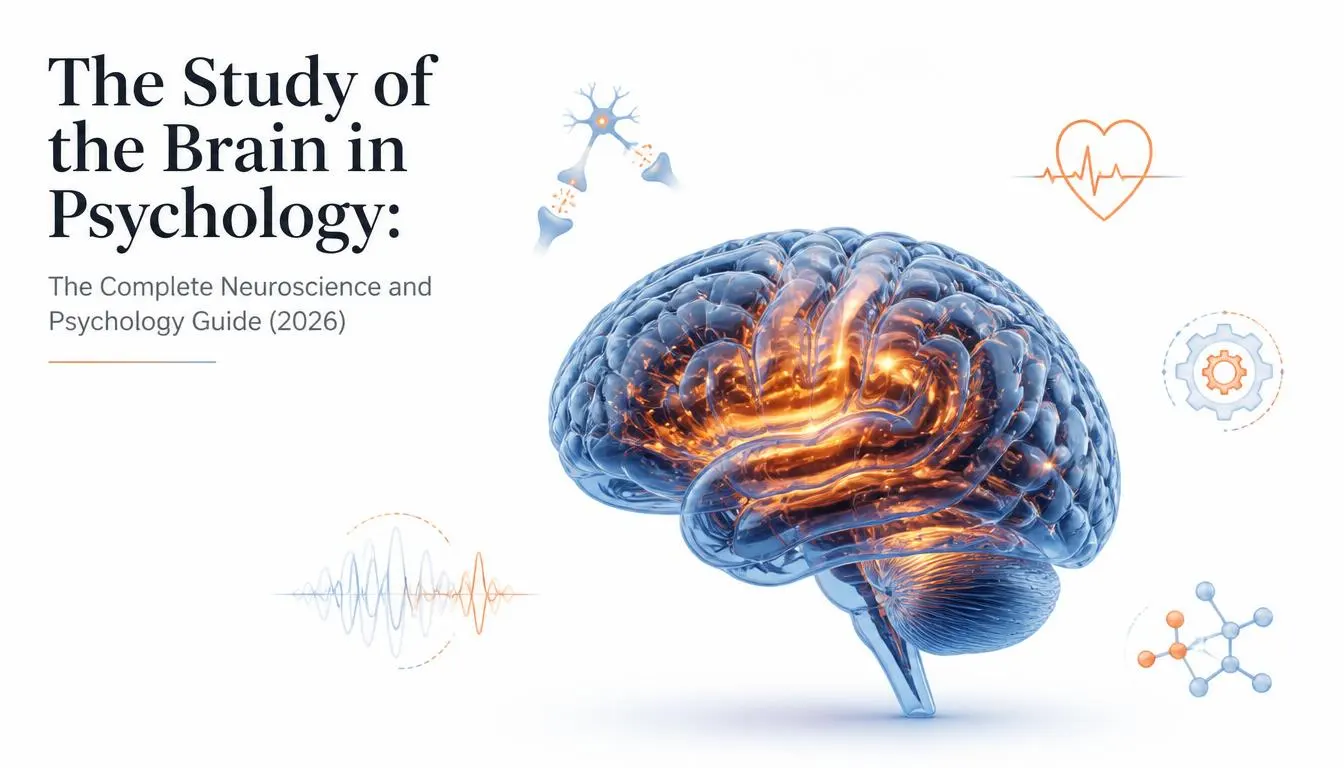
Every thought you’ve had today started as an electrical signal traveling through roughly three pounds of tissue behind your eyes. That’s not a metaphor. It’s the working premise of an entire field: the brain study branch of psychology, better known as biological psychology or biopsychology. This guide breaks down how the brain builds behavior, mood, and memory, and why 2026’s neuroimaging tools are changing what we can prove about the mind.
What Is the Study of the Brain in Psychology Called?
The study of the brain within psychology is formally called biological psychology (or biopsychology), and it overlaps heavily with the broader field of neuroscience. Biological psychology asks how the nervous system, hormones, and genetics produce thoughts, emotions, and actions. Where general psychology might ask why someone feels anxious, biological psychology asks which structures and chemicals are driving that anxiety.
This isn’t a niche corner of the discipline anymore. Since the 1990s “Decade of the Brain,” biological explanations have become the backbone of nearly every psychological subfield, from developmental psychology to clinical treatment planning. Depression is no longer discussed purely in terms of life events; it’s discussed in terms of serotonin transporter genes, hippocampal volume, and prefrontal activity patterns.
Three terms get used almost interchangeably, and it’s worth separating them:
- Biological psychology — the psychological discipline studying brain-behavior links.
- Neuroscience — the broader biological science of the nervous system, spanning molecular biology to cognitive function.
- Cognitive neuroscience — the specific overlap zone, focused on how neural activity produces mental processes like memory, language, and attention.
How Does Neuroscience Relate to Psychological Processes?
Neuroscience relates to psychology by supplying the physical mechanism behind mental events; every psychological process, from falling in love to solving a math problem, corresponds to a measurable pattern of neural activity. Psychology describes the experience. Neuroscience explains the hardware running underneath it.
Take working memory. A psychologist might describe it behaviorally: you can hold roughly four to seven items in mind at once. A cognitive neuroscientist adds the mechanism: this capacity limit tracks closely with activity in the dorsolateral prefrontal cortex, and it degrades predictably when that region is damaged or under-resourced by stress hormones like cortisol.
This partnership matters clinically too. A person diagnosed with depression used to receive treatment based almost entirely on symptom checklists. Today, functional imaging studies routinely show reduced activity in the prefrontal cortex alongside amygdala hyperactivity in depressed patients. This pattern helps explain both the low motivation and the heightened emotional reactivity clinicians see in session.
What Is the Structure of the Human Brain in Psychology?
Psychologists organize the brain into three broad structural tiers: the hindbrain (survival functions), the midbrain (relay and arousal), and the forebrain (higher cognition), with the cerebral cortex sitting at the very top of that hierarchy. Each tier evolved at a different point in our species’ history, and each still governs a distinct layer of behavior.
The hindbrain includes the medulla, pons, and cerebellum. It handles breathing, heart rate, and balance — the functions you’d die without but never consciously think about. The midbrain handles sensory relay and arousal, including the reticular formation that keeps you awake and alert. The forebrain is where psychology gets interesting: it houses the thalamus, hypothalamus, limbic system, and the cerebral cortex — the wrinkled outer layer responsible for language, planning, and self-awareness.
What Are the Four Lobes of the Cerebrum and Their Functions in Psychology?
The cerebrum divides into four lobes — frontal, parietal, temporal, and occipital — each tied to a distinct category of psychological function. Damage to any one produces a fairly predictable behavioral signature, which is exactly how early neuropsychologists first mapped the brain.
- Frontal lobe — planning, impulse control, personality, and voluntary movement. This is the region famously altered in Phineas Gage’s 1848 railroad accident, which shifted him from careful and reliable to impulsive and erratic.
- Parietal lobe — spatial awareness, touch processing, and integrating sensory information from across the body.
- Temporal lobe — auditory processing, language comprehension, and memory consolidation, largely because it houses the hippocampus.
- Occipital lobe — visual processing, almost exclusively. Damage here can produce cortical blindness even when the eyes themselves are perfectly healthy.
Which Part of the Brain Controls Human Emotions?
The limbic system controls human emotions, with the amygdala driving fear and threat detection, the hippocampus anchoring emotional memories, and the prefrontal cortex regulating how strongly those emotions get expressed. No single “emotion center” exists; it’s a circuit, not a switch.
The amygdala deserves special attention here because it acts almost like an alarm system. It receives sensory information before the conscious cortex has even finished processing it, which is why you can flinch at a loud noise before you’ve consciously registered what made the sound. This is the neurological basis of the fight-or-flight response, and it’s also why anxiety disorders are so often linked to amygdala overactivity paired with reduced prefrontal “braking” power.
The hippocampus, meanwhile, is less about the emotion itself and more about tagging it to memory. This is why emotionally intense events — a wedding, a car accident, a breakup — tend to be recalled in far sharper detail than neutral ones. The stronger the amygdala’s activation during an event, the more vividly the hippocampus tends to encode it.
How Do Neurons Communicate? (Synaptic Transmission Explained)
Neurons communicate through synaptic transmission: an electrical signal called an action potential travels down the axon, triggers the release of neurotransmitters at the synapse, and those chemicals bind to receptors on a neighboring neuron’s dendrite to continue or stop the signal. It’s a chemical relay race happening billions of times per second across your nervous system.
Breaking that process into its components:
- Dendrite — receives incoming signals from other neurons.
- Cell body (soma) — integrates those signals and decides whether to fire.
- Axon — the long fiber that carries the action potential away from the cell body, often insulated by myelin for speed.
- Synapse — the microscopic gap where neurotransmitters cross from one neuron to the next.
An action potential is essentially an electrochemical domino effect. Sodium ions rush into the neuron, flipping its charge from negative to positive; potassium ions then rush out, resetting it. This entire cycle takes about one millisecond, which is why reflexes feel instantaneous even though they involve multiple neurons firing in sequence.
How Do Neurotransmitters Influence Mood and Behavior in Psychology?
Neurotransmitters shape mood and behavior by determining how strongly and how often specific neural circuits activate; dopamine drives motivation and reward, serotonin regulates mood stability and impulse control, and imbalances in either are strongly linked to clinical disorders. This is the chemical layer that antidepressants, stimulants, and antipsychotics are all designed to target.
Dopamine gets oversimplified as the “pleasure chemical,” but that’s not quite accurate. It’s more accurate to call it the anticipation and motivation chemical. Dopamine spikes aren’t strongest when you get the reward — they spike hardest right before, which is exactly the mechanism that makes slot machines, social media notifications, and gambling so behaviorally sticky.
Serotonin plays a more stabilizing role, regulating sleep, appetite, and emotional evenness. Low serotonin activity is consistently associated with depressive symptoms and impulsive aggression, which is why selective serotonin reuptake inhibitors (SSRIs) remain the most commonly prescribed class of antidepressant worldwide.
What’s the Difference Between Neuroscience and Biological Psychology?
Neuroscience is the broader biological science covering everything from single-neuron molecular signaling to whole-brain systems. In contrast, biological psychology is the specific psychological subfield that applies neuroscience findings to explain behavior, cognition, and mental health. Think of neuroscience as the parent discipline and biological psychology as one of its most practically oriented children.
A neuroscientist might spend a career studying how a single ion channel opens and closes. A biological psychologist takes that kind of finding and asks what it means for something observable — why a person with a specific channel mutation might be more prone to seizures, anxiety, or memory problems. Biological psychology is where lab-bench neuroscience gets translated into diagnostic criteria, therapy design, and public health guidance.
How Does Brain Injury Impact Human Personality and Cognition?
Brain injury can permanently alter personality and cognition depending on which region is damaged; frontal lobe injuries most commonly produce impulsivity and blunted judgment, while temporal lobe injuries more often disrupt memory and language. The location of the damage matters far more than the severity of the impact itself.
Traumatic brain injury (TBI) research has repeatedly shown that even mild, repeated concussions — the kind common in contact sports — can produce measurable changes in mood regulation and impulse control years later. This is the underlying mechanism behind chronic traumatic encephalopathy (CTE), a condition now well documented in former athletes and increasingly discussed in mainstream sports medicine.
Beyond sports, this research also reshapes how courts, employers, and families think about post-injury behavior. A once even-tempered person who becomes volatile after a car accident isn’t “acting out” — in many documented cases, the behavior traces directly to measurable frontal lobe damage. This is one of the clearest real-world demonstrations that psychology and neurology are not separate conversations; they’re the same conversation viewed from different angles.
Structural vs. Functional Brain Mapping: What’s the Difference?
Structural brain mapping shows what the brain looks like — its anatomy — while functional brain mapping shows what the brain is doing in real time; psychologists rely on both to connect anatomy to behavior. Neither approach alone tells the full story.
Structural imaging, primarily through MRI, produces detailed anatomical pictures: the size of the hippocampus, the thickness of the cortex, the presence of lesions or atrophy. Functional imaging goes further, tracking activity as it happens.
Technological Advances in Neuroimaging (2026)
By 2026, functional MRI (fMRI) and electroencephalography (EEG) remain the two dominant neuroimaging tools in psychological research, and both have become faster, more portable, and more precise than they were even five years ago. fMRI tracks blood-oxygen-level changes to infer which brain regions are active during a task, offering excellent spatial precision — it can pinpoint activity down to a few millimeters. EEG instead measures electrical activity directly through scalp electrodes, sacrificing spatial precision for outstanding timing accuracy, often down to the millisecond.
Newer wearable EEG systems and portable near-infrared spectroscopy devices have started moving neuroimaging out of the lab and into more naturalistic settings, letting researchers study brain activity during real conversations, real classroom tasks, and real therapy sessions rather than only inside a scanner. This shift toward ecological validity is one of the more significant methodological developments shaping psychological research methods heading into the back half of the decade.
Why Is Neuroplasticity Important in Psychological Therapy?
Neuroplasticity — the brain’s ability to reorganize itself by forming new neural connections — matters in therapy because it means psychological change is not just behavioral; it’s physically measurable in brain structure over time. This single concept underpins why therapy, medication, and even habit change can produce lasting results rather than temporary symptom relief.
Cognitive behavioral therapy (CBT), for instance, isn’t just a talking exercise. Repeated studies using pre- and post-treatment imaging have shown measurable changes in amygdala reactivity and prefrontal connectivity after a structured course of CBT for anxiety disorders. The brain is, quite literally, rewiring itself in response to new thought patterns being practiced repeatedly.
This is also the science behind why early intervention matters so much in mental health treatment. Younger brains show higher plasticity, meaning behavioral and cognitive interventions tend to produce faster, more durable structural change the earlier they’re introduced. That plasticity never fully disappears, but it does slow, which is part of why habit change and therapy both tend to require more repetition later in adulthood.
How Do Neurological Disorders Reveal Themselves Behaviorally?
Neurological disorders reveal themselves through specific, trackable behavioral patterns because damage or dysfunction in a given brain region tends to disable the exact psychological function that region supports. This is why clinicians can often form a working hypothesis about where a problem lies before a single scan is even ordered.
A few well-documented examples make the pattern clear:
- Parkinson’s disease stems from dopamine-producing neuron loss in the substantia nigra, producing the tremor, rigidity, and slowed movement associated with the condition, alongside subtler cognitive slowing and mood changes.
- Alzheimer’s disease begins with hippocampal atrophy, which explains why short-term memory loss is almost always the earliest visible symptom, well before broader cognitive decline sets in.
- Schizophrenia is associated with altered dopamine signaling in the mesolimbic pathway alongside reduced prefrontal gray matter. This combination helps explain both the hallucinations and the flattened motivation seen in many patients.
- Frontotemporal dementia attacks the frontal and temporal lobes directly, which is why personality change and language breakdown often appear before memory problems do — the reverse pattern from Alzheimer’s.
What makes this section genuinely useful rather than just a list of diagnoses is the underlying principle: behavior is diagnostic information. A sudden shift in impulse control, memory, or language isn’t just “personality” — it’s data pointing toward a specific neural system that deserves medical attention.
Structural vs. Functional Mapping: A Side-by-Side Comparison
Structural and functional brain mapping answer two different questions — “what does the brain look like” versus “what is the brain doing right now” — and combining both produces far stronger conclusions than either method alone.
| Feature | Structural Mapping (MRI, CT) | Functional Mapping (fMRI, EEG, PET) |
| What it measures | Anatomy: size, shape, lesions | Activity: blood flow, electrical signals |
| Spatial precision | Very high (millimeters) | High for fMRI, lower for EEG |
| Timing precision | Not applicable (static image) | Excellent for EEG, slower for fMRI |
| Typical psychological use | Detecting atrophy, tumors, injury | Mapping which regions activate during a task |
| Common limitation | Can’t show real-time function | Can’t always show fine anatomical detail |
A well-designed study frequently layers both. Researchers might use structural MRI to confirm hippocampal volume in a group of patients, then use functional MRI during a memory task to see whether that same, smaller hippocampus is also working harder or less efficiently than a healthy control’s. Neither dataset alone would answer that question convincingly.
Where Can You Study Brain-Based Psychology in 2026?
Neuroscience-focused psychology programs are widely available across the US, UK, and Canada, typically housed within psychology, neuroscience, or cognitive science departments, and increasingly offered through flexible online formats. Program structure varies more by research focus than by geography.
In the United States, many research universities run combined “behavioral neuroscience” or “cognitive neuroscience” tracks that pair coursework in biological psychology with hands-on lab time in an active neuroimaging or animal-model lab. UK programs, particularly at research-intensive universities, tend to integrate biological psychology directly into the standard psychology degree rather than treating it as a separate track, with a stronger emphasis on quantitative methods from the outset. Canadian programs often sit at the intersection of psychology and medical schools, giving students earlier exposure to clinical neuroimaging equipment.
For those not pursuing a full degree, 2026 has brought a noticeable expansion in credentialed online behavioral neuroscience courses, several of which now include virtual EEG data sets so students can practice analysis without needing physical lab access. If you’re evaluating a program or course, the two questions worth asking upfront are: what neuroimaging equipment (if any) will you get hands-on time with, and does the coursework lean more toward clinical application or basic research?
Where YourBrainLens Fits Into the Picture
Understanding the biology behind behavior is one thing. Applying it to your own life, your own anxiety, your own habits, is another. That’s the gap YourBrainLens was built to close. Rather than presenting neuroscience as trivia, our guides connect brain structure and chemistry directly back to practical psychological tools — how neuroplasticity shapes habit formation, how understanding psychological theories can reframe a stuck pattern, and how the biological research above translates into daily decisions about sleep, stress, and focus.
If the goal is genuine behavior change rather than surface-level tips, starting from the biology first tends to produce more durable results. That’s the throughline across every guide on this site, from foundational overviews of what psychology actually studies to deeper dives into the major branches of the field.
Frequently Asked Questions
What is the study of the brain in psychology called?
It’s called biological psychology or biopsychology, a subfield that examines how the nervous system, hormones, and genetics shape behavior and mental processes.
Which part of the brain controls human emotions?
The limbic system, particularly the amygdala and hippocampus, drives emotional processing, while the prefrontal cortex regulates how those emotions are expressed and controlled.
What are the four lobes of the cerebrum?
The frontal lobe (planning, impulse control), parietal lobe (spatial and sensory processing), temporal lobe (memory and language), and occipital lobe (vision).
Why is neuroplasticity important in therapy?
Because it proves psychological interventions like CBT create measurable, physical changes in brain structure and activity, not just temporary shifts in mood or behavior.
How is neuroscience different from biological psychology?
Neuroscience is the broader biological study of the nervous system at every level, while biological psychology specifically applies neuroscience findings to explain behavior and mental health.
Can brain injury really change someone’s personality?
Yes. Frontal lobe damage in particular is strongly associated with increased impulsivity, poor judgment, and personality shifts, a pattern well documented since the 19th-century case of Phineas Gage and confirmed repeatedly through modern neuroimaging.
The Bottom Line
Behavior was never just a matter of willpower or upbringing. It’s electricity, chemistry, and structure, all working together in a system that can be measured, imaged, and, increasingly, understood well enough to treat. The more precisely researchers can map that system — through tools like the ones tracked by the National Institute of Mental Health — the more precisely psychology can help people change.
If this kind of brain-first approach to understanding yourself resonates, start your journey to improve yourself with us at YourBrainLens.






7 thoughts on “Best Brain Study in Psychology: Neuroscience Guide (2026)”