
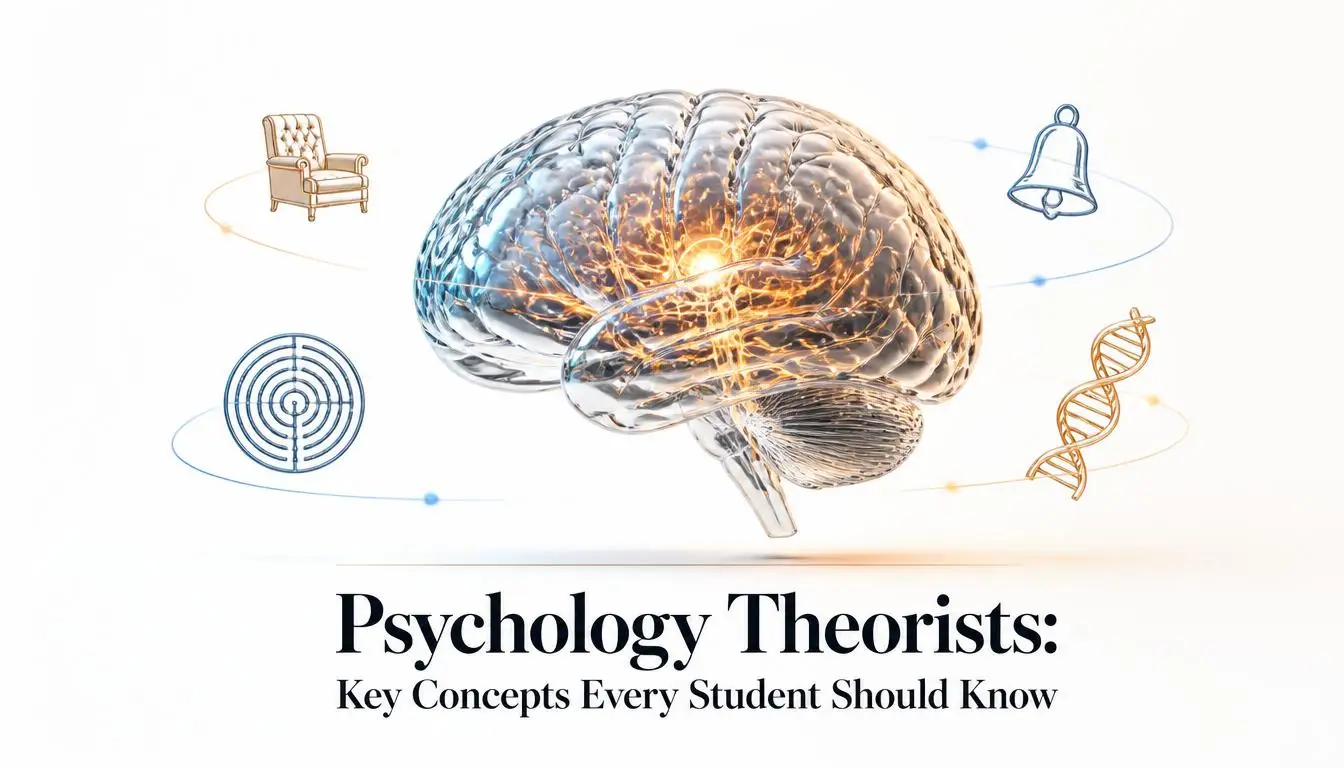
Every intro psych course throws a dozen names at you in the first two weeks, and by midterms they’ve all blurred together. Freud, Piaget, Skinner — who did what, again? This guide separates the major theorists into their actual schools of thought, defines their core concepts in plain language, and gives you the comparisons professors love to test on.
Who Are the Major Psychology Theorists Students Need to Know?
The theorists who appear most consistently across AP Psychology, intro college courses, and licensing exams fall into four camps: behaviorism, psychoanalytic/personality theory, cognitive-developmental theory, and humanistic psychology. Knowing which camp a theorist belongs to makes it far easier to predict what kind of question you’ll get about them.
- Behaviorism: Ivan Pavlov, John B. Watson, B.F. Skinner, Albert Bandura
- Psychoanalytic & Personality: Sigmund Freud, Carl Jung, Alfred Adler
- Cognitive & Developmental: Jean Piaget, Lev Vygotsky, Erik Erikson, Lawrence Kohlberg
- Humanistic: Abraham Maslow, Carl Rogers
- Social & Behavioral Research: Stanley Milgram, Philip Zimbardo
What Is Behaviorism and Who Founded It?
Behaviorism is the theoretical perspective holding that psychology should study only observable behavior, not internal mental states, and that behavior is shaped primarily through conditioning. It dominated American psychology for the first half of the 20th century and still underlies much of modern therapy and education.
Ivan Pavlov and Classical Conditioning
Pavlov, a Russian physiologist, discovered that dogs could learn to salivate at the sound of a bell if that sound was repeatedly paired with food. This is classical conditioning: learning through association, where a neutral stimulus (the bell) comes to trigger a response (salivation) originally caused by a different stimulus (the food).
John B. Watson and the Birth of Behaviorism
Watson took Pavlov’s findings and turned them into a manifesto for psychology as a whole, arguing the field should abandon introspection entirely and study only measurable behavior. His controversial “Little Albert” experiment demonstrated that a human infant could be classically conditioned to fear a neutral object.
B.F. Skinner and Operant Conditioning
Operant conditioning is learning through consequences — behavior followed by reinforcement becomes more likely, behavior followed by punishment becomes less likely. Skinner built on Pavlov and Watson but shifted the focus from involuntary reflexes to voluntary behavior. Using his famous “Skinner box,” he showed how rats and pigeons could be trained through reinforcement schedules — a framework still used today in everything from classroom management to app notification design.
Classical vs. Operant Conditioning: What’s the Difference?
| Feature | Classical Conditioning (Pavlov) | Operant Conditioning (Skinner) |
| Type of behavior | Involuntary, reflexive | Voluntary |
| Learning mechanism | Association between two stimuli | Consequences (reinforcement/punishment) |
| Key figure | Ivan Pavlov | B.F. Skinner |
| Classic example | Dog salivating at a bell | Rat pressing a lever for food |
Albert Bandura and Social Learning Theory
Social learning theory holds that people learn new behaviors by observing and imitating others, without needing to experience reinforcement themselves. Bandura’s famous Bobo doll experiment showed that children who watched an adult act aggressively toward an inflatable doll were far more likely to imitate that aggression later, even with no reward involved. This introduced observational learning and modeling as core mechanisms alongside direct conditioning, and it’s the bridge between strict behaviorism and cognitive psychology.
What Are the Core Concepts of Freud’s Psychoanalytic Theory?
Freud’s psychoanalytic theory proposes that human behavior is driven largely by unconscious drives and conflicts, particularly those formed in early childhood, and that personality develops through a series of psychosexual stages. Sigmund Freud, an Austrian neurologist, is arguably the most culturally famous psychologist in history, even though large parts of his theory are considered scientifically unfalsifiable by modern standards.
Key concepts to know:
- The unconscious mind: thoughts, memories, and urges outside conscious awareness that still influence behavior.
- Id, ego, and superego: the id runs on instinct and immediate gratification; the superego holds moral standards; the ego mediates between the two and reality.
- Psychosexual stages: oral, anal, phallic, latent, and genital — stages Freud believed shaped adult personality depending on how conflicts at each were resolved.
- Defense mechanisms: unconscious strategies like repression, denial, and projection that protect the ego from anxiety.
Two of Freud’s own students eventually broke from him and built competing frameworks. Carl Jung developed analytical psychology, introducing concepts like the collective unconscious and archetypes. Alfred Adler developed individual psychology, emphasizing feelings of inferiority and the drive toward compensation and social belonging over Freud’s sexual drives.
How Do Piaget’s and Vygotsky’s Developmental Theories Compare?
Piaget argued that children develop cognitively through independent exploration and internal stages, while Vygotsky argued that social interaction and language are the primary drivers of cognitive growth. Both were giants of developmental psychology working around the same era, but their core assumptions differ sharply.
Jean Piaget proposed four universal stages — sensorimotor, preoperational, concrete operational, and formal operational — that all children pass through in the same order, driven by a process of assimilation, accommodation, and equilibration. Learning, in his model, is something a child largely does alone, through direct interaction with objects and the physical world. For a full breakdown of that mechanism, see our dedicated guide on cognitive equilibrium and Piaget’s theory.
Lev Vygotsky, a Soviet psychologist working at roughly the same time, focused on the zone of proximal development — the gap between what a learner can do alone and what they can do with guidance from a more knowledgeable other. Where Piaget saw the child as a lone scientist, Vygotsky saw the child as an apprentice, learning primarily through language, culture, and social scaffolding.
Piaget vs. Vygotsky
| Feature | Jean Piaget | Lev Vygotsky |
| Primary driver of development | Independent exploration | Social interaction |
| Role of language | Reflects thought | Shapes thought |
| Stage structure | Four fixed, universal stages | No fixed universal stages |
| Key concept | Equilibration | Zone of Proximal Development |
Erik Erikson and Psychosocial Development
Erikson, trained partly in Freudian theory, reframed development around social relationships rather than sexual drives. His eight psychosocial stages — such as trust vs. mistrust in infancy and identity vs. role confusion in adolescence — each center on a specific crisis a person must resolve to develop a healthy personality. This is the key distinction tested on exams: Freud’s stages are psychosexual; Erikson’s are psychosocial.
Lawrence Kohlberg and Moral Development
Kohlberg extended Piaget’s cognitive framework specifically to moral reasoning, proposing three levels — preconventional, conventional, and postconventional — each with two stages, tracing how a person’s justification for right and wrong shifts from avoiding punishment to following abstract ethical principles.
What Is Humanistic Psychology and Who Are Its Key Figures?
Humanistic psychology is the perspective that emphasizes free will, personal growth, and self-actualization, positioning itself as a direct response to what its founders saw as the overly mechanical view of behaviorism and the overly pessimistic view of psychoanalysis. It emerged in the mid-20th century as psychology’s so-called “third force.”
Abraham Maslow and the Hierarchy of Needs
Maslow proposed that human motivation is organized in a hierarchy — physiological needs, safety, love and belonging, esteem, and finally self-actualization, the realization of one’s full potential — and that lower needs generally must be reasonably met before higher ones become motivating priorities.
Carl Rogers and Person-Centered Therapy
Rogers argued that psychological growth happens best in an environment of unconditional positive regard — acceptance and support of a person regardless of what they say or do — combined with genuineness and empathy. His person-centered approach became foundational to modern talk therapy; you can read more in our talk therapy guide.
Which Social Psychologists Are Essential for Understanding Obedience and Conformity?
Stanley Milgram and Philip Zimbardo are the two researchers most associated with demonstrating how situational and authority pressures can override individual moral judgment. Milgram’s obedience experiments found that a majority of participants would deliver what they believed were dangerous electric shocks to another person simply because an authority figure instructed them to continue. Zimbardo’s Stanford Prison Experiment assigned college students to roles of “guard” and “prisoner” and found that ordinary people escalated toward abusive behavior within days, purely as a function of assigned role and situation. Both studies remain central to how psychologists talk about the power of context over character, and both raised the ethical concerns that shaped modern research consent standards. The American Psychological Association maintains detailed historical context on how these studies reshaped research ethics.
Which Psychology Theorists Are Covered on the AP Psychology Exam?
The AP Psychology exam consistently tests Pavlov, Watson, Skinner, Bandura, Freud, Piaget, Vygotsky, Erikson, Kohlberg, Maslow, and Rogers, along with Milgram and Zimbardo under social psychology. These names anchor the “Learning,” “Developmental Psychology,” “Personality,” and “Social Psychology” units respectively, and they show up disproportionately in both the multiple-choice section and the free-response questions.
If you’re building a study sheet, the fastest way to lock these in is by school of thought rather than alphabetically — group Pavlov, Watson, Skinner, and Bandura together under learning; Freud, Jung, and Adler together under personality; Piaget, Vygotsky, Erikson, and Kohlberg together under development. Pattern recognition by category beats rote memorization of a flat list every time.
How BrainLens Helps You Study Smarter, Not Longer
Memorizing a list of names is the easy part. Understanding why each theorist mattered — what gap in the field they were filling, and how their ideas argue with each other — is what actually sticks during an exam. That’s the throughline across our site. Our psychological theories guide goes deeper into the perspectives summarized here, our developmental psychology guide expands on Piaget, Vygotsky, and Erikson specifically, and our types of psychology overview maps out how these historical theories connect to the specialized fields psychologists work in today. If you’re just starting, our what is psychology guide is the right place to build the foundation these theorists all sit on top of.
Frequently Asked Questions
Who are the main psychology theorists every student must know?
Pavlov, Watson, Skinner, and Bandura for behaviorism; Freud, Jung, and Adler for psychoanalytic theory; Piaget, Vygotsky, Erikson, and Kohlberg for development; and Maslow and Rogers for humanistic psychology are the names that appear most consistently across intro courses and standardized exams.
What is the main difference between B.F. Skinner and Ivan Pavlov’s theories?
Pavlov studied classical conditioning, where involuntary responses become associated with a neutral stimulus. Skinner studied operant conditioning, where voluntary behavior changes based on the consequences — reinforcement or punishment — that follow it.
How do Piaget’s and Vygotsky’s developmental theories compare?
Piaget saw children as independent explorers moving through four universal cognitive stages. Vygotsky saw development as fundamentally social, driven by language and guided learning within a child’s zone of proximal development.
What are the core concepts of Freud’s psychoanalytic theory?
The unconscious mind, the id-ego-superego structure, psychosexual stages of development, and unconscious defense mechanisms like repression and denial are the pillars of Freud’s theory.
Which psychology theorists are covered on the AP Psychology exam?
The exam most heavily tests Pavlov, Watson, Skinner, Bandura, Freud, Piaget, Vygotsky, Erikson, Kohlberg, Maslow, Rogers, Milgram, and Zimbardo, spread across the Learning, Developmental, Personality, and Social Psychology units.
Who is considered the father of psychology?
Wilhelm Wundt is generally credited as the father of psychology for founding the first formal psychology laboratory in 1879, which marked the field’s separation from philosophy into an experimental science.
Final Thoughts
These theorists spent entire careers arguing with each other — Freud versus the behaviorists, Piaget versus Vygotsky, humanism versus both. That disagreement is the useful part. Once you see each theory as a response to the one before it, the names stop being a memorization problem and start being a story you already understand. Start your journey to actually understand psychology, not just memorize it, with us at BrainLens.








5 thoughts on “Top Psychology Theorists & Key Concepts: Student Study Guide”