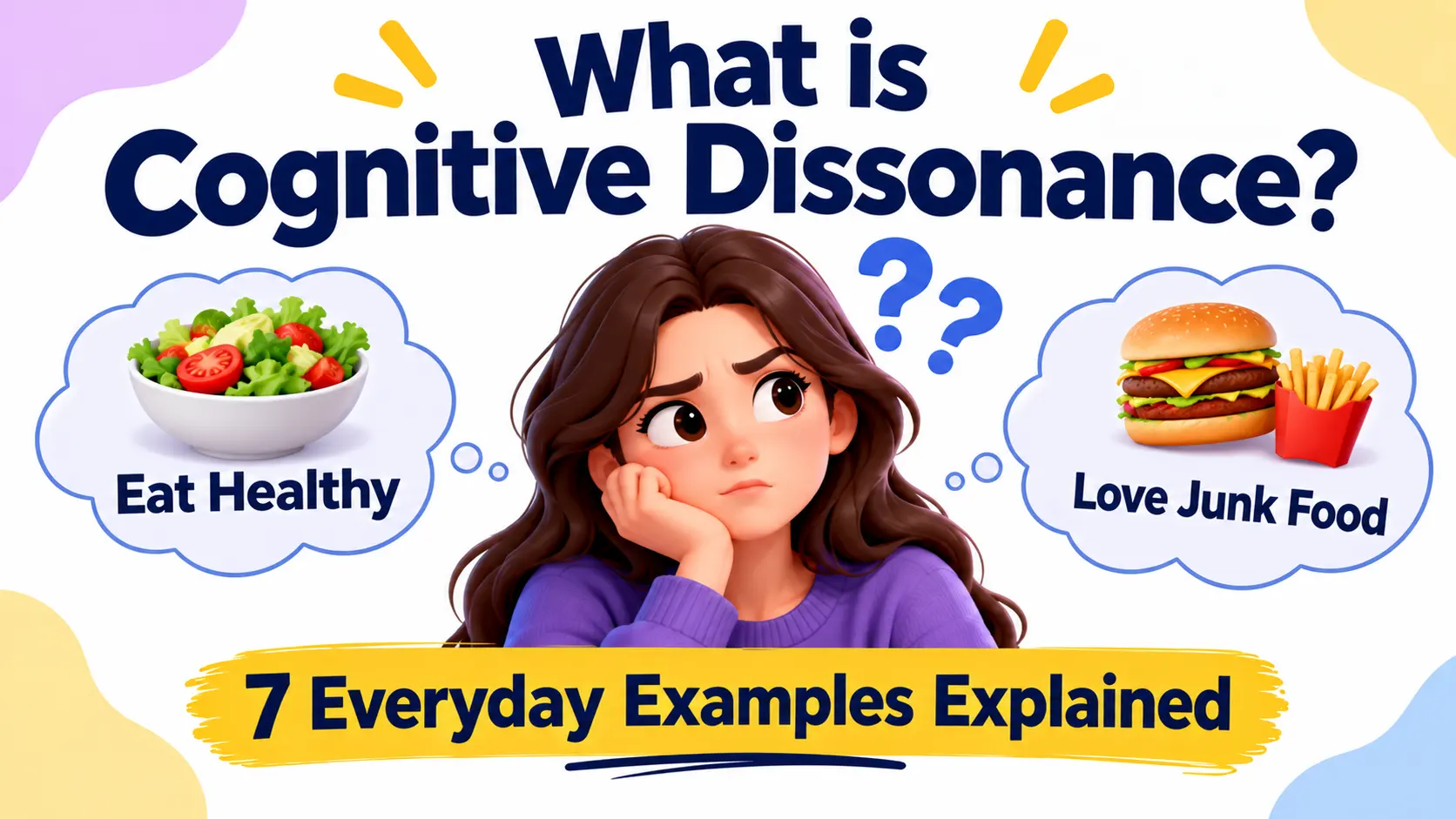
You know smoking can harm your health, but you light another cigarette. You believe saving money is important, but you make another impulse purchase. You value honesty, yet you tell a small lie to avoid an uncomfortable conversation.
These moments can create an uncomfortable mental conflict known as cognitive dissonance.
Cognitive dissonance influences how people make decisions, defend their choices, respond to criticism, and sometimes change their beliefs. It can encourage positive change, but it can also lead to excuses and self-deception.
In this guide, YourBrainLens explains what cognitive dissonance means, how psychologist Leon Festinger developed the theory, and how it appears in seven everyday situations. You’ll also learn practical ways to recognize and reduce dissonance, with a short quiz and exercises to help you apply the concept.
What Is Cognitive Dissonance? (Quick Definition)
Cognitive dissonance is the uncomfortable psychological state that can occur when a person holds conflicting beliefs, attitudes, or ideas, or when their behavior conflicts with something they believe.
For example:
- Belief: “I care about my health.”
- Behavior: You regularly skip exercise and ignore advice about improving your health.
- Conflict: Your actions do not match something you consider important.
- Possible response: You feel uncomfortable and try to reduce the mismatch.
The American Psychological Association describes cognitive dissonance as an unpleasant state associated with inconsistent cognitions, such as thoughts, beliefs, or opinions.
In simple terms, it is the tension that can arise when parts of your thinking do not fit together.
Dissonance does not automatically mean that you have done something wrong. You might experience it when learning new information, making a difficult choice, or discovering that an old belief no longer fits the evidence.
What matters is how you respond. You might change your behavior, reconsider a belief, or find a reasonable explanation. Alternatively, you might dismiss useful information simply because accepting it feels uncomfortable.
Who Discovered Cognitive Dissonance? Leon Festinger’s Theory
Psychologist Leon Festinger introduced the theory of cognitive dissonance in his 1957 book, A Theory of Cognitive Dissonance. His work helped explain why people sometimes change their attitudes or justify their decisions when their beliefs and actions conflict.
Three important developments help explain the theory’s history.
1. The research behind When Prophecy Fails
In the 1950s, Festinger and his colleagues studied a group whose members believed a catastrophic flood would destroy the world on a predicted date.
When the prediction failed, some members did not abandon their beliefs. Instead, they developed a new explanation for the failed prediction.
Festinger and his colleagues described the group’s behavior in When Prophecy Fails (1956). The case helped illustrate how people may reinterpret events to protect strongly held beliefs.
It is important to remember that this was an observational case study, not a controlled experiment proving that every person responds to disconfirmed beliefs in the same way.
2. The theory published in 1957
Festinger’s A Theory of Cognitive Dissonance proposed that inconsistent cognitions can produce psychological discomfort. This discomfort motivates people to reduce the inconsistency.
For example, someone who believes honesty is essential but has recently lied may try to resolve the conflict by admitting the lie, changing their future behavior, or convincing themselves that the lie was justified.
3. The famous $1 versus $20 experiment in 1959
In a well-known study, Leon Festinger and James Carlsmith asked participants to complete repetitive, boring tasks. Some participants were then paid $1 and others $20 to tell another person that the tasks were enjoyable.
The researchers later asked participants how enjoyable they had found the tasks.
The $1 group rated the tasks more positively than the $20 group did. One interpretation was that participants who received only $1 had less external justification for saying something they did not believe, making attitude change a possible means of reducing the inconsistency.
The study was published in 1959 under the title Cognitive Consequences of Forced Compliance.
Remember the dates: Festinger published the theory in 1957. The famous $1-versus-$20 experiment by Festinger and Carlsmith appeared in 1959.
For the original research, read Festinger and Carlsmith’s 1959 study. You can also explore the original book, https://doi.org/10.1515/9781503620766A Theory of Cognitive Dissonance.
If you enjoy learning about influential psychologists, explore our guides to psychology theorists, their key concepts, and major psychological theories.
How Does Cognitive Dissonance Work?
Cognitive dissonance is a psychological process, not a simple brain alarm with one specific location or mechanism.
It begins when a person notices an inconsistency between relevant thoughts, beliefs, attitudes, or actions. The inconsistency can create discomfort, particularly when the conflicting ideas are important to the person’s identity or values.
Consider this example:
You believe that keeping promises is important. However, you repeatedly cancel plans with a close friend without a good reason.
You might experience discomfort because your behavior does not align with your belief that you are a reliable friend.
You could respond in several ways:
- Change your behavior: Make a genuine effort to keep plans.
- Change your belief: Decide that keeping every promise is not always realistic, while still recognizing the importance of reliability.
- Add relevant information: Consider whether genuine circumstances made it difficult to keep the promises.
- Minimize the conflict: Tell yourself that the cancellations do not matter, even if they have hurt your friend.
These responses do not have identical consequences. Some can help you understand the situation and make a better decision. Others can become excuses that prevent you from addressing the problem.
What makes cognitive dissonance stronger?
Several factors can influence how much dissonance a person experiences.
| Factor | Meaning | Example |
| Importance | How much the conflicting beliefs or actions matter to you | A person who strongly values honesty may feel greater conflict after lying |
| Number of conflicting thoughts | How many relevant ideas disagree | Repeatedly breaking a personal commitment can create more conflict than one minor mistake |
| Available justification | Whether there are convincing reasons for the behavior | A person who acted under strong pressure may experience a different level of conflict from someone who acted freely |
The theory also helps explain why people sometimes avoid information that challenges their existing beliefs. This tendency is often discussed as selective exposure.
For example, after purchasing an expensive phone, you might read positive reviews while avoiding negative ones. This can protect you from second-guessing your purchase, but it may also prevent you from considering useful information.
For more background, explore our cognitive psychology guide and cognitive equilibrium guide.
What Are the Signs of Cognitive Dissonance?
Common signs of cognitive dissonance include discomfort, defensiveness, rationalization, and the avoidance of information that challenges your decisions. These reactions are not proof of dissonance on their own, but they can be useful clues.
Look for patterns such as:
- Feeling uncomfortable after a decision: You keep wondering whether your choice matched your values.
- Making repeated excuses: You tell yourself, “Everyone does it” or “It was only one time.”
- Avoiding certain information: You ignore facts or opinions that challenge a decision.
- Becoming defensive: You react strongly when someone questions a choice.
- Changing your attitude after acting: You begin to view a decision more positively once you’ve made it.
- Replaying a situation: You repeatedly think about what happened and whether you should have acted differently.
- Downplaying the consequences: You convince yourself that a choice does not matter, even when it affects something important.
One useful question is:
“Am I defending this decision because it makes sense, or because admitting a mistake feels uncomfortable?”
That question can help you separate a reasonable explanation from an automatic excuse.
If repeated mental replay is affecting your daily routine, you may also find our overthinking test and guide to reducing stress in seven easy ways useful.
What Are 7 Everyday Examples of Cognitive Dissonance?
Cognitive dissonance can arise when an important belief, attitude, or value conflicts with a person’s behavior or with another belief. The following seven examples show how it can arise in health, money, relationships, work, and everyday choices.
1. Smoking While Knowing the Health Risks
A person knows that smoking increases the risk of serious health problems but continues to smoke.
The conflict is between two thoughts:
- “I want to protect my health.”
- “I continue to smoke.”
To reduce discomfort, the person might minimize the danger by saying, “My relative smoked for decades and lived a long life.” They might also promise to quit later without taking steps toward quitting.
Healthier response: Acknowledge the conflict without judging yourself. If you want to quit, consider setting a realistic plan and seeking evidence-based support rather than dismissing the health risks.
2. Making Impulse Purchases Despite Wanting to Save Money
Imagine that you have promised yourself that you will save money this month. Then you see an expensive gadget advertised at a discount and buy it without considering your budget.
The conflict is between:
- “I want to manage my money responsibly.”
- “I just spent money I intended to save.”
You might justify the purchase by saying, “It was 40% off, so I actually saved money.”
But a discount does not automatically make an unnecessary purchase financially sensible.
Healthier response: Try waiting 24 or 48 hours before making non-essential purchases. Review your budget and decide whether the item genuinely meets a need.
3. Loving Animals While Eating Meat
Some people care deeply about animal welfare but also eat meat. Researchers and social psychologists sometimes discuss this tension as the meat paradox.
The conflict can involve two attitudes:
- “I care about animals and do not want them to suffer.”
- “I regularly eat products that come from animals.”
People may respond by avoiding information about animal agriculture, emphasizing tradition, or changing how they think about the animals involved.
Healthier response: Consider the values and information that matter to you. People make different dietary choices, and the purpose of this example is to understand the psychological conflict, not to judge anyone’s diet.
4. Staying in an Unhealthy Relationship
A person believes that respect and kindness are essential in a relationship but remains with a partner who repeatedly treats them poorly.
The conflict might be:
- “I deserve to be treated with respect.”
- “I continue accepting behavior that hurts me.”
They may explain the situation by saying, “My partner is just stressed” or “Things will improve eventually.”
Past emotional investment can also make leaving difficult. This may overlap with the sunk-cost effect, in which people feel pressure to continue because they have already invested time, energy, or resources.
Healthier response: Focus on repeated behavior rather than relying solely on promises. Consider discussing the situation with someone you trust. If you feel unsafe or are experiencing abuse, seek appropriate support from a trusted person or local service.
You can also explore our guide to attachment styles.
5. Procrastinating Despite Valuing Success
A student wants good grades, or an employee wants to progress professionally. Yet they repeatedly delay important tasks by scrolling through social media or doing unrelated activities.
The conflict is:
- “My goals are important to me.”
- “I keep avoiding the work needed to achieve them.”
A common justification is, “I work better under pressure.” Sometimes that may feel true, but repeated procrastination can still create unnecessary stress and reduce the quality of the work.
Healthier response: Start with a small, specific task. Work for 10 minutes, remove one distraction, and decide on the next step as soon as you begin.
6. Breaking a Healthy Eating Commitment
Someone decides to follow a balanced eating routine but overeats during a stressful evening.
The conflict might be:
- “I want to take care of my health.”
- “I did not follow the eating plan I had set.”
They may respond with an all-or-nothing thought: “I’ve already ruined today, so I might as well give up.”
This reaction can make one unplanned meal feel like a complete failure.
Healthier response: Treat the experience as information rather than a personal verdict. Consider whether stress, hunger, boredom, or an unrealistic plan contributed to the decision. Return to balanced habits without punishing yourself.
7. Caring About the Environment but Choosing Convenience
A person says they care about reducing waste but regularly chooses single-use packaging, disposable cups, or unnecessary plastic products.
The conflict is:
- “I want to reduce my environmental impact.”
- “I often choose convenience over waste reduction.”
A common response is, “One person’s actions won’t make a difference.”
This may reduce personal discomfort, but it does not resolve the inconsistency.
Healthier response: Choose one practical habit, such as carrying a reusable bottle or bag. Small, realistic changes are easier to maintain than trying to change everything at once.
What Do These Examples Have in Common?
Across all seven situations, the same basic pattern appears:
- A person holds a belief, value, or attitude.
- Their behavior or another belief conflicts with it.
- The inconsistency may create discomfort.
- The person tries to reduce that discomfort.
- Their response may lead to useful change or unhelpful rationalization.
Recognizing this pattern is the first step toward making more thoughtful decisions.
Does Cognitive Dissonance Cause Stress and Anxiety?
Cognitive dissonance can involve uncomfortable feelings such as guilt, tension, frustration, or worry. However, it should not be treated as a mental health disorder or assumed to cause clinical anxiety.
For example, imagine that you value honesty but have told a lie to avoid an awkward conversation. You may feel uncomfortable when you remember what happened.
You might respond by:
- Recognizing that your behavior conflicted with your value.
- Thinking about why you acted that way.
- Deciding whether to correct the situation.
- Making a plan to respond differently in the future.
Sometimes the discomfort passes once the conflict is addressed. In other situations, a person may continue thinking about the event or avoid dealing with it.
It is useful to distinguish ordinary psychological discomfort from persistent symptoms that interfere with daily life. Cognitive dissonance itself is not an anxiety diagnosis, and this theory does not establish that every experience of inner conflict causes sleep problems or chronic anxiety.
If worry, low mood, or sleep difficulties persist and affect your relationships, work, or everyday activities, consider speaking with a qualified mental health professional.
For general information, visit the National Institute of Mental Health’s guide to anxiety disorders. You can also read our talk therapy guide.
What Are the Main Ways to Reduce Cognitive Dissonance?
People can reduce cognitive dissonance by changing a conflicting belief or behavior, adding relevant information, or reducing the importance of the inconsistency. These are broad approaches from the theory; everyday examples often divide them into four practical strategies.
| Strategy | What it means | Example | Possible limitation |
| Change behavior | Act in a way that better matches your belief | Stop smoking because you want to protect your health | Change can require time, effort, and support |
| Change a belief or attitude | Reconsider an idea that conflicts with other information | Update an inaccurate belief after learning reliable facts | Changing beliefs just to avoid discomfort can reinforce misinformation |
| Add relevant information | Consider another fact or belief that helps explain the situation | Recognize that a missed workout happened during an unusually demanding week | Added information should be genuine, not an invented excuse |
| Reduce the importance of the conflict | Decide that the inconsistency matters less than you initially thought | Recognize that one small mistake does not define your character | Minimizing a serious issue can prevent necessary action |
These strategies are not automatically good or bad. Their value depends on whether they help you understand the situation accurately.
For example, changing your belief about a health risk because reliable new evidence becomes available is reasonable. Rejecting well-established evidence simply because it is uncomfortable is not.
Likewise, changing your behavior may be the most direct response when your actions genuinely conflict with an important value. But behavior change is not always the only valid way to reduce dissonance.
A useful question to ask is: “Am I resolving this conflict by understanding the situation more accurately, or am I simply finding a way to avoid it?”
Quiz: Can You Recognize Cognitive Dissonance?
Test your understanding with these four questions. Try answering before reading the explanations.
1. When people experience cognitive dissonance, do they always change their behavior?
True or False?
2. In Festinger and Carlsmith’s 1959 study, which group rated the boring task more positively?
A. The $1 group
B. The $20 group
C. Both groups rated it equally
3. Is cognitive dissonance a mental illness?
True or False?
4. Can ordinary everyday decisions create cognitive dissonance?
True or False?
Answer Key
- False. People may change their behavior, revise a belief, add relevant information, or minimize the importance of the conflict.
- A. The $1 group. The researchers found that the participants paid $1 rated the task more positively than those paid $20.
- False. Cognitive dissonance is a psychological process, not a mental illness or clinical diagnosis.
- True. Everyday choices, including purchases and personal commitments, can create conflicting thoughts or attitudes.
Your Score
- 4 correct: Excellent. You understand the main ideas.
- 2–3 correct: Good start. Review the sections on Festinger’s experiment and dissonance reduction.
- 0–1 correct: No problem. Revisit the examples and try again.
Which Cognitive Dissonance Response Do You Use First?
This exercise helps you recognize how you might respond when your actions conflict with your values. It is a reflection activity, not a psychological test or personality assessment.
Scenario: You promised yourself that you would save money this month. Today, you spent a large amount on something you wanted but did not need. A friend asks, “Was it worth it?”
What is your first reaction?
- A. “Yes. I work hard. I deserve it.”
- B. “It’s honestly not that much money.”
- C. “Not really. I need to review my budget.”
- D. “I’d rather not talk about it.”
Path A: The Justifier
You add a reason that makes your decision feel acceptable.
Justification is not always unreasonable. You may genuinely have needed a break or wanted to reward yourself. The important question is whether the explanation fits your financial priorities.
Try this: Set aside a planned amount for personal treats so you can enjoy them without undermining your savings goal.
Path B: The Trivializer
You reduce the importance of the decision.
This can temporarily make the discomfort disappear, but repeatedly dismissing small purchases may mask a larger spending pattern.
Try this: Review your recent purchases and calculate how much the supposedly small expenses add up to.
Path C: The Behavior Changer
You recognize the conflict and consider changing your actions.
This response directly addresses the mismatch between your savings goal and your spending behavior.
Try this: Set a realistic weekly spending limit and track your progress.
Path D: The Avoider
You avoid discussing the decision because it makes you uncomfortable.
Avoidance can provide short-term relief, but it may prevent you from understanding what happened.
Try this: Give yourself five quiet minutes to review your budget without judging yourself.
Most people use different responses in different situations. The goal is not to label yourself. It is to notice your reaction and decide whether it is helping you.
How Can You Resolve Cognitive Dissonance When Making Difficult Decisions?
You can approach difficult decisions more thoughtfully by identifying the conflict, checking your assumptions, and considering actions that reflect your values.
Try this Decision Clarity Toolkit.
Step 1: Name the conflict
Complete this sentence:
“I believe __________, but I am considering __________.”
Example:
“I believe saving money is important, but I am considering buying something I do not need.”
Step 2: Separate facts from assumptions
Ask yourself:
- What do I actually know about this situation?
- What am I assuming?
- Am I ignoring information because it makes me uncomfortable?
- Has new evidence changed what I should believe?
Step 3: Identify your options
Write down at least three possible responses, including doing nothing.
For each option, ask whether it involves:
- Changing your behavior.
- Updating a belief or attitude.
- Considering additional relevant information.
- Reducing the importance of the conflict.
Step 4: Compare the options with your values
Ask:
- Which option best reflects what matters to me?
- Which option is based on accurate information?
- What are the likely consequences?
- Am I choosing this option because it is sensible or simply because it feels easier?
Step 5: Review your decision
Use these check-ins to reflect on what happened.
| Check-in | Question |
| Day 1 | Did I take the action I planned? |
| Day 3 | Am I making excuses or avoiding the issue? |
| Day 7 | Does my decision still fit my values? |
| Day 21 | Have I made a useful change, or does the conflict remain? |
The schedule is a practical reflection exercise, not a scientifically established treatment for cognitive dissonance. Adjust it to suit the decision you are facing.
How Can an ABC Log Help You Examine Conflicting Thoughts?
An ABC log is a structured way to examine how an event, your beliefs about it, and your emotional or behavioral response are connected.
The ABC framework is associated with Albert Ellis’s Rational Emotive Behavior Therapy (REBT). It is part of the broader cognitive-behavioral tradition, but it should not be attributed to CBT generally as though it originated there.
The American Psychological Association describes ABC theory as a framework underlying REBT, in which activating events are understood in relation to beliefs that influence emotional and behavioral consequences.
You can use a simple ABC log to examine a situation that creates discomfort.
How to Complete an ABC Log
- A — Activating event: Describe what happened, focusing on observable facts.
- B — Beliefs: Write down the thoughts or interpretations you had about the event.
- C — Consequences: Identify the emotions and behaviors that followed.
Some extended versions of the exercise include:
- D — Disputation: Question whether your belief is accurate, helpful, or based on incomplete information.
- E — Effective new belief: Write a more balanced belief and consider what you could do next.
ABC Log Example
Imagine that you have skipped several planned workouts.
| Step | Example |
| A — Activating event | I skipped my workout for the fifth day in a row |
| B — Beliefs | “I’m lazy. I have no willpower. There is no point trying now.” |
| C — Consequences | Guilt, frustration, and avoiding my exercise plan |
| D — Disputation | “Five missed days do not prove that I am lazy. I have also had a demanding work week.” |
| E — Effective new belief | “I can restart with a manageable goal and plan two workouts this week.” |
The purpose is not to force yourself to think positively. It is to examine whether your interpretation is accurate and whether a different response would be more useful.
For more information, see the APA Dictionary’s explanation of ABC theory and the National Institute of Mental Health’s overview of psychotherapies.
You can also explore our guides to positive thinking, resilience, and emotional strength.
Is Cognitive Dissonance Ever a Good Thing?
Yes. Cognitive dissonance can be useful because noticing a conflict may encourage you to reconsider a belief, correct a mistake, or change an unhelpful behavior.
Imagine that you believe treating others fairly is important, but you realize that you have been dismissive toward a colleague.
The discomfort may encourage you to reflect on your behavior, apologize, and act differently in the future.
However, dissonance does not always lead to positive change. Someone might instead blame the colleague, minimize the incident, or convince themselves that their behavior was acceptable.
The important distinction is how the conflict is handled.
- Constructive response: Examine the facts, take responsibility where appropriate, and consider a better course of action.
- Unhelpful response: Reject relevant information, make excuses, or repeatedly dismiss the consequences.
In education, a carefully designed question that challenges an assumption can encourage students to examine their thinking. The aim should be learning and reflection, not embarrassment or manipulation.
Frequently Asked Questions About Cognitive Dissonance
What is the best example of cognitive dissonance?
Smoking, even knowing it can harm your health, is a familiar example. The conflict occurs when a person’s desire to protect their health clashes with their continued smoking behavior.
What are the main ways to reduce cognitive dissonance?
People can reduce dissonance by changing a behavior, revising a belief or attitude, adding relevant information, or reducing the importance of the conflict. These are broad approaches, and they do not all have the same consequences.
Is cognitive dissonance a mental illness?
No. Cognitive dissonance is a normal psychological process, not a mental illness or clinical diagnosis. Persistent emotional distress should be considered separately and discussed with a qualified professional when it affects daily life.
What triggers cognitive dissonance in everyday life?
It can arise when actions conflict with personal values, when two important beliefs disagree, when a decision forces you to give up an alternative, or when new information challenges an existing belief.
Why do people experience doubt after buying something expensive?
A major purchase can create post-decision conflict because a person may wonder whether they made the right choice or gave up a better alternative. They may focus on the product’s advantages and overlook its disadvantages to feel more confident about the decision.
How long does cognitive dissonance last?
There is no universal duration. The discomfort may fade quickly after a person addresses the conflict, or it may return when the issue remains unresolved or new information brings it back to mind.
What Should You Do Next About Cognitive Dissonance?
Cognitive dissonance occurs when relevant beliefs, attitudes, or actions do not fit together. It can create discomfort, but it can also give you a reason to pause and examine your decisions.
You have now explored:
- The meaning of cognitive dissonance.
- Leon Festinger’s theory and the famous 1959 experiment.
- Common signs and seven everyday examples.
- The main ways people reduce psychological inconsistency.
- Practical reflection exercises, including the Decision Clarity Toolkit and ABC log.
Try this simple plan over the next week:
- Notice one conflict between a belief and an action.
- Write it down in one clear sentence.
- Check the facts instead of immediately defending your decision.
- Choose one realistic response that reflects your values.
- Review your progress after a few days.
If stress is also affecting your daily life, explore our stress level test. You can continue learning about how attitudes, groups, and social expectations influence behavior in our social psychology guide.
The goal is not to eliminate every contradiction in your life. It is to recognize important conflicts, understand them honestly, and respond thoughtfully.
References and Further Reading
- American Psychological Association. Cognitive Dissonance.
- Festinger, L. (1957). A Theory of Cognitive Dissonance. Stanford University Press. Publication information.
- Festinger, L., & Carlsmith, J. M. (1959). Cognitive consequences of forced compliance. The Journal of Abnormal and Social Psychology, 58(2), 203–210. Original study.
- American Psychological Association. ABC Theory.
- Harmon-Jones, E., & Mills, J. (2019). An introduction to cognitive dissonance theory and an overview of current perspectives. In Cognitive Dissonance: Reexamining a Pivotal Theory in Psychology. American Psychological Association. Chapter preview.
- National Institute of Mental Health. Psychotherapies.