You turn off the lights, settle into bed, and suddenly your brain becomes busy.
You replay an awkward conversation. You remember an unfinished task. You start worrying about tomorrow’s meeting, next month’s bills, or something that happened years ago.
If your mind seems to get louder the moment you try to sleep, you’re not alone. Stress, unresolved worries, and learned patterns of nighttime alertness can all make it difficult to switch off.
The good news? You don’t have to force your thoughts to disappear. You can learn to respond to them differently.
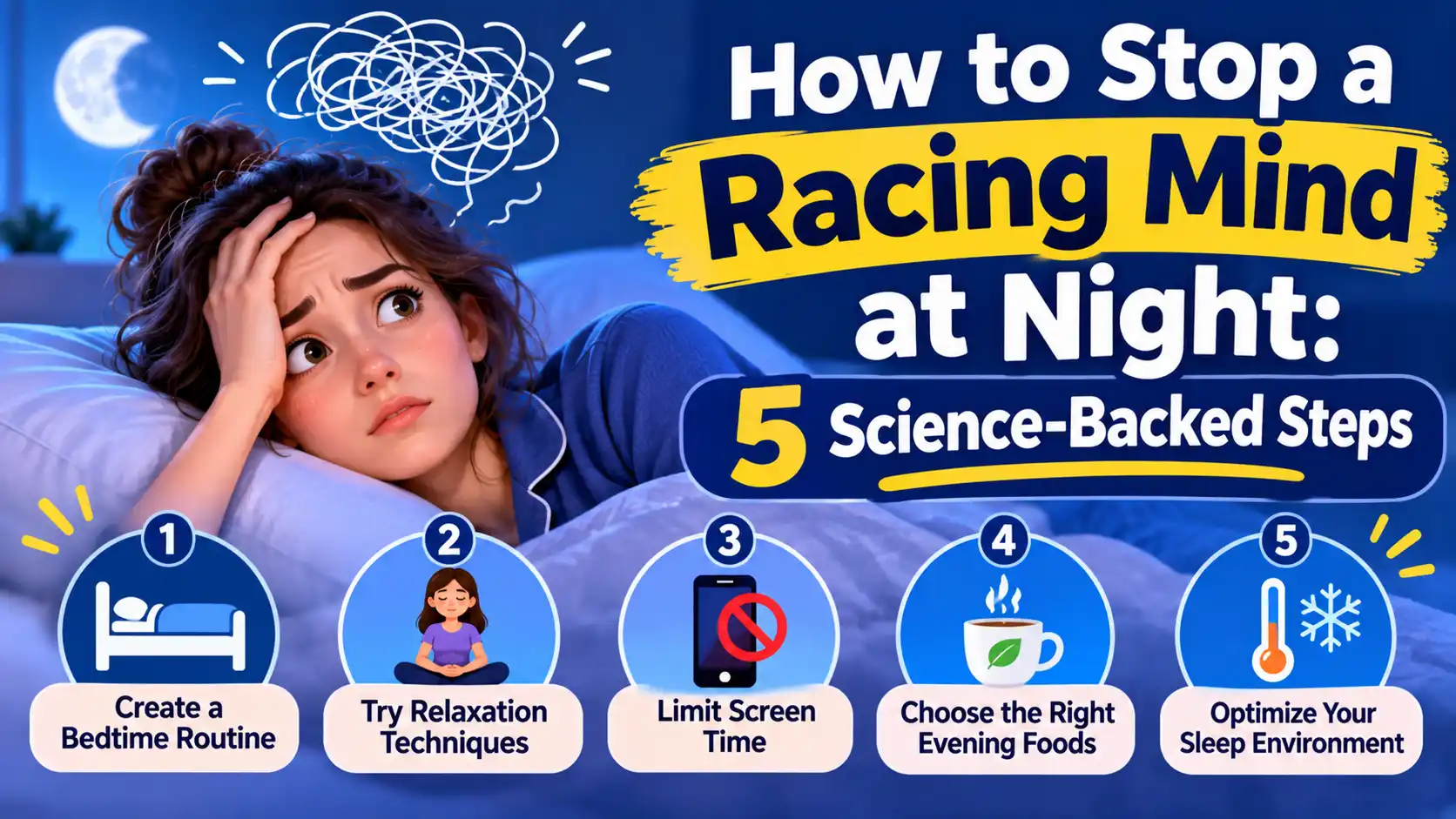
This guide explores five practical techniques to calm a racing mind at night: a breathing exercise, a bedtime brain dump, cognitive shuffling, stimulus control, and an evening thought log. You’ll also find a technique matcher, a sleep-myth quiz, and simple exercises you can try tonight.
Why Does Your Mind Race When You Lie Down?
Your mind may race at bedtime because the distractions of the day disappear, leaving more room for worries, memories, and unfinished tasks.
During the day, work, conversations, errands, and other activities compete for your attention. When you lie down, those distractions become less prominent. Thoughts that you postponed earlier may become more noticeable.
Stress can make this experience more intense. If you’re worried about an upcoming event or feel under pressure, your body may remain more alert than you’d like when it’s time to sleep.
What’s happening in your brain and body?
Several processes influence the transition from wakefulness to sleep:
- Mind-wandering and self-reflection: Brain networks involved in internally focused thought, including the Default Mode Network (DMN), support remembering, imagining, and self-reflection. Their activity changes as you move toward sleep, but the DMN does not simply switch on and cause insomnia.
- Stress-related arousal: Worry can keep your attention focused on possible problems. You may notice muscle tension, a faster heartbeat, or feeling on alert.
- Circadian rhythm: Your internal body clock helps coordinate sleep and wakefulness through signals influenced by light, darkness, and daily routines.
- Sleep pressure: The longer you stay awake, the more your body generally builds a biological drive for sleep. However, stress and excessive alertness can make it harder to experience that sleepiness comfortably.
Cortisol and melatonin also play roles in the sleep-wake cycle. Cortisol normally follows a daily rhythm, while melatonin rises in response to darkness. But being awake at night does not automatically mean your cortisol is unusually high or your melatonin is abnormally low.
The practical goal is not to switch off a particular brain region. It’s to reduce unnecessary alertness, create a more consistent sleep routine, and stop turning bedtime into a struggle.
Normal bedtime thinking vs. repetitive nighttime rumination
Having thoughts before sleep is normal. The problem is when those thoughts become repetitive, distressing, and difficult to disengage from.
| Normal bedtime thinking | Nighttime rumination |
| Thoughts move between different topics | The same worry keeps returning |
| Ideas feel relatively neutral | Thoughts feel threatening or upsetting |
| You can let thoughts pass | You feel stuck analyzing or predicting |
| You gradually become sleepy | You remain frustrated or alert |
| Thoughts don’t significantly disrupt rest | Thinking repeatedly delays sleep |
Sleep onset latency is the time between trying to sleep and actually falling asleep. Many adults take around 10–20 minutes, although individual experiences vary. This is a general reference, not a diagnostic cutoff.
If difficulty falling asleep happens regularly and affects your daytime functioning, it is worth discussing with a healthcare professional. The National Heart, Lung, and Blood Institute’s insomnia guide explains common symptoms and when to seek an assessment.
Step 1: Use a Slow Breathing Exercise to Reduce Physical Arousal
When your body feels tense or restless, slow, comfortable breathing may help you settle.
One technique worth trying is cyclic sighing, sometimes called the physiological sigh. It uses two gentle inhales followed by a longer exhale.
A randomized study published in Cell Reports Medicine compared five minutes of daily breathing exercises with mindfulness meditation over one month. Cyclic sighing produced improvements in mood and reductions in respiratory rate. However, the study did not establish that the exercise treats insomnia or guarantees faster sleep.
Read the original breathing study for the research details.
How to practice cyclic sighing
- Get comfortable in bed or sit somewhere quiet.
- Relax your jaw, shoulders, and hands.
- Inhale gently through your nose.
- Before exhaling, take a second, smaller inhale.
- Exhale slowly and comfortably through your mouth.
- Repeat for a short period without forcing your breath.
The second inhale should be smaller than the first. Keep the exhale relaxed rather than trying to make it as long as possible.
If you feel dizzy, uncomfortable, or short of breath, return to normal breathing. You do not need to hold your breath or push yourself.
Why try it?
A slower breathing pattern may help reduce physical arousal and give your attention something simple to follow. It can be especially useful when your body feels tense even though you aren’t focused on one particular worry.
Remember: this is a relaxation tool, not a guaranteed sleep treatment.
Step 2: Write a Five-Minute Brain Dump Before Bed
If your mind keeps reminding you about unfinished tasks, write them down.
A brain dump is a short writing exercise in which you transfer tasks, reminders, and worries from your mind onto paper. It gives you a practical place to record what needs attention, rather than mentally rehearsing everything.
There is research supporting this approach.
A study published in the Journal of Experimental Psychology: General examined 57 healthy young adults in a sleep laboratory. Participants who spent five minutes writing a specific to-do list before bed fell asleep faster than participants who wrote about completed activities.
The researchers found that greater specificity in the to-do list was associated with shorter sleep-onset time. The study was relatively small and involved young adults, so its findings should not be assumed to apply equally to everyone.
You can read the original Baylor University study.
The five-minute bedtime brain dump
Ideally, complete this exercise before getting into bed, rather than turning your mattress into a workspace.
Date: __________
1. What do I need to remember tomorrow?
2. What am I worried about?
3. What is one small action I can take?
4. What can wait until tomorrow?
5. My reminder to myself:
“I have written this down. I don’t need to solve everything tonight.”
Why specificity matters
Compare these two reminders:
- Vague: “Finish work.”
- Specific: “Review the presentation slides for 20 minutes after breakfast.”
The second reminder gives you a clearer starting point. It turns an undefined concern into an action you can take later.
You don’t need to solve every problem in your notebook. The purpose is to capture the information and permit yourself to return to it tomorrow.
Step 3: Try Cognitive Shuffling to Interrupt Worry Loops
Sometimes your mind isn’t thinking about unfinished tasks. It’s jumping between worries, imagined conversations, and worst-case scenarios.
Cognitive shuffling is a mental exercise that involves imagining unrelated, emotionally neutral objects one at a time.
For example, you might picture a spoon, a mountain, a bicycle, and a flower. You briefly imagine each object without building a connected story.
The idea is to replace organized, emotionally charged thinking with a stream of unrelated mental images.
This technique is associated with cognitive scientist Luc Beaudoin. Its proposed mechanism is interesting, but the clinical evidence remains limited compared with that for established insomnia treatments such as CBT-I.
You can explore the approach at mySleepButton.
How to do cognitive shuffling
- Choose a neutral word, such as GARDEN.
- Focus on its first letter: G.
- Think of a simple word beginning with G, such as “glove.”
- Picture a glove for a few seconds.
- Move to another G word, such as “grapes.”
- Imagine grapes briefly, then move to another word.
- When you run out of ideas, move to the next letter.
Keep the images simple and unrelated.
For example:
- G: glove, grapes, guitar
- A: apple, airplane, anchor
- R: river, rabbit, ribbon
Don’t try to create a story or make the exercise perfect.
If a stressful thought interrupts, acknowledge it and gently return to the next image.
What to do and what to avoid
| Do | Avoid |
| Choose ordinary, neutral objects | Choose upsetting or emotionally charged words |
| Picture one object at a time | Create a complicated story |
| Let images come and go | Force yourself to concentrate |
| Return gently after distractions | Treat the exercise like a test |
Who might find it useful?
Cognitive shuffling may suit people who experience repetitive verbal thoughts or imagined scenarios. If it feels like another task you have to perform correctly, stop and try a simpler relaxation exercise instead.
Step 4: Get Out of Bed When You Become Frustrated and Wide Awake
One of the most useful strategies for persistent difficulty falling asleep is called stimulus control.
It is a behavioral technique used in Cognitive Behavioral Therapy for Insomnia (CBT-I). The goal is to strengthen the association between your bed and sleep rather than repeatedly pairing it with frustration, worrying, and wakefulness.
Imagine lying in bed for a long time, checking the clock, calculating how little sleep you will get, and becoming increasingly irritated.
Over time, that pattern can make bedtime feel stressful.
Stimulus control helps interrupt the cycle.
The gentle bedtime reset
If you are awake and becoming frustrated:
- Stop checking the clock.
- Get out of bed.
- Move to a quiet, dimly lit place.
- Choose a calm activity, such as reading a paper book or listening to gentle audio.
- Avoid bright lights, work, stressful conversations, and stimulating content.
- Return to bed when you feel sleepy again.
- Repeat if necessary.
You do not need to time yourself with a stopwatch. The commonly mentioned 20-minute guideline is an approximation, not a strict rule. Pay attention to whether you are becoming increasingly alert or frustrated.
Why does this work?
The principle is learning.
If you repeatedly spend long periods awake and frustrated in bed, your brain may begin associating the bed with wakefulness. Stimulus control aims to rebuild the connection between going to bed and falling asleep.
The American Academy of Sleep Medicine includes stimulus control among its recommended behavioral approaches for chronic insomnia. Its clinical guideline also gives a strong recommendation for multicomponent CBT-I.
Read the AASM clinical practice guideline for details.
Important: CBT-I is more comprehensive than simply getting out of bed. It may include sleep scheduling, cognitive strategies, relaxation, and other behavioral components. If insomnia is persistent, a trained CBT-I provider can help you use these methods appropriately.
Step 5: Use an Evening Thought Log to Challenge Worry
Some nighttime thoughts are not reminders. They are predictions.
You might think:
- “I’ll definitely fail tomorrow.”
- “My manager is unhappy with me.”
- “If I make one mistake, everything will go wrong.”
These thoughts can feel convincing, particularly when you’re tired.
An evening thought log helps you examine the difference between what happened, what you believe it means, and how that belief affects your emotions.
One useful framework is the ABC model, associated with psychologist Albert Ellis and Rational Emotive Behavior Therapy (REBT).
The model describes how an activating event, your beliefs about that event, and the consequences of those beliefs are connected. You can extend the exercise by disputing an unhelpful belief and developing a more balanced alternative.
The ABCDE thought log
| Stage | Question | Example |
| A: Activating event | What happened? | My manager asked to speak with me Friday. |
| B: Belief | What am I telling myself? | I’m going to lose my job. |
| C: Consequence | What do I feel or do? | Anxiety, tension, and difficulty concentrating. |
| D: Dispute | What evidence challenges this belief? | My manager schedules regular check-ins. I have no evidence that I’m being dismissed. |
| E: Effective new belief | What is a more balanced interpretation? | I don’t know what the meeting is about. I can prepare and find out on Friday. |
How to complete your thought log
- Describe the event without adding assumptions.
- Write down your immediate interpretation.
- Identify the emotions or behaviors that followed.
- Look for evidence supporting and challenging your interpretation.
- Write a realistic alternative thought.
Try this exercise earlier in the evening rather than in bed. The goal is to process the worry before bedtime, not to start a long analysis when you’re trying to sleep.
You may also find it helpful to explore our guides to how positive thinking affects the brain and talk therapy.
If stress affects you throughout the day, our stress level test may offer a starting point for reflecting on your current stress.
Which Nighttime Technique Should You Try First?
Different techniques address different problems. You do not need to practice all five at once.
Use this guide to choose a starting point.
| What happens when you lie down? | Try this first | Why it may help |
| Your body feels tense or restless | Step 1: Slow breathing | Gives your attention a calming physical rhythm |
| You keep remembering unfinished tasks | Step 2: Brain dump | Records reminders and next steps |
| Your thoughts jump between worries | Step 3: Cognitive shuffling | Redirects attention toward neutral images |
| You become frustrated while lying awake | Step 4: Stimulus control | Breaks the association between bed and wakefulness |
| You repeatedly imagine worst-case outcomes | Step 5: Thought log | Helps examine and reframe unhelpful beliefs |
A simple combination to try
If you are unsure where to start, try this sequence:
- Before bed: Write a five-minute to-do list.
- During your wind-down: Complete a short, comfortable breathing exercise.
- When thoughts keep jumping around: Experiment with cognitive shuffling.
- If you become frustrated and wide awake: Get out of bed and return when sleepy.
- Earlier in the evening: Use the ABCDE thought log for recurring worries.
Start with one or two techniques. Adding too many new routines can make bedtime feel like another responsibility.
Sleep Myths: Can You Separate Fact From Fiction?
Misunderstandings about sleep can create unnecessary pressure. Test your knowledge with these four statements.
Question 1: Staying in bed for hours while worrying is the best way to encourage sleep.
Question 2: Alcohol may make you sleepy, but it can disrupt sleep later in the night.
Question 3: Trying harder and harder to force yourself to sleep is always helpful.
Question 4: Writing a specific to-do list before bed may help some people fall asleep faster.
Answers
1. False. Repeatedly lying awake while becoming frustrated can strengthen the association between bed and wakefulness. Stimulus control encourages you to leave bed when you are wide awake and to return when you are sleepy.
2. True. Alcohol can make you feel drowsy initially, but it can disrupt sleep quality and contribute to nighttime awakenings.
3. False. Monitoring the clock and pressuring yourself to sleep can increase frustration. Focus on creating comfortable conditions rather than forcing sleep.
4. True. A small laboratory study found that participants who wrote specific to-do lists fell asleep faster than those who wrote about completed activities. More research is needed to understand how broadly this finding applies.
How Can Daytime Habits Make Nighttime Sleep Easier?
Your nighttime routine matters, but your daytime habits also influence sleep.
Your body uses circadian rhythms to coordinate periods of alertness and sleepiness. Light exposure, regular schedules, caffeine, physical activity, and other daily behaviors can affect this system.
Here are some habits worth considering:
| Habit | Why it matters | What to try |
| Morning daylight | Helps regulate your body clock | Spend some time outside after waking |
| Consistent wake time | Supports a regular sleep-wake schedule | Wake at roughly the same time each day |
| Caffeine awareness | Caffeine can interfere with sleep for hours | Avoid it late in the day |
| Evening wind-down | Helps create a predictable transition to rest | Read, listen to calm audio, or take a warm bath |
| Regular movement | Supports overall health and sleep | Exercise during the day |
| Reduced evening light | Bright light can influence circadian timing | Dim lights before bedtime |
| Alcohol awareness | Alcohol can disrupt sleep later in the night | Avoid using it as a sleep aid |
The National Institutes of Health provides additional guidance in its healthy sleep recommendations.
Create a short worry window
If your mind constantly returns to tomorrow’s problems, set aside 10–15 minutes earlier in the evening for planning and reflection.
During this time:
- Write down your main concerns.
- Identify which ones require action.
- Decide on one next step where possible.
- Leave problems that cannot be solved immediately for another time.
This is not about eliminating every worry. It is about giving worries a more appropriate time and place.
For additional strategies, explore our guides to 7 easy ways to reduce stress and resilience and emotional strength.
When Should You Seek Professional Help for Nighttime Racing Thoughts?
Occasional difficulty falling asleep is common. However, persistent sleep problems deserve attention, especially when they affect your concentration, mood, relationships, or ability to function during the day.
Consider speaking with a healthcare professional if:
- You regularly struggle to fall asleep or stay asleep.
- Sleep difficulties affect your work, studies, mood, or daily activities.
- You experience persistent anxiety, panic, or low mood.
- You snore loudly, gasp, or experience pauses in breathing during sleep.
- You rely on alcohol or other substances to make yourself sleepy.
- Your sleep problems continue despite reasonable changes to your routine.
Chronic insomnia is generally characterized by difficulty sleeping at least three nights a week for three months or longer, despite adequate opportunity to sleep, with daytime consequences.
You do not have to wait three months to seek help. If sleep difficulties are affecting your life, you can speak with a doctor sooner.
What is CBT-I?
Cognitive Behavioral Therapy for Insomnia (CBT-I) is an evidence-based treatment designed to address the thoughts and behaviors that maintain insomnia.
It commonly includes:
- Stimulus control.
- Sleep scheduling and sleep restriction, when clinically appropriate.
- Cognitive strategies for unhelpful sleep-related beliefs.
- Relaxation techniques.
- Education about sleep and sleep habits.
The American Academy of Sleep Medicine recommends multicomponent CBT-I for adults with chronic insomnia. It is generally considered a first-line behavioral treatment.
You can read the AASM treatment guideline or the NHLBI guide to insomnia diagnosis.
If you have thoughts of harming yourself or feel unable to stay safe, seek immediate support from local emergency services or a crisis service in your country.
This article is educational and does not replace individual medical advice.
Frequently Asked Questions About a Racing Mind at Night
Why does my mind race as soon as I try to sleep?
When daytime distractions disappear, worries and unfinished thoughts may become more noticeable. Stress can also increase mental and physical alertness, making it harder to relax. This does not mean that one particular brain region has suddenly taken over.
How do I stop overthinking when I am trying to sleep?
Start by avoiding the pressure to force your thoughts away. You can try slow breathing, neutral mental imagery, or a brief relaxation exercise. If you become frustrated and wide awake, get out of bed and return when you feel sleepy.
Does the physiological sigh help you fall asleep?
Cyclic sighing has shown benefits for mood and respiratory rate in a randomized breathwork study. However, that research did not directly establish it as an insomnia treatment. You can try it as a relaxation exercise, but results will vary.
Does writing down worries help with sleep?
It may help. A study involving 57 healthy young adults found that writing a specific to-do list before bed was associated with faster sleep onset than writing about completed tasks. This is promising evidence, but it does not guarantee that everyone will experience the same benefit.
What is cognitive shuffling?
Cognitive shuffling is a mental exercise in which you imagine unrelated, neutral objects one at a time. It is intended to interrupt repetitive thinking. The technique is interesting and simple to try, but its clinical evidence is more limited than that for established insomnia treatments.
Should I get out of bed if I cannot sleep?
If you are wide awake and becoming frustrated, stimulus control recommends getting out of bed for a quiet activity in dim light. Return when you feel sleepy. You do not need to monitor the clock obsessively or follow an exact minute-by-minute rule.
How long does it take to improve nighttime overthinking?
There is no universal timeline. Some people find a relaxation exercise helpful immediately, while changing persistent sleep patterns can take longer. Consistency matters, but ongoing sleep problems may require professional assessment and treatment.
Your Next Step: Give Your Mind a Gentler Bedtime Routine
A racing mind at night can make sleep feel like something you have to work hard to achieve. But sleep is not a task you can force through effort.
Instead, focus on changing the conditions around bedtime.
You now have five techniques to experiment with:
- Slow breathing: Try cyclic sighing when your body feels tense.
- Brain dump: Write down tomorrow’s tasks and worries before bed.
- Cognitive shuffling: Picture unrelated, neutral objects when your thoughts keep jumping.
- Stimulus control: Leave the bed when you become frustrated and return when you are sleepy.
- ABCDE thought log: Examine recurring worries earlier in the evening.
You don’t need to master every technique tonight. Choose one that matches what keeps you awake and practice it consistently.
If overthinking affects you during the day as well, try our overthinking test as a starting point for self-reflection. You can also explore our cognitive psychology guide to understand how thinking, attention, and behavior work.
At YourBrainLens, our goal is to make psychology easier to understand and apply in everyday life.
Tonight, don’t try to win an argument with your thoughts. Give yourself permission to put them down and rest.