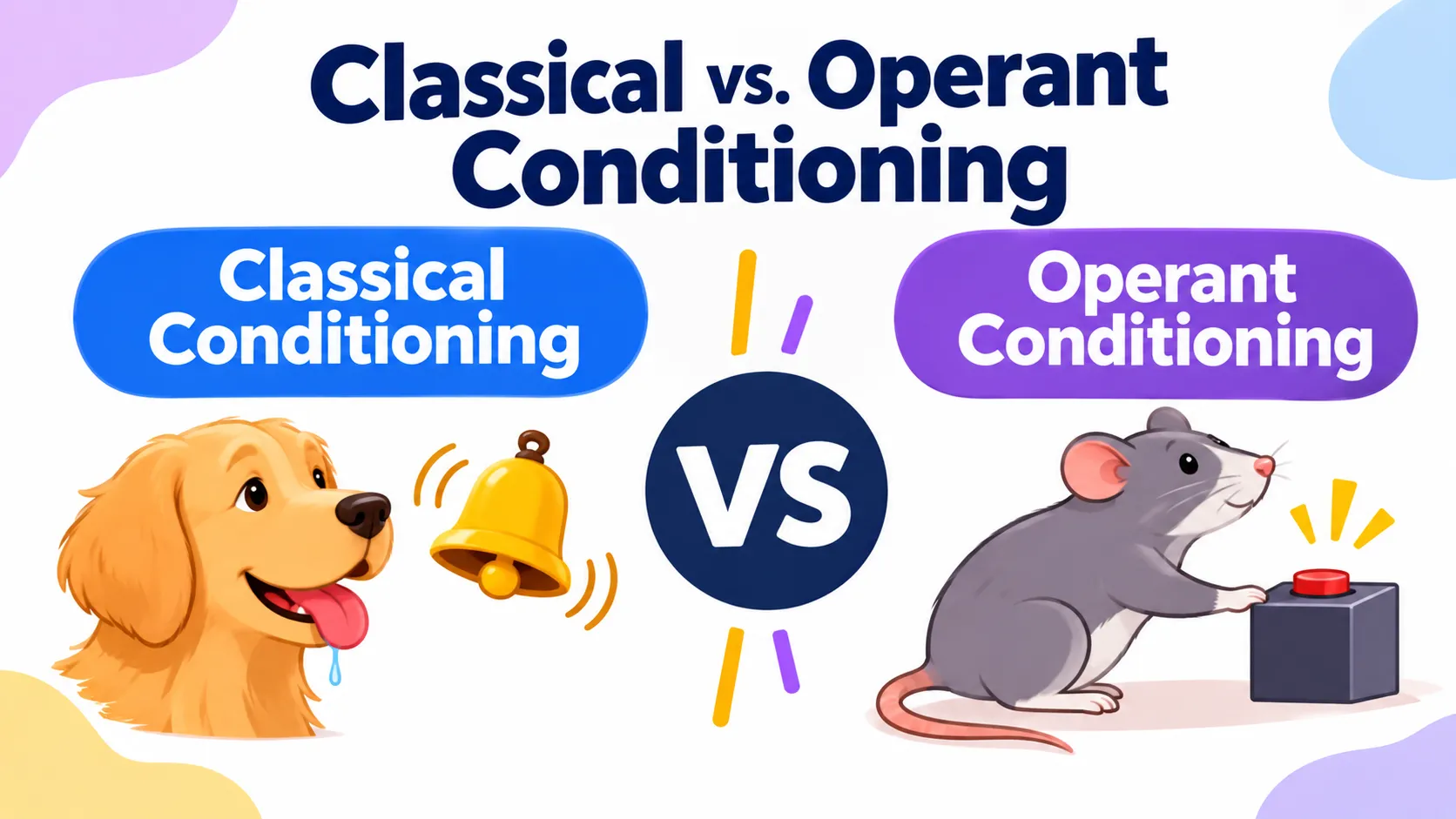
Learning happens in many ways. Sometimes we develop an automatic reaction after repeatedly experiencing two things together. Other times, we change our behavior because of what happens after we act.
Psychologists call these two learning processes classical conditioning and operant conditioning. Both are important forms of associative learning, but they work through different mechanisms.
Classical conditioning involves learning an association between two stimuli. Operant conditioning involves learning an association between a behavior and its consequences. Understanding this distinction helps explain everything from a dog responding to a familiar sound to a student studying harder after receiving a good grade.
In this guide, you’ll learn what classical and operant conditioning mean, how they work, their seven key differences, and how psychologists apply them to everyday behavior.
What Is Classical Conditioning?
Classical conditioning is a type of learning in which an organism develops an association between two stimuli, causing a previously neutral stimulus to trigger a response.
The process occurs when a neutral stimulus is repeatedly paired with an unconditioned stimulus that naturally produces a response. Eventually, the previously neutral stimulus can produce a similar learned response on its own.
The psychologist Ivan Pavlov famously demonstrated this process through experiments with dogs. His research showed that dogs could learn to associate a sound with food and eventually begin salivating when they heard the sound alone.
For a more detailed academic explanation, read OpenStax’s guide to classical conditioning.
Pavlov’s Dog Experiment
Pavlov originally studied digestion in dogs. During his experiments, he noticed that the dogs began salivating before food reached them. They had learned to associate certain signals, such as the arrival of laboratory staff, with feeding.
He investigated this observation by pairing a sound with food.
The experiment involved three main stages:
- Before conditioning: Food naturally caused the dogs to salivate. The sound did not initially produce the same response.
- During conditioning: Pavlov repeatedly presented the sound before giving the dogs food.
- After conditioning, the dogs began salivating at the sound, even when no food was presented.
The experiment illustrates how an organism can learn to respond to a stimulus that previously had no particular meaning.
The Five Important Terms in Classical Conditioning
Understanding classical conditioning becomes easier when you know its basic terminology.
| Term | Meaning | Pavlov’s example |
| Unconditioned stimulus (UCS) | A stimulus that naturally produces a response | Food |
| Unconditioned response (UCR) | A natural, unlearned response | Salivation caused by food |
| Neutral stimulus (NS) | A stimulus that initially does not produce the target response | Sound before conditioning |
| Conditioned stimulus (CS) | A previously neutral stimulus that produces a learned response | Sound after conditioning |
| Conditioned response (CR) | The learned response to the conditioned stimulus | Salivation after hearing the sound |
These terms describe how a neutral stimulus becomes associated with something that naturally produces a response.
What Is Operant Conditioning?
Operant conditioning is a type of learning in which behavior becomes more or less likely depending on its consequences.
When a behavior is followed by reinforcement, it becomes more likely to happen again. When it is followed by punishment, it becomes less likely.
Psychologist B. F. Skinner helped develop the modern understanding of operant conditioning through experiments involving animals and controlled environments. His work demonstrated how consequences can influence the frequency of behavior.
For a more detailed explanation, see OpenStax’s guide to operant conditioning and the American Psychological Association’s definition of operant conditioning.
Skinner’s Box Experiment
Skinner developed an experimental chamber commonly called the Skinner box. It allowed researchers to observe how consequences influenced animal behavior.
For example, a rat placed inside the chamber could press a lever to receive food.
The learning process worked as follows:
- The rat explored the chamber and eventually pressed the lever.
- Pressing the lever produced food.
- The rat learned that pressing the lever was associated with receiving food.
- The rat became more likely to press the lever again.
The food served as a reinforcer, increasing the likelihood of lever pressing.
This experiment demonstrated that behavior can be shaped by its consequences.
The Four Types of Operant Conditioning
Operant conditioning includes four major processes. They are based on two questions:
- Does the consequence add or remove something?
- Does the consequence increase or decrease a behavior?
| Type | What happens? | Example |
| Positive reinforcement | Something desirable is added to increase behavior | A student receives praise for completing homework |
| Negative reinforcement | Something unpleasant is removed to increase behavior | A driver fastens a seat belt to stop an annoying warning sound |
| Positive punishment | Something unpleasant is added to decrease behavior | A student receives an additional assignment after breaking a classroom rule |
| Negative punishment | Something desirable is removed to decrease behavior | A teenager loses gaming privileges after missing a curfew |
Remember that positive means adding something, while negative means removing something. Reinforcement increases behavior, whereas punishment decreases behavior.
For the psychological meaning of reinforcement, see the APA Dictionary of Psychology.
Classical vs. Operant Conditioning: 7 Key Differences
Classical and operant conditioning both explain how learning occurs through associations. However, they differ in the type of association, the role of consequences, and how behavior changes.
Here are seven important differences.
1. Learning Mechanism
The first difference concerns what an individual learns to associate.
Classical conditioning: An individual learns to associate two stimuli. A stimulus that previously had no particular effect eventually triggers a learned response.
Example: A dog learns to associate a sound with food and begins salivating when it hears the sound.
Operant conditioning: An individual learns to associate a behavior with its consequences.
Example: A student completes assignments regularly because doing so leads to praise or good grades.
2. Type of Behavior
Classical conditioning is commonly associated with automatic or reflexive responses, such as salivation, fear, and certain emotional reactions.
Operant conditioning is commonly associated with behaviors that an individual emits or performs, such as studying, exercising, or pressing a lever.
However, this distinction is a useful starting point rather than an absolute rule. Learning processes can interact, and classical conditioning can influence emotional and physiological responses that occur during more complex behavior.
3. Role of the Individual
In classical conditioning, the learner does not need to perform a particular action to receive the unconditioned stimulus. The important process is the association between stimuli.
In operant conditioning, the learner’s behavior plays a central role because the consequences depend on what the learner does.
For example:
- Classical conditioning: A person feels anxious after repeatedly associating a particular sound with an unpleasant event.
- Operant conditioning: A person studies more often after receiving positive feedback for good performance.
4. Role of Reinforcement and Punishment
Classical conditioning does not depend on reinforcement and punishment in the operant sense. Its central mechanism is the association between stimuli.
Operant conditioning directly uses reinforcement and punishment to increase or decrease the likelihood of behavior.
For example, food can naturally produce salivation in classical conditioning. In operant conditioning, food can act as a reinforcer by increasing the likelihood of a behavior, such as lever pressing.
5. Key Psychologists
Several psychologists contributed to the development of these learning theories.
| Classical conditioning | Operant conditioning |
| Ivan Pavlov | B. F. Skinner |
| John B. Watson | Edward Thorndike |
| Mary Cover Jones | B. F. Skinner |
Pavlov is especially associated with classical conditioning, while Skinner is strongly associated with operant conditioning. Thorndike’s law of effect also helped establish the foundations of learning through consequences.
You can explore more about these researchers in our guide to psychology theorists and their key concepts.
6. Extinction Process
Extinction occurs when a learned response or behavior becomes weaker under certain conditions.
In classical conditioning, extinction can happen when the conditioned stimulus is repeatedly presented without the unconditioned stimulus. For example, if a sound is repeatedly played without food, a dog’s conditioned salivation response may gradually decrease.
In operant conditioning, extinction occurs when a previously reinforced behavior no longer produces the expected reinforcement. For example, if pressing a lever no longer provides food, a rat may gradually stop pressing it.
Extinction does not necessarily erase the original learning. A response may sometimes return after a period of time, a process known as spontaneous recovery.
7. Everyday Applications
Both forms of conditioning help explain everyday learning, but they are used in different ways.
Classical conditioning examples:
- Feeling hungry after smelling food associated with mealtimes.
- Feeling nervous when entering a location associated with an unpleasant experience.
- Developing an emotional response to a familiar song connected with a memory.
Operant conditioning examples:
- Studying regularly after receiving good grades.
- Exercising more often after noticing positive results.
- Completing household tasks to earn an allowance.
- Reducing a behavior after losing a privilege.
These examples show how learned associations and consequences can influence everyday behavior.
Classical vs. Operant Conditioning: Comparison Table
The following table summarizes the main differences.
| Feature | Classical conditioning | Operant conditioning |
| Basic process | Association between stimuli | Association between behavior and consequences |
| Main learning focus | Stimulus-response association | Behavior-consequence association |
| Typical response | Often automatic or reflexive | Often emitted or goal-directed |
| Key psychologist | Ivan Pavlov | B. F. Skinner |
| Important process | Stimulus pairing | Reinforcement and punishment |
| Learner’s action | Not required for the stimulus pairing | Behavior is central to the process |
| Extinction | Conditioned stimulus appears without the unconditioned stimulus | Reinforcement is no longer provided |
| Common example | Salivating after hearing a learned sound | Studying more after receiving praise |
What Are the Similarities Between Classical and Operant Conditioning?
Although classical and operant conditioning work differently, they share several important features.
1. Both Are Forms of Learning
Both processes explain how experience can change behavior or responses over time.
2. Both Involve Associations
Classical conditioning involves associations between stimuli. Operant conditioning involves associations between behavior and consequences.
3. Both Can Influence Everyday Behavior
Both processes help explain how people and animals develop habits, emotional reactions, and behavioral patterns.
4. Both Can Be Studied Experimentally
Researchers can investigate both forms of conditioning through controlled experiments, observation, and behavioral measurement.
5. Both Can Involve Extinction
Learned responses or behaviors can weaken when the conditions that maintain them change.
Real-Life Examples of Classical and Operant Conditioning
The easiest way to understand these theories is to connect them with familiar situations.
Example 1: Developing a Fear of Dogs
Imagine a child who is frightened by a dog after being bitten.
Later, the child may feel anxious when seeing other dogs, even when those dogs are harmless.
This can be explained through classical conditioning:
- The bite or other painful experience serves as the unconditioned stimulus.
- Fear is the unconditioned response.
- Dogs may become associated with the unpleasant experience.
- Dogs can then act as conditioned stimuli.
- Fear when seeing a dog can become a conditioned response.
This example illustrates how emotional responses can develop through learned associations.
Example 2: Studying for Better Grades
A student receives positive feedback after completing homework and preparing for exams.
Over time, the student becomes more likely to study regularly because a desirable consequence follows the behavior.
This is an example of positive reinforcement in operant conditioning.
Example 3: Feeling Hungry at Lunchtime
A person eats lunch at approximately the same time every day. Eventually, approaching lunchtime may trigger feelings of hunger.
This may involve learned associations between environmental or time-related cues and eating. However, hunger is also influenced by biological processes, so not every lunchtime hunger response should be attributed solely to classical conditioning.
Example 4: Turning Off an Alarm
A driver hears a warning sound because the seat belt is not fastened. After fastening the seat belt, the sound stops.
Removing the unpleasant sound makes fastening the seat belt more likely in the future.
This is negative reinforcement, not punishment.
How Are Classical and Operant Conditioning Used in Psychology?
Psychologists use learning principles to understand behavior and inform approaches to behavior change.
Classical Conditioning in Psychology
Classical conditioning helps explain emotional and physiological responses, including learned fears and reactions to environmental cues.
For example, a person may develop anxiety around a location associated with a distressing experience. Understanding the association can help psychologists examine how the response developed.
Operant Conditioning in Psychology
Operant conditioning is used to understand how consequences influence behavior.
It can inform approaches to classroom management, habit development, workplace behavior, and behavior-support programs.
For example, teachers may use praise to encourage participation, while parents may establish consistent rewards for completing age-appropriate responsibilities.
Conditioning and Behavioral Therapy
Learning principles have influenced psychological treatments, including some approaches to exposure-based interventions and behavior modification.
For example, exposure-based approaches can help people gradually face feared situations in a structured and supported way. These treatments are more complex than simply repeating a stimulus, and they should be planned by qualified professionals when used for clinical concerns.
To explore related approaches, read our guide to AP Psychology and its major psychological concepts.
Classical vs. Operant Conditioning in AP Psychology
Classical and operant conditioning are important learning concepts in introductory psychology and AP Psychology.
Students should be able to:
- Define classical conditioning and operant conditioning.
- Identify the unconditioned stimulus and conditioned stimulus.
- Distinguish positive reinforcement from negative reinforcement.
- Distinguish reinforcement from punishment.
- Recognize examples of extinction.
- Apply learning principles to unfamiliar situations.
A useful exam strategy is to ask one question when you see a scenario:
Is the person learning an association between two stimuli, or learning from the consequences of a behavior?
If the scenario involves stimulus pairing, classical conditioning is likely involved. If it involves reinforcement or punishment following a behavior, operant conditioning is likely involved.
For more exam preparation, see our AP Psychology study guide and six-week AP Psychology study plan. You can also consult the official College Board AP Psychology course and exam information.
Frequently Asked Questions
1. What is the main difference between classical and operant conditioning?
Classical conditioning involves learning an association between two stimuli, while operant conditioning involves learning through the consequences of behavior.
2. What is an example of classical conditioning?
Pavlov’s dog experiment is a classic example. Dogs learned to associate a sound with food and eventually salivated when they heard the sound alone.
3. What is an example of operant conditioning?
A student receives praise for completing homework and becomes more likely to complete future assignments. This is positive reinforcement.
4. Is classical conditioning voluntary or involuntary?
Classical conditioning is commonly associated with automatic or reflexive responses, such as salivation and emotional reactions. However, it can also influence more complex behavior.
5. Is operant conditioning voluntary or involuntary?
Operant conditioning is commonly associated with behaviors that an individual performs and that are influenced by their consequences. The behavior does not have to be consciously planned.
6. Who developed classical conditioning?
Ivan Pavlov is best known for demonstrating classical conditioning through his experiments with dogs. John B. Watson later applied conditioning principles to human emotional responses.
7. Who developed operant conditioning?
B. F. Skinner is the psychologist most closely associated with the development of modern operant conditioning. Edward Thorndike’s earlier work on the law of effect also influenced the field.
8. What are the four types of operant conditioning?
The four types are positive reinforcement, negative reinforcement, positive punishment, and negative punishment. They differ according to whether something is added or removed and whether behavior increases or decreases.
9. Can classical and operant conditioning happen together?
Yes. The two learning processes are not mutually exclusive. For example, a person may develop an emotional response to a particular environment through classical conditioning while also changing their behavior in that environment through operant conditioning.
10. What is extinction in conditioning?
Extinction refers to the weakening of a learned response or behavior when the conditions that previously supported it change. In classical conditioning, the conditioned stimulus is presented without the unconditioned stimulus. In operant conditioning, the behavior no longer produces the reinforcement that previously maintained it.
Test Your Knowledge: Classical vs. Operant Conditioning
Try answering these questions to check whether you understand the difference.
Question 1: A dog begins salivating after hearing a sound that has repeatedly been paired with food. Which learning process is this?
A. Operant conditioning
B. Classical conditioning
C. Observational learning
D. Negative punishment
Correct answer: B. Classical conditioning.
Question 2: A student receives praise for completing homework and begins completing it more regularly. Which process is involved?
A. Classical conditioning
B. Positive reinforcement
C. Negative punishment
D. Extinction
Correct answer: B. Positive reinforcement.
Question 3: A driver fastens a seat belt to stop an unpleasant warning sound. What is this an example of?
A. Positive punishment
B. Negative punishment
C. Negative reinforcement
D. Classical conditioning
Correct answer: C. Negative reinforcement.
Question 4: A rat stops pressing a lever after food is no longer provided. What process may explain this change?
A. Operant extinction
B. Classical acquisition
C. Positive reinforcement
D. Stimulus generalization
Correct answer: A. Operant extinction.
Conclusion
Classical and operant conditioning are two major forms of associative learning. Both explain how experience influences behavior, but they focus on different learning mechanisms.
Classical conditioning involves forming associations between stimuli and is commonly linked to automatic responses. Operant conditioning involves learning through consequences, including reinforcement and punishment.
Remember the simplest distinction: classical conditioning links stimuli, while operant conditioning links behavior to consequences.
Understanding these two processes makes it easier to recognize how people and animals learn, develop habits, respond emotionally to their environments, and change their behavior over time.
References and Further Reading
The following educational and research sources provide additional information about conditioning and its history:
- OpenStax – Classical Conditioning
- OpenStax – Operant Conditioning
- American Psychological Association – Operant Conditioning
- American Psychological Association – Reinforcement
- Watson and Rayner (1920) – Conditioned Emotional Reactions
- College Board – AP Psychology Course and Exam Information
Editorial note: Watson and Rayner’s Little Albert study is historically important, but its methods and ethical standards have been widely questioned. For a later investigation of the case, see Beck, Levinson, and Irons (2009), Finding Little Albert.