
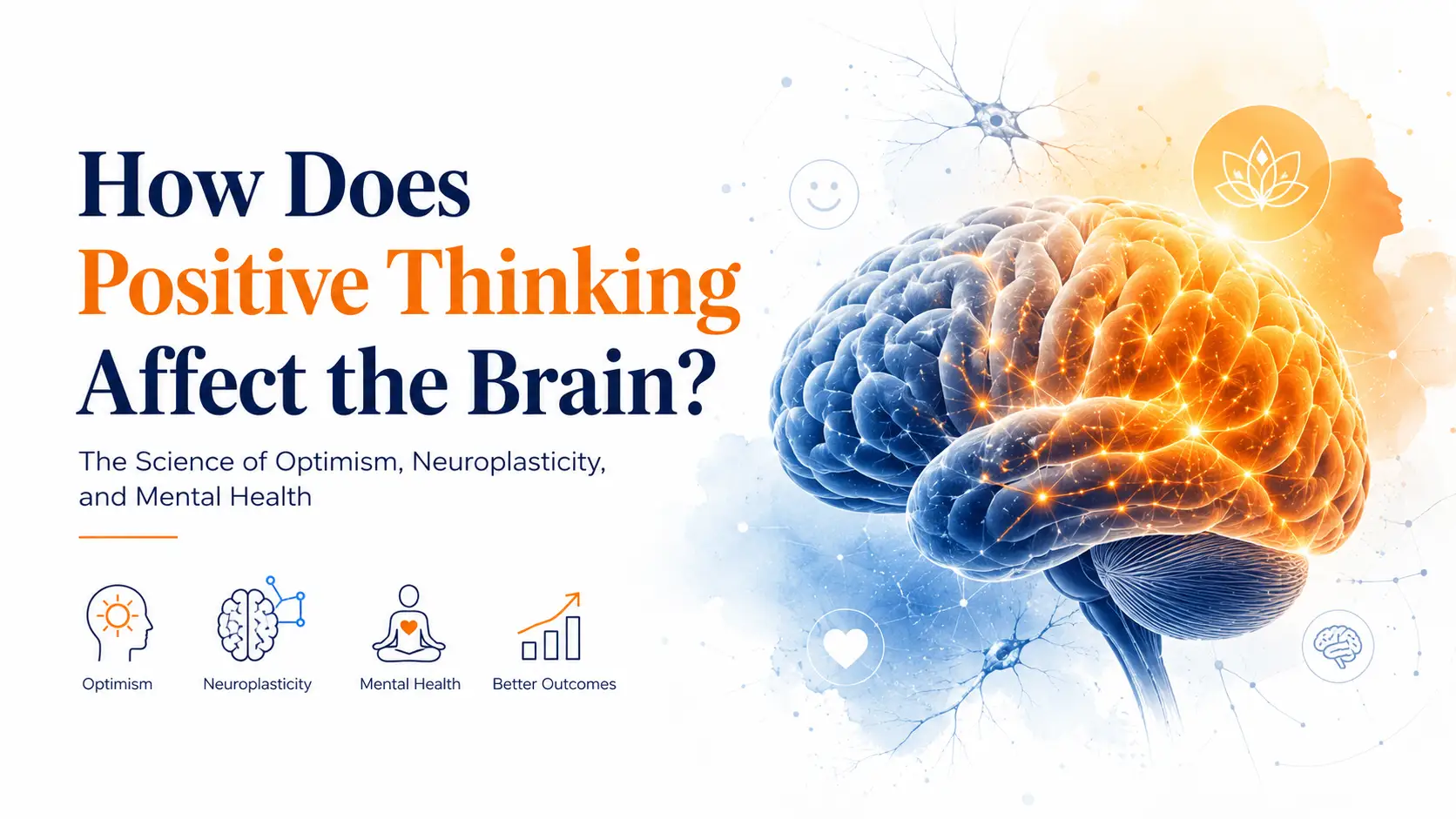
Positive thinking is not a motivational poster. It is a measurable biological event.
Every time you shift a thought from “I can’t handle this” to “I can figure this out,” your brain changes its chemistry, its blood flow, and — with enough repetition — its physical wiring. That’s not wishful thinking. That’s neuroscience.
This guide breaks down exactly how positive thinking affects the brain: which regions light up, which hormones rise and fall, how long rewiring actually takes, and where the line sits between healthy optimism and toxic positivity. You’ll get the research, the practical exercises, and honest answers to the questions people ask most.
Let’s look inside your head.
What Is Positive Thinking? (A Clear, Science-Based Definition)
Positive thinking is the habit of interpreting events in a realistic but constructive way — focusing on what can be influenced, learned, or improved, rather than only on what can go wrong.
That definition matters. Positive thinking is not:
- Pretending problems don’t exist
- Forcing a smile through genuine grief
- Believing that thoughts alone change external reality
In psychology, positive thinking sits inside a broader field called positive psychology, formalised by Martin Seligman in the late 1990s. It studies what makes people flourish rather than only what makes them sick.
Three related terms you’ll see throughout this article:
| Term | What It Means | Brain Link |
|---|---|---|
| Optimism | Expecting good outcomes more often than bad | Stronger prefrontal regulation of fear circuits |
| Growth mindset | Believing ability can improve with effort | Greater error-related brain activity and learning |
| Resilience | Recovering quickly after setbacks | Faster amygdala “reset” after Stress |
If you’re new to the field, our beginner’s overview — What Is Psychology? A Complete Guide — explains the foundations on which these concepts are built.
The Psychology of Positive Thinking: Why Your Brain Fights It
Here’s the uncomfortable truth: your brain is not designed to be positive. It’s designed to keep you alive.
Negativity Bias — Your Ancient Default Setting
Evolution rewarded caution. The ancestor who assumed the rustle in the grass was a predator and survived. The one who assumed it was the wind sometimes didn’t.
That legacy is called negativity bias, and it means:
- Negative events register faster and stick longer in memory
- Criticism outweighs praise emotionally, often several times over
- The brain scans for threat automatically, without permission
Psychologist Rick Hanson describes it memorably: the brain is like Velcro for bad experiences and Teflon for good ones.
So positive thinking isn’t your natural state. It’s a trained skill, which is exactly why it’s able to change your brain. Skills change brains. That’s what practice is.
The Broaden-and-Build Theory
Barbara Fredrickson’s broaden-and-build theory is one of the most influential frameworks in the psychology of positive thinking. It argues that:
- Negative emotions narrow your thinking (fight, flee, freeze — a short menu)
- Positive emotions broaden your thought-action repertoire (explore, connect, play, create)
- Broadened thinking builds durable resources — skills, relationships, knowledge, resilience
This is why anxious people tunnel-vision and calm people problem-solve. It’s not personality. It’s cognitive bandwidth.
What Happens in the Brain When You Think Positively?
When you think positively, your prefrontal cortex increases regulation over the amygdala, cortisol output drops, and dopamine and serotonin activity rise— improving focus, mood, memory, and decision-making.
Let’s unpack that region by region.
1. The Prefrontal Cortex — Your Brain’s CEO
Located behind your forehead, the prefrontal cortex (PFC) handles planning, judgment, impulse control, and emotional regulation.
Positive thinking strengthens PFC engagement in two ways:
- Reappraisal: consciously reframing a situation activates the lateral PFC, which then dampens the emotional alarm downstream
- Left-side activation: neuroscientist Richard Davidson at the University of Wisconsin–Madison found that greater relative activity in the left prefrontal cortex correlates with approach-oriented, positive emotional styles, while right-dominant patterns associate with withdrawal and negative affect
Practically, every time you reframe a setback, you’re doing a repetition at the PFC gym.
2. The Amygdala — Your Smoke Alarm
The amygdala is a small almond-shaped structure that triggers the stress response. It’s fast, loud, and not very accurate.
Negative rumination keeps it firing. Positive reappraisal quiets it. Brain imaging studies of emotion regulation consistently show the same pattern: PFC activity increases, amygdala activity decreases.
This is the single most important circuit in the entire conversation about positive thinking and mental health. A calmer amygdala means:
- Less baseline anxiety
- Fewer false-alarm threat readings
- More accessible memory and reasoning under pressure
3. The Hippocampus — Memory and Context
Chronic stress hormones damage the hippocampus, the region central to memory formation. Prolonged high cortisol is associated with reduced hippocampal volume in multiple studies.
Lower Stress means better memory encoding, which is why people often report that they “can’t think straight” when anxious, then suddenly remember everything once they’ve calmed down.
4. The Anterior Cingulate Cortex — The Conflict Detector
The ACC notices when your expectations and reality disagree. It’s heavily involved in gratitude practice, error monitoring, and empathy. Gratitude interventions consistently show engagement of the ACC and medial prefrontal cortex.
Positive Thinking and Brain Chemistry: The Four Key Molecules
Positive-thinking brain chemistry isn’t just one hormone. It’s a system.
Dopamine — Motivation and Reward
Dopamine is widely misunderstood as the “pleasure chemical.” It’s more accurate to call it the anticipation-and-motivation chemical. It fires when your brain predicts a reward is coming.
Optimism raises reward-prediction. Higher reward-prediction means:
- More willingness to start tasks
- Better persistence after failure
- Stronger learning from success
This creates a genuine self-fulfilling prophecy loop: expect success → act more → succeed more often → expect success more strongly.
Serotonin — Mood Stability
Serotonin influences mood, sleep, appetite, and social confidence. Behaviours associated with positive thinking — sunlight exposure, exercise, gratitude, social connection — all support serotonergic function.
Endorphins — Natural Pain Relief
Laughter, exercise, and social bonding release endorphins, which reduce pain perception and produce mild euphoria. This is measurable: shared laughter raises pain thresholds in controlled experiments.
Cortisol — The One You Want Lower
Does positive thinking reduce stress hormones? Yes. Optimistic individuals show lower cortisol reactivity to stressors and faster recovery afterwards.
Cortisol isn’t evil — you need it to wake up and respond to challenge. The problem is chronic elevation, which is linked to:
- Impaired memory
- Weakened immune response
- Higher blood pressure
- Poorer sleep quality
- Increased inflammation
The practical takeaway is worth pausing on: positive thinking works largely by reducing the damage of chronic Stress, not by producing magic. If you want the applied version, our guide, 7 Easy Ways to Reduce Stress, covers techniques that directly lower cortisol levels.
Can Positive Thinking Rewire Your Brain? The Neuroplasticity Answer
Yes. Repeated positive thinking physically rewires the brain through neuroplasticity — the process by which neurons that fire together strengthen their connections, while unused pathways weaken.
How Brain Rewiring Actually Works
The principle is called Hebbian learning, usually summarised as “neurons that fire together, wire together”.
Here’s the sequence:
- You think a thought. A specific set of neurons fires.
- You repeat it. The connection between those neurons strengthens (long-term potentiation).
- Myelin builds. The insulating sheath around the pathway thickens, making signals faster.
- The thought becomes automatic. It now requires less conscious effort than the alternative.
This is identical to how you learned to drive, type, or speak a second language. Positive thinking and neuroplasticity work by the same rules as any other skill.
The Evidence Base
- London taxi drivers who memorised the city’s street network showed enlarged posterior hippocampi compared to controls (Maguire et al., University College London). Learning changed structure.
- Meditators show measurable differences in cortical thickness and amygdala reactivity after eight-week programmes — notably in Sara Lazar’s work at Harvard.
- Cognitive Behavioural Therapy (CBT) produces brain changes comparable to medication for several anxiety and depressive conditions. CBT is, at its core, structured training in identifying and reframing distorted negative thoughts.
That last point deserves emphasis. CBT is positive thinking with a clinical evidence base. It’s the same mechanism — catching automatic negative thoughts and replacing them with accurate, balanced ones — delivered systematically.
How Long Does It Take to Rewire Your Brain?
Meaningful change typically begins within 4–8 weeks of consistent daily practice, though early mood improvements often appear within days.
The popular “21 days to a habit” figure has no solid research to back it up. The better-known study, led by Phillippa Lally at University College London, found that habit formation ranged from 18 to 254 days, with an average of around 66 days.
Realistic expectations:
| Timeframe | What Usually Changes |
|---|---|
| Days 1–7 | Increased awareness of negative thought patterns |
| Weeks 2–4 | Reframing becomes easier; small mood shifts |
| Weeks 4–8 | Measurable stress reduction; new default responses forming |
| 3–6 months | Reframing feels automatic; resilience noticeably higher |
| 1 year+ | Trait-level shift in explanatory style |
Consistency beats intensity. Five minutes daily outperforms an hour once a week — because plasticity responds to repetition, not duration.
The Benefits of Positive Thinking: What Research Actually Shows
Let’s separate the well-supported from the overstated.
Well-Supported Benefits
Cognitive:
- Improved working memory under pressure
- Broader attentional scope (literally wider peripheral awareness in some studies)
- Better creative problem-solving
- Faster decision-making with less rumination
Emotional:
- Reduced anxiety symptom severity
- Lower depression relapse rates when combined with CBT
- Higher emotional regulation capacity
- Greater tolerance of uncertainty
Physical:
- Lower cardiovascular event rates among optimists across multiple large cohort studies
- Better immune function markers
- Improved sleep quality
- Faster surgical recovery in several controlled studies
Longevity:
- The famous Nun Study (Danner, Snowdon & Friesen, 2001) analysed autobiographies written by nuns in their early twenties. Those expressing the most positive emotion lived, on average, substantially longer than those expressing the least — up to roughly a decade of difference between top and bottom quartiles.
- Becca Levy’s Yale research found that people with positive self-perceptions of ageing lived approximately 7.5 years longer than those with negative perceptions — an effect larger than that of low blood pressure or low cholesterol.
Honest Limitations
- Most of this is correlational. Healthy people may find it easier to be optimistic, not just the reverse.
- Effect sizes are moderate, not miraculous.
- Positive thinking does not cure disease. It supports the systems that help you cope with and recover from it.
- Defensive pessimism works better for some people, particularly high-anxiety individuals who perform better when they prepare for worst cases.
Good science includes its own caveats. That’s how you know it’s science.
Positive Thinking vs Negative Thinking: How the Brain Responds Differently
How does negative thinking affect the brain differently? It narrows attention, elevates cortisol, strengthens threat pathways through the amygdala, and — with chronic repetition — reduces hippocampal volume and impairs memory.
Side by side:
| Dimension | Positive Thinking | Negative Thinking |
|---|---|---|
| Attention | Broadens, notices options | Narrows, tunnel vision |
| Amygdala | Downregulated | Hyperactive |
| Prefrontal cortex | Engaged, in control | Offline under Stress |
| Cortisol | Lower, faster recovery | Chronically elevated |
| Memory | Better encoding | Impaired encoding |
| Problem-solving | Creative, flexible | Rigid, repetitive |
| Long-term structure | Strengthens regulation circuits | Strengthens threat circuits |
Both directions use the same mechanism. Rumination is neuroplasticity, too — just pointed the wrong way. Every rehearsal of “I always fail” builds that pathway exactly as efficiently as gratitude builds its own.
That symmetry is the most hopeful fact in this entire article. If your brain successfully learned pessimism, it’s already proved it can learn.
Positive Thinking vs Toxic Positivity: The Critical Difference
Positive thinking acknowledges difficulty and chooses a constructive response. Toxic positivity denies difficulty entirely and suppresses emotion, which increases Stress rather than reducing it.
Emotional suppression is measurably harmful. Research by James Gross at Stanford shows that suppressing emotional expression raises physiological arousal, both in the suppressor and often in the person they’re talking to. Reappraisal lowers it. Suppression doesn’t.
| Situation | Toxic Positivity | Healthy Positive Thinking |
|---|---|---|
| Job loss | “Everything happens for a reason!” | “This hurts. What can I control this week?” |
| Grief | “At least they’re in a better place.” | “This is devastating. I’ll let myself feel it.” |
| Failure | “Just stay positive!” | “That went badly. What’s the lesson?” |
| Illness | “Think positive and you’ll heal.” | “I’ll do what supports my treatment and my mind.” |
The rule of thumb: healthy positivity adds a perspective. Toxic positivity deletes a feeling.
This connects to a broader point about reading emotional reality accurately — in yourself and in others. If that interests you, How to Read Body Language: A Complete Guide covers the non-verbal side of emotional intelligence.
How Gratitude Changes Brain Structure Over Time
Gratitude is the single most researched positive-thinking intervention, largely because it’s easy to standardise and test.
The Evidence
Wong and Brown (2016) ran a landmark study on people seeking mental health counselling. One group wrote gratitude letters alongside therapy; the others didn’t. Findings:
- The gratitude group reported significantly better mental health at 4 weeks and 12 weeks — improvements that grew after writing stopped
- fMRI scans three months later showed greater medial prefrontal cortex sensitivity during gratitude tasks
- Benefits appeared even when letters were never sent
That last detail matters enormously. The benefit came from generating gratitude, not from receiving a response. The work happens inside your head.
Why Gratitude Is So Effective
It directly counters negativity bias. Your brain automatically catalogues threats. Gratitude forces it to catalogue resources instead — using the same attentional machinery, pointed the other way.
How to Train Your Brain to Think Positively: 9 Science-Backed Methods
These aren’t affirmations in a mirror. They’re mechanisms with evidence.
1. The Three Good Things Exercise
Each night, write three specific good things from the day and why each happened.
- Specificity matters: “My colleague brought me chai” beats “Work was fine”
- The “why” step engages causal reasoning, deepening the encoding
- Seligman’s research found benefits lasting up to six months from a one-week practice
Time cost: 5 minutes.
2. Cognitive Reframing (the CBT Core)
Catch a negative automatic thought, then interrogate it:
- What’s the thought? “I’m going to fail this presentation.”
- What’s the evidence for it? “I stumbled last time.”
- What’s the evidence against it? “I’ve delivered six others fine. I’m prepared.”
- What’s a balanced alternative? “I might be nervous, and I’ll still deliver it.”
This is not lying to yourself. It’s auditing yourself. Most negative automatic thoughts fail their own evidence test.
3. Cognitive Defusion
Add a prefix: instead of “I’m a failure,” say “I’m having the thought that I’m a failure.”
This small linguistic move shifts processing from the emotional system to the observing system. It’s a core technique in Acceptance and Commitment Therapy.
4. Third-Person Self-Talk
Kross’s research at the University of Michigan found that using your own name — “Ali, you’ve handled harder things than this” — reduces emotional reactivity compared with “I” statements. It creates psychological distance, and distance calms the amygdala.
5. Mindfulness Meditation
Ten minutes daily. The goal isn’t emptying your mind — it’s noticing when it wanders and returning to it. Each return is a rep for attentional control.
Eight-week mindfulness programmes are associated with reduced amygdala reactivity and improved emotional regulation.
6. Physical Exercise
The most reliable mood intervention that exists outside a pharmacy. Aerobic exercise:
- Raises BDNF (brain-derived neurotrophic factor), the protein that enables neuroplasticity itself
- Reduces cortisol
- Improves sleep, which improves everything else
You cannot rewire a chronically exhausted brain. Exercise makes the rewiring physically possible.
7. Sleep Protection
Sleep deprivation increases amygdala reactivity dramatically while weakening prefrontal control — the exact opposite of what positive thinking requires. Seven to nine hours isn’t a luxury. It’s the substrate.
8. Curate Your Inputs
Your brain trains on whatever you feed it. Doomscrolling for an hour is an hour of practice at threat detection. Choose deliberately.
9. Social Connection
Positive emotions are contagious through social networks. Relationships remain the strongest single predictor of wellbeing in longitudinal research, including the 85-year Harvard Study of Adult Development.
Positive Thinking, Brain Health, and the Mind-Body Connection
The mind-body connection isn’t mystical. It’s anatomical.
The vagus nerve runs from the brainstem to the heart, lungs, and gut, carrying signals in both directions. Your emotional state changes heart rate variability, digestion, and immune signalling — physically, through wiring.
This is why positive thinking and physical health are linked:
- Cardiovascular: Optimists show lower rates of heart disease across large cohorts, including the Women’s Health Initiative
- Immune: Suzanne Segerstrom’s work found optimism associated with stronger immune responses in stable conditions
- Inflammation: Chronic sstress raisesinflammatory markers; positive affect is associated with lower ones
- Recovery: Optimistic patients often show faster post-surgical recovery
Supporting the Hardware
Brain health isn’t only psychological. The organ has physical requirements:
- Omega-3 fatty acids — walnuts, flaxseed, oily fish (DHA is a structural component of neurons)
- Polyphenols — berries, dark chocolate, green tea
- B vitamins and Vitamin D — both linked to mood regulation
- Hydration — even mild dehydration measurably impairs cognition
- Exercise — the strongest known driver of BDNF
Thoughts run on biology. Feed the hardware.
Real-World Examples: Positive Thinking in Practice
The Student Who Reframed Failure
A university student in Lahore fails a mid-term. Version one: “I’m not smart enough for this degree.” That thought triggers avoidance; avoidance leads to less study; less study leads to another failure. The prophecy fulfils itself.
Version two: “My study method didn’t work. Which part?” That thought triggers analysis, analysis produces a new method, and the new method produces improvement—same event. Different pathways strengthened.
The Surgery Patient
Two patients, same knee replacement. One expects a difficult recovery and moves cautiously. The other expects to walk within weeks and start physiotherapy on schedule. Expectation drove behaviour. Behaviour drove outcome. The brain wrote the script the body followed.
The Nun Study Revisited
Young women in the 1930s wrote short autobiographies. Decades later, researchers scored those texts for positive emotional content. The correlation with lifespan was strong, and the writing had happened sixty years before anyone measured anything.
Their words weren’t causing longevity by magic. Their words revealed an explanatory style that shaped six decades of stress physiology, behaviour, and social connection.
Why Positive Thinking Matters Especially in Pakistan
Mental health awareness in Pakistan is rising, but access remains limited. Estimates suggest that fewer than 500–600 qualified psychiatrists serve a population exceeding 240 million, which is among the lowest ratios globally.
That reality makes self-directed, evidence-based mental training unusually valuable here:
- Cost: Gratitude journalling, reframing, and mindfulness cost nothing
- Stigma: Private daily practice sidesteps the social barriers that keep many from seeking help
- Access: No appointment, no waiting list, no travel to a major city
- Cultural fit: Gratitude (shukar), patience (sabr), and hopefulness are already deeply embedded values in Pakistani and Islamic tradition — the science aligns with what the culture already teaches.
An important boundary: this is not a substitute for clinical care. Moderate to severe depression, anxiety disorders, and trauma require professional treatment. Positive thinking is preventive maintenance and a therapeutic supplement — not a replacement.
Career and Learning Opportunities in Positive Psychology
Interest in the psychology of positive thinking has created real professional pathways.
Growing Fields
- Clinical psychology — the traditional route- requires accredited postgraduate training.
- Multinationals in Karachi, Lahore, and Islamabad increasingly fund wellbeing programmes.
- Wellness and mindset coaching — the fastest-growing segment, though standards vary widely
- Educational psychology — growth mindset programmes in schools
- Content and communication — science writing, mental health media, curriculum design
- UX and behavioural design — applying cognitive science to product decisions
Free LearniWellbeinges
- Yale’s Wellbeingg ofWellbeingg” with Laurie Santos — one of the most-enrolled courses in Coursera’s history, free to audit
- UC Berkeley’s Greater Good Science Center — greatergood.berkeley.edu offers free, research-backed practice.s
- Harvard Health Publishing — health.harvard.edu for accessible summaries of neuroscience research
- PubMed — pubmed.ncbi.nlm.nih.gov for reading primary studies yourself
- American Psychological Association — apa.org for professional standards and guidance
- World Health Organization — who.int for global mental health data
Paid Options
- University certificates in positive psychology (Penn’s programme is the field’s origin point)
- Accredited CBT training for those with a relevant background
- ICF-accredited coaching credentials for the coaching route
Start free. Verify the field genuinely interests you before spending anything.
Why Choose Your Brain Lens
There’s a lot of psychology content online. Most of it is recycled, unsourced, or quietly wrong.
Your Brain Lens exists for a specific reason: to explain how the mind actually works, using research you can verify, in language you don’t need a degree to read.
What that means in practice:
- Sourced claims. We name the researchers and the studies. You can check us.
- Honest limitations. When evidence is mixed, we say so. When a popular claim is weak, we say that too.
- No pseudoscience. No manifestation, no unverified brain hacks, no supplement affiliate schemes.
- Practical output. Every article ends with something you can actually do.
- Regional relevance. Written with readers in Pakistan and South Asia in mind, not translated from a US template.
Start with 10 Interesting Psychology Facts for a quick sense of how we work, or explore the full library at Your Brain Lens.
Frequently Asked Questions
What happens to your brain when you think positively?
Positive thinking increases prefrontal cortex activity, which calms the amygdala and reduces cortisol. Dopamine and serotonin activity rise, improving motivation, mood, memory, and focus. With repetition, these pathways physically strengthen through neuroplasticity.
Can positive thinking rewire the brain?
Yes. Repeated thoughts strengthen the neural pathways they use, a process called Hebbian learning. Consistent positive reframing physically strengthens emotional regulation circuits while unused negative pathways weaken. This is the same mechanism behind learning any skill.
Is positive thinking scientifically proven?
The mechanisms are well-supported: optimists show lower cortisol reactivity, better cardiovascular outcomes, and stronger immune markers across large studies. Cognitive Behavioural Therapy — structured thought reframing — has strong clinical evidence. supporting it. However, most population research is correlational, and positive thinking does not cure disease.
How long does it take to rewire your brain with positive thinking?
Awareness shifts within days. Measurable changes typically appear at 4–8 weeks of daily practice. Full habit automaticity averaged 66 days in University College London research, with a range of 18 to 254 days depending on the person and the habit.
What part of the brain controls positive thinking?
No single region. The prefrontal cortex leads reappraisal and regulation, the amygdala generates the emotional response being regulated, the anterior cingulate cortex monitors conflict and gratitude, and the ventral striatum processes reward. Positive thinking is a network activity.
Does positive thinking reduce stress hormones?
Yes. Optimistic people show lower cortisol reactivity to stressors and faster recovery afterwards. Since chronic cortisol elevation damages memory, immunity, and cardiovascular health, this is one of the clearest physical benefits.
Can positive thinking improve memory and focus?
Indirectly but reliably. Stress impairs the hippocampus and takes the prefrontal cortex offline. Reducing stress resStressboth. Positive emotions also broaden attention, improving creative problem-solving.
What is the difference between positive thinking and toxic positivity?
Positive thinking acknowledges difficulty and chooses a constructive response. Toxic positivity denies the difficulty and suppresses the emotion. Research shows suppression raises physiological arousal, while reappraisal lowers it — they produce opposite results.
Is positive thinking linked to longevity?
Research suggests yes. Becca Levy’s Yale study found positive self-perceptions of ageing associated with roughly 7.5 additional years of life. The Nun Study found similar patterns in writing analysed sixty years earlier. These are correlations, but they’re strong and replicated.
Conclusion: Your Brain Is Listening
Here’s what the research adds up to.
Your brain is not fixed. It is a living, changing organ that rebuilds itself around whatever you repeatedly ask it to do. Right now, it’s already being rewired — by your commute, your feed, your inner monologue at 2 am. The only question is whether you’re choosing the input or the input is choosing you.
Positive thinking isn’t about pretending life is easy. It’s about training the specific circuit that decides whether a hard thing breaks you or teaches you.
Start here, tonight:
- Write three specific good things from today, and why each happened
- Catch one negative automatic thought and ask what evidence supports it
- Do it again tomorrow
Five minutes. Eight weeks. That’s the whole protocol.
Your brain has spent years practising the alternative and has become very good at it. That’s not bad news — it’s proof of what it can learn.
Ready to go deeper? Explore advanced psychology, updated regularly, at Your Brain Lens — and read advanced blogs written by Your Brain Lens, including What Is Psychology?, How to Read Body Language, 7 Easy Ways to Reduce Stress, and 10 Interesting Psychology Facts.
Your brain changes either way. You may as well choose the direction.
Medical disclaimer: This article is for educational purposes and is not a substitute for professional diagnosis or treatment. If you are experiencing persistent low mood, anxiety, or thoughts of self-harm, please get in touch with a qualified mental health professional.





6 thoughts on “How Does Positive Thinking Affect the Brain? The Science of Optimism, Neuroplasticity, and Mental Health”