You meet your deadlines. You answer messages, manage responsibilities, and rarely let people see you struggle. Friends may describe you as organized, dependable, or unusually calm.
But inside, your mind rarely rests. You replay conversations, worry about small mistakes, and feel uncomfortable whenever you are not being productive.
This experience is sometimes described as high-functioning anxiety: a popular, informal term for anxiety symptoms that coexist with apparently successful everyday functioning.
Although someone may look confident and capable, that does not necessarily mean they feel emotionally well. Persistent worry, perfectionism, physical tension, and difficulty relaxing can take a significant toll even when work or school performance remains strong.
In this guide, you’ll discover eight possible signs of high-functioning anxiety, how they differ from generalized anxiety disorder (GAD) and perfectionism, and what evidence-based strategies may help. You’ll also find a practical reflection exercise and guidance on when to seek professional support.
What Is High-Functioning Anxiety?
High-functioning anxiety is an informal term used to describe people who experience anxiety while continuing to perform well in everyday responsibilities.
For example, someone may consistently achieve excellent results at work while privately worrying about disappointing others, making mistakes, or losing control.
Their outward behavior might look like this:
- Meeting deadlines consistently.
- Preparing carefully for important events.
- Taking responsibility for difficult tasks.
- Appearing calm in stressful situations.
- Maintaining relationships and professional commitments.
Their internal experience may look very different:
- Constantly anticipating problems.
- Feeling unable to switch off.
- Replaying minor mistakes.
- Feeling guilty when resting.
- Worrying that their achievements are never good enough.
Think of someone who receives praise for completing an important project but immediately starts worrying about the next assignment.
The achievement provides temporary relief rather than lasting satisfaction.
This is one reason the term high-functioning anxiety resonates with people who appear successful but experience persistent internal distress.
Is High-Functioning Anxiety a Medical Diagnosis?
No. High-functioning anxiety is not an official mental health diagnosis in the DSM-5-TR.
It is a descriptive phrase rather than a recognized clinical disorder.
A person who identifies with the term may experience ordinary situational anxiety, symptoms associated with generalized anxiety disorder, social anxiety, perfectionism-related distress, or another concern. Only an appropriately qualified professional can assess and diagnose an anxiety disorder.
The distinction matters because outward performance does not determine whether someone has a mental health condition.
Someone can maintain a demanding career and still experience clinically significant distress. Another person may experience temporary anxiety without meeting the criteria for a disorder.
For information about formal diagnostic categories, see the American Psychiatric Association’s DSM resources.
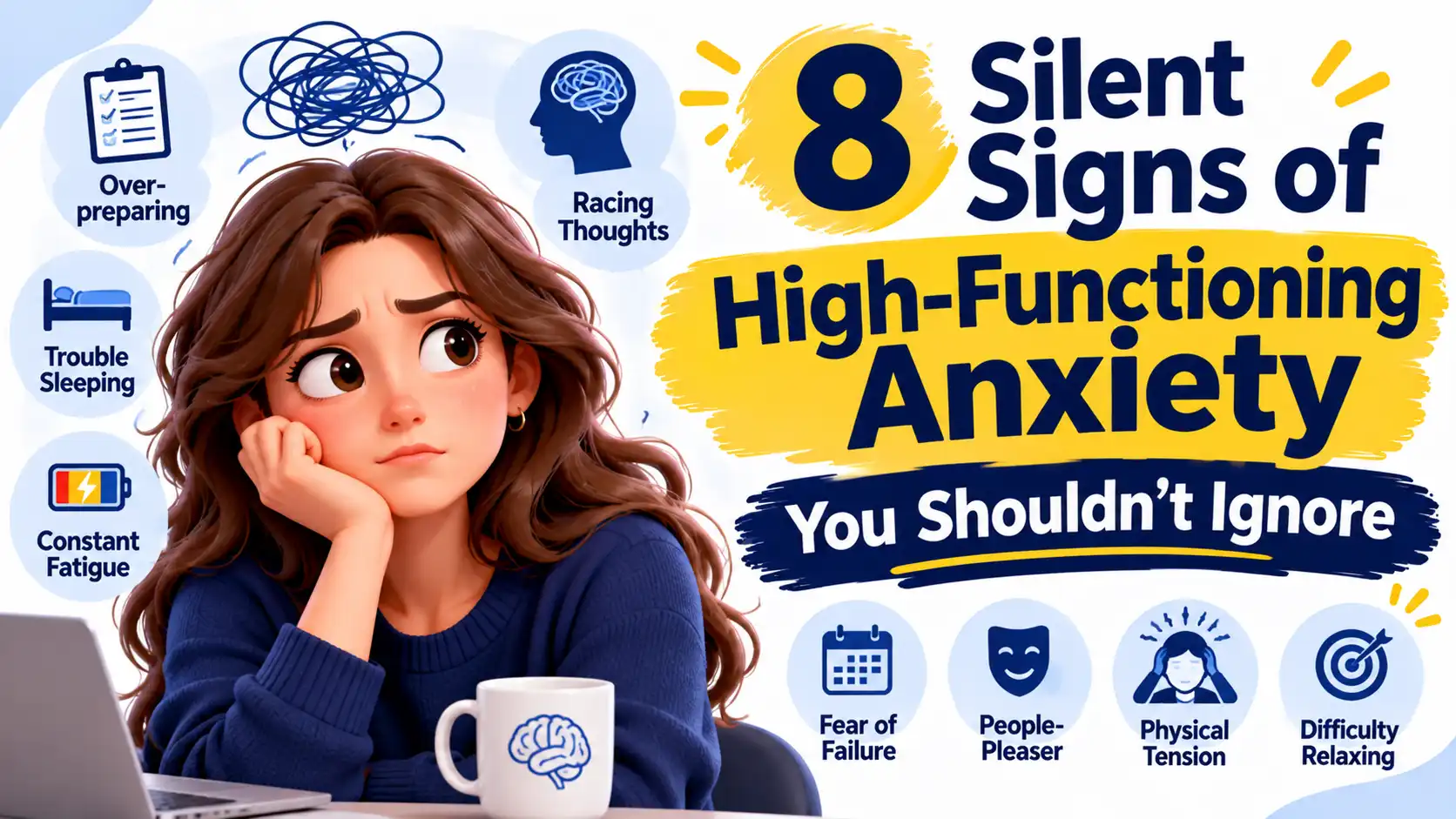
What Are the 8 Silent Signs of High-Functioning Anxiety?
Common experiences associated with the informal label include overthinking, fear-driven perfectionism, people-pleasing, difficulty relaxing, procrastination, physical tension, sleep difficulties, and fear of failure.
These experiences are not unique to high-functioning anxiety. They can occur with several mental health conditions or during stressful periods.
One sign alone does not establish that someone has an anxiety disorder. What matters is the pattern, its duration, and how much distress it causes.
| No. | Possible sign | What others may notice | What you may experience |
| 1 | Overthinking | Careful planning | Repeated worry and mental rehearsal |
| 2 | Perfectionism | High-quality work | Fear of mistakes and criticism |
| 3 | People-pleasing | Reliability and helpfulness | Difficulty saying no |
| 4 | Difficulty relaxing | Constant productivity | Guilt or restlessness during downtime |
| 5 | Procrastination followed by overwork | Last-minute success | Anxiety about starting or making mistakes |
| 6 | Physical tension | Little visible distress | Muscle tension, headaches, or stomach discomfort |
| 7 | Sleep difficulties | Getting through the day | Trouble falling asleep or staying asleep |
| 8 | Fear of failure | Cautious decision-making | Excessive worry about disappointing others |
Let’s examine each sign more closely.
1. Do You Overthink Almost Everything?
Persistent overthinking is one possible sign of anxiety, particularly when thoughts repeatedly focus on future threats or past mistakes.
You may find yourself:
- Replaying a conversation from several days ago.
- Rewriting a simple email multiple times.
- Imagining everything that could go wrong before a meeting.
- Worrying about how someone interpreted your words.
- Rehearsing conversations that may never happen.
For example, your manager sends a short message saying, “Can we talk tomorrow?”
Instead of treating it as a neutral request, you immediately wonder whether you made a mistake or are about to receive criticism.
You may spend hours preparing explanations for a problem that does not exist.
This kind of repetitive thinking can feel like preparation, but it may increase distress without helping you solve anything.
Try this: Ask yourself, “Is there a specific action I can take right now, or am I repeatedly imagining possibilities?”
If there is an action, write down one practical next step. If there is not, gently redirect your attention to something you can control.
You can also explore our overthinking test as a reflection exercise.
2. Is Your Perfectionism Driven by Fear?
Perfectionism may become emotionally exhausting when your standards are driven by fear of criticism, rejection, or failure.
You might spend hours checking a report because you are afraid that one small mistake will damage your reputation.
Even after receiving positive feedback, you focus on what could have been better.
Common experiences include:
- Repeatedly checking completed work.
- Feeling dissatisfied with successful results.
- Setting increasingly demanding standards.
- Avoiding tasks when you are unsure you can do them perfectly.
- Interpreting minor mistakes as evidence that you are not good enough.
However, perfectionism and high standards are not automatically unhealthy.
Research distinguishes between perfectionistic striving and perfectionistic concerns. A 2023 systematic review and meta-analysis covering 416 studies and more than 113,000 participants found that perfectionistic concerns were more strongly associated with psychological distress than perfectionistic striving.
This suggests that the fear of making mistakes and the constant worry about meeting expectations may be more concerning than simply wanting to do good work.
Try this: Before beginning a task, define what a successful and reasonable result looks like. Once you meet that standard, avoid adding unnecessary checks solely for temporary reassurance.
3. Do You Say Yes Even When You Want to Say No?
Repeatedly agreeing to requests despite feeling overwhelmed may reflect difficulty setting boundaries or fear of disappointing others.
For example, a colleague asks you to take on another assignment even though your schedule is already full.
You want to refuse, but you immediately imagine that they will think you are unreliable.
So you agree.
Later, you feel exhausted or resentful, but you still find it difficult to explain that you have too much to do.
This pattern may involve:
- Apologizing unnecessarily.
- Avoiding disagreement.
- Taking responsibility for other people’s feelings.
- Feeling guilty when refusing requests.
- Struggling to ask for help.
People-pleasing is not itself a diagnosis, and it can have many causes. However, when fear of rejection drives repeated overcommitment, it may contribute to anxiety and emotional exhaustion.
Try this: Pause before agreeing to a request. You can say, “Let me check my schedule and get back to you.”
This gives you time to decide whether you genuinely have the capacity to help.
4. Do You Feel Guilty When You Relax?
Difficulty relaxing may occur when a person associates productivity with safety, approval, or personal worth.
You finally have a free afternoon, but instead of enjoying it, you start looking for something productive to do.
You may:
- Check work messages during breaks.
- Feel uncomfortable watching a film without multitasking.
- Turn weekends into detailed schedules.
- Think about unfinished tasks while trying to rest.
- Feel guilty when others seem more productive.
Rest can become another task to complete rather than an opportunity to recover.
It is important not to assume that everyone who enjoys being busy has anxiety. Some people genuinely prefer active routines.
The concern arises when resting repeatedly produces significant distress or when someone feels unable to stop working despite exhaustion.
Try this: Schedule a short period of unstructured time. You do not need to earn rest by completing every task first.
Begin with ten or fifteen minutes and notice what thoughts appear without immediately acting on them.
5. Do You Procrastinate and Then Overwork?
Some people delay tasks because they feel overwhelmed, uncertain, or afraid of making mistakes, then work intensely as deadlines approach.
From the outside, this can look like a person who performs well under pressure.
Inside, the pattern may be much less comfortable.
For example:
- You receive an important assignment.
- You worry that you will not do it well enough.
- Starting feels overwhelming.
- You postpone the task.
- The deadline approaches and anxiety increases.
- You work intensely to finish it.
- You feel temporary relief after submitting it.
This cycle can reinforce the belief that you need extreme pressure to perform.
However, procrastination has many possible causes, including low motivation, competing priorities, unclear instructions, fatigue, and difficulties with attention or planning. It should not automatically be attributed to anxiety.
Try this: Break a task into a first step that takes no more than ten minutes.
Instead of writing, “Complete the entire report,” begin with, “Open the document and write three section headings.”
A manageable starting point can make the task feel less intimidating.
6. Does Anxiety Show Up in Your Body?
Anxiety can produce physical symptoms because emotional distress and the body’s stress-response systems are connected.
Possible symptoms include:
- Muscle tension.
- Headaches.
- A racing or noticeable heartbeat.
- Stomach discomfort.
- Sweating or trembling.
- Feeling restless.
- Fatigue.
For example, you may feel physically tense before an ordinary meeting, even when you have prepared thoroughly.
Some people also clench their jaw or experience digestive discomfort during stressful periods.
However, physical symptoms are not proof of anxiety. They can have medical causes and should not automatically be dismissed as psychological.
If symptoms are new, severe, persistent, or concerning, speak with a healthcare professional.
For a reliable overview, see the NHS guide to anxiety.
7. Do You Struggle to Sleep Because Your Mind Will Not Switch Off?
Worry and anxiety can make it harder to fall asleep, stay asleep, or feel rested.
You may go to bed exhausted but find yourself thinking about tomorrow’s responsibilities.
Common experiences include:
- Replaying the day’s events.
- Worrying about upcoming deadlines.
- Checking the time repeatedly.
- Finding it difficult to settle your thoughts.
- Waking during the night and struggling to fall back asleep.
Sleep difficulties and anxiety can also reinforce each other. Poor sleep may make it harder to manage emotions and worry the following day, while anxiety may make restful sleep more difficult.
But sleep problems have many possible causes, including medical conditions, medication effects, lifestyle factors, and other sleep disorders.
Try this: Establish a consistent bedtime routine. Set aside a few minutes earlier in the evening to write down tomorrow’s tasks and any concerns that need attention.
If sleep difficulties persist or interfere with daily functioning, discuss them with a healthcare professional.
8. Are You Afraid of Failure Even When You Are Successful?
Fear of failure may lead you to avoid opportunities, overprepare, or interpret ordinary mistakes as threats to your self-worth.
Imagine that you are offered a promotion.
You have the experience and qualifications, but instead of feeling excited, you immediately think:
- “What if I cannot handle it?”
- “What if people discover that I am not capable?”
- “What if I disappoint everyone?”
- “What if I fail after getting this opportunity?”
You may turn down the opportunity or spend excessive time preparing for it.
Success can also bring only temporary relief. Once one goal is achieved, your attention shifts to the next possible failure.
Try this: Separate the outcome of a task from your value as a person. Making a mistake does not automatically mean that you are incompetent.
Ask yourself, “What would I attempt if I knew that making a mistake would not define me?”
What Does High-Functioning Anxiety Look Like During a Typical Day?
High-functioning anxiety is often described as a contrast between outward functioning and internal experience.
Consider this fictional example.
Morning: Alex wakes up and immediately reviews the day’s responsibilities. Before getting out of bed, they are already worried about being late or forgetting something.
At work: Alex is organized, meets deadlines, and helps colleagues. However, they repeatedly check emails and worry about how their manager interprets each message.
Afternoon: A colleague asks for help. Alex agrees despite having too much work because saying no feels uncomfortable.
Evening: Alex finishes the day’s tasks but continues thinking about small mistakes. Relaxing feels difficult because several responsibilities remain unfinished.
Night: Alex goes to bed tired but spends time thinking about tomorrow.
This example illustrates a possible pattern, not a clinical profile. Different people experience anxiety in different ways.
The key question is whether worry and pressure are interfering with your quality of life, even as you continue to meet your responsibilities.
How Is High-Functioning Anxiety Different From Generalized Anxiety Disorder?
High-functioning anxiety is an informal description, while generalized anxiety disorder is a recognized mental health diagnosis with specific clinical criteria.
The distinction is not simply whether someone performs well at work or school.
People with GAD can continue to achieve goals and meet responsibilities. Others may experience significant difficulties in daily functioning.
According to the DSM-5-TR diagnostic criteria, GAD involves excessive anxiety and worry about several events or activities, occurring more days than not for at least six months. The person also has difficulty controlling the worry and experiences associated symptoms.
For adults, these may include restlessness, fatigue, difficulty concentrating, irritability, muscle tension, and sleep disturbance. The symptoms must also cause clinically significant distress or impairment.
A qualified professional considers the full clinical picture rather than relying on one symptom or an informal label.
| Feature | High-Functioning Anxiety | Generalized Anxiety Disorder |
| Clinical status | Informal descriptive term | Recognized diagnosis |
| Main idea | Anxiety symptoms alongside outward functioning | Excessive, difficult-to-control worry meeting diagnostic criteria |
| Duration | No formal diagnostic duration | Specific duration criterion |
| Symptoms | May include worry, tension, perfectionism, or difficulty relaxing | Defined pattern of worry and associated symptoms |
| Functioning | May appear successful externally | May involve significant distress or impairment, even if performance remains high |
| Assessment | Not a formal diagnosis | Requires clinical assessment |
For further information, read the NIMH guide to generalized anxiety disorder and the NHS guide to GAD.
Is It High-Functioning Anxiety or Perfectionism?
Perfectionism and anxiety can overlap, but they are not the same thing.
Perfectionism involves demanding standards and concerns about mistakes or performance.
Anxiety involves worry, apprehension, and other emotional or physical responses to perceived threats.
A person can be highly conscientious without experiencing significant anxiety. Another person may experience anxiety even when their standards are not particularly demanding.
Ask yourself:
- Can I complete a task without repeatedly checking it?
- Can I accept constructive criticism without feeling personally threatened?
- Can I rest without feeling that I am doing something wrong?
- Can I make a mistake and move forward?
- Do my standards help me, or do they leave me constantly worried?
These questions are useful for reflection, not diagnosis.
For more information, see our guide to Type A and Type C personality patterns.
Why Can Anxiety Go Unnoticed in High Achievers?
Anxiety may go unnoticed when a person’s outward behavior gives others little reason to suspect that they are struggling.
Several factors can contribute.
1. Achievement Can Hide Distress
People often associate success with confidence and emotional stability.
Someone who receives good grades or consistently performs well at work may be assumed to be doing fine.
But productivity alone does not reveal a person’s emotional wellbeing.
2. Overpreparation Can Be Rewarded
Preparing carefully is usually viewed positively.
However, when preparation is driven by persistent fear, it can become exhausting.
If someone is repeatedly praised for working late or taking on additional responsibilities, they may find it difficult to recognize when the behavior has become unhealthy.
3. People May Minimize Their Own Distress
Someone may think:
“Other people have bigger problems.”
“I should be grateful.”
“I am still functioning, so nothing can be wrong.”
These thoughts can discourage people from seeking support.
4. Anxiety Can Become Familiar
When worry has been part of someone’s routine for years, they may assume that constant mental pressure is normal.
They may not recognize how much energy it takes to manage everyday situations.
Personal history, relationships, and learned coping patterns can influence how people respond to stress. However, no single childhood experience or attachment style explains every person’s anxiety.
Explore our guide to attachment styles for more information about relationship patterns.
How Can You Recognize Your Own Anxiety Patterns?
The following exercise is designed to help you reflect on your experiences. It is not a diagnostic test.
Read each statement and consider whether it describes something that happens regularly.
- I frequently worry about things that have not happened.
- I replay conversations and worry about what I said.
- I find it difficult to stop working even when I am tired.
- I feel uncomfortable when I am not being productive.
- I often agree to requests even when I am overwhelmed.
- I worry excessively about making mistakes.
- I struggle to enjoy achievements because I immediately focus on the next task.
- I experience physical tension during stressful periods.
- My worries sometimes interfere with sleep.
- I find it difficult to ask others for help.
How to Interpret Your Answers
Rather than calculating a score or assigning yourself a label, consider these questions:
- Which experiences occur most frequently?
- How long have they been happening?
- Do they interfere with your relationships, health, work, or enjoyment of life?
- What situations tend to make them worse?
- Have you developed habits that temporarily reduce worry but create more pressure later?
If several experiences are persistent or distressing, consider discussing them with a qualified mental health professional.
How Can You Cope With High-Functioning Anxiety?
Helpful strategies include identifying unhelpful thought patterns, setting realistic standards, building recovery time into your routine, and seeking evidence-based treatment when necessary.
The goal is not to eliminate ambition or stop caring about your responsibilities.
It aims to reduce the distress associated with everyday activities.
1. Practice More Balanced Thinking
Anxiety can make uncertain situations feel more threatening than they really are.
For example:
“My manager has not replied. I must have done something wrong.”
A more balanced interpretation might be:
“My manager may be busy. I do not have enough information to know why they have not replied.”
This does not mean forcing yourself to think positively. It means considering multiple explanations instead of immediately accepting the most frightening one.
2. Use the Good-Enough Rule
If you repeatedly overwork routine tasks, decide in advance what completion looks like.
For example:
| Task | A reasonable stopping point |
| Routine email | Clear, accurate, and polite |
| Everyday report | Complete and checked once |
| Presentation | Main information accurate and organized |
| Important project | Meets agreed requirements and receives appropriate review |
High-stakes work may need additional checks. The point is to avoid endless revisions when they are not necessary.
3. Practice Saying No
Setting boundaries can reduce unnecessary pressure.
Try phrases such as:
- “I cannot take that on this week.”
- “I need to check my current workload first.”
- “I can help with part of it, but not the entire task.”
- “I appreciate you asking, but I do not have the capacity.”
You do not need to provide a long explanation every time you decline a request.
4. Schedule Rest Without Treating It as a Reward
Rest is part of maintaining health and wellbeing.
Try scheduling a short break during the day without using it to catch up on messages or unfinished tasks.
You might take a walk, listen to music, read, or sit quietly.
If guilt appears, notice it without treating it as an instruction to start working again.
5. Create a Worry-Planning Routine
Set aside a short period each day to review concerns.
For each worry, ask:
- Can I take a practical action?
- Is this something I can influence?
- Am I trying to predict an outcome I do not yet know?
- What is the smallest useful next step?
Write down one action you can take for each concern you can address. For concerns outside your control, practice returning your attention to the present task.
6. Support Healthy Sleep Habits
Try to maintain a regular sleep-wake schedule.
Other helpful habits may include:
- Reducing stimulating activities before bed.
- Creating a comfortable sleep environment.
- Writing down tomorrow’s tasks earlier in the evening.
- Avoiding repeated clock-checking.
- Seeking medical advice for persistent sleep difficulties.
These habits can support sleep, but they are not a substitute for assessment or treatment when a sleep or anxiety disorder is present.
7. Make Time for Physical Activity
Regular physical activity can support general mental and physical wellbeing.
Choose an activity that fits your abilities and routine, such as walking, cycling, swimming, or gentle stretching.
You do not need an intense exercise plan to begin.
The aim is to develop a sustainable habit rather than create another demanding performance goal.
Practical Exercise: The ABC Thought Log
The ABC model is associated with Albert Ellis’s Rational Emotive Behavior Therapy (REBT). It helps people examine how beliefs about an event influence emotional and behavioral consequences.
The American Psychological Association describes ABC theory as a framework underlying REBT.
It can be used as a reflection tool, although a worksheet alone is not a replacement for therapy.
What Does ABC Stand For?
- A — Activating event: What happened?
- B — Beliefs: What did you think about the event?
- C — Consequences: What emotions and behaviors followed?
Extended versions of the exercise may add:
- D — Disputation: Examine the accuracy and usefulness of the belief.
- E — Effective new belief: Develop a more balanced interpretation.
Example: Your Manager Does Not Reply to an Email
| Stage | Example |
| A — Event | My manager has not replied to my email |
| B — Belief | “I must have made a mistake. They are probably unhappy with my work.” |
| C — Consequence | Anxiety, stomach tension, and repeatedly checking my inbox |
| D — Disputation | “I do not have evidence that my manager is unhappy. They may simply be busy.” |
| E — New belief | “I can wait until tomorrow before following up if necessary.” |
Blank ABC Thought Log
| Stage | Your reflection |
| A — What happened? | |
| B — What did I think? | |
| C — What did I feel and do? | |
| D — What evidence supports or challenges my belief? | |
| E — What is a more balanced response? |
Try using the log when a particular worry keeps returning.
The aim is not to dismiss genuine concerns. It is to distinguish facts from assumptions and to identify a more helpful response.
Read more: APA Dictionary — ABC Theory.
What Treatments Can Help With Persistent Anxiety?
If anxiety is frequent, difficult to control, or interfering with daily life, professional support can help.
Treatment depends on the person’s symptoms, diagnosis, preferences, and circumstances.
Cognitive Behavioral Therapy (CBT)
CBT is an evidence-based psychological treatment used for several anxiety disorders.
It can help people identify unhelpful thinking patterns, understand the relationship between thoughts and behavior, and gradually change responses that maintain anxiety.
Applied Relaxation
Applied relaxation teaches people to recognize tension and use structured relaxation techniques.
It is one of the psychological treatment options recommended in NICE guidance for adults with GAD.
Medication
A healthcare professional may discuss medication when symptoms are significant or when it is appropriate for the person’s clinical circumstances.
Medication decisions should be made with a qualified prescriber who can explain possible benefits, side effects, and alternatives.
Do not start, stop, or change prescribed medication without medical guidance.
What Does Clinical Guidance Recommend?
The UK National Institute for Health and Care Excellence (NICE) recommends evidence-based approaches for diagnosed GAD, including CBT and applied relaxation in appropriate circumstances. Medication may also be considered following clinical assessment.
Read the full guideline:
NICE: Generalised Anxiety Disorder and Panic Disorder in Adults — Recommendations.
For an accessible explanation, see NICE’s information about GAD treatment.
When Should You Seek Professional Help?
Consider speaking with a healthcare professional if:
- Worry feels difficult to control.
- Anxiety occurs frequently and persists over time.
- Sleep or physical wellbeing is affected.
- You avoid important activities because of fear.
- Relationships or work are suffering.
- You feel overwhelmed despite continuing to meet responsibilities.
- Self-help strategies are not providing enough relief.
You do not need to wait until you are unable to work or manage daily tasks before asking for help.
A clinician can assess your symptoms, consider possible physical or psychological causes, and discuss appropriate treatment.
If you are experiencing thoughts of self-harm or feel unable to keep yourself safe, seek urgent help through your local emergency or crisis service.
Where Can You Find Reliable Anxiety Support?
These organizations provide trustworthy information:
- National Institute of Mental Health (NIMH) — Information about anxiety disorders and treatment.
- National Health Service (NHS) — Symptoms, diagnosis, and treatment information.
- American Psychological Association (APA) — Educational information about anxiety.
- NICE clinical guidelines — Evidence-based recommendations for GAD treatment.
Frequently Asked Questions About High-Functioning Anxiety
Is high-functioning anxiety a real diagnosis?
No. High-functioning anxiety is a popular descriptive term, not an official psychiatric diagnosis. It is used to describe people who experience anxiety while continuing to perform everyday responsibilities.
Can you have anxiety and still be successful?
Yes. People experiencing anxiety can maintain careers, relationships, education, and other responsibilities. Outward success does not necessarily reflect a person’s internal emotional wellbeing.
What are the most common signs of high-functioning anxiety?
Commonly described signs include overthinking, fear-driven perfectionism, people-pleasing, difficulty relaxing, procrastination, physical tension, sleep difficulties, and fear of failure. These experiences are not unique to one condition.
Is high-functioning anxiety the same as generalized anxiety disorder?
No. High-functioning anxiety is an informal label, whereas GAD is a recognized diagnosis with specific clinical criteria. Someone who identifies with the informal label may or may not meet the criteria for GAD.
Can high-functioning anxiety cause physical symptoms?
Anxiety can be associated with muscle tension, headaches, stomach discomfort, sweating, and a noticeable heartbeat. However, these symptoms can also have medical causes and should be assessed when persistent or concerning.
Does high-functioning anxiety go away on its own?
There is no single answer. Some anxiety improves when a stressful situation changes. Persistent symptoms may require changes in coping strategies or professional treatment.
Can perfectionism be related to anxiety?
Yes. Research suggests that perfectionistic concerns, particularly fear of mistakes and doubts about performance, are associated with anxiety symptoms. However, high standards alone do not mean someone has an anxiety disorder.
What is the best way to cope with high-functioning anxiety?
Helpful approaches may include balanced thinking, realistic standards, healthy boundaries, regular recovery time, physical activity, and professional support when needed.
Conclusion: You Can Be Successful Without Living Under Constant Pressure
High-functioning anxiety is an informal term for a pattern that many people recognize: appearing capable and composed while privately experiencing persistent worry and pressure.
The eight experiences discussed in this article include overthinking, fear-driven perfectionism, people-pleasing, difficulty relaxing, procrastination, physical tension, sleep difficulties, and fear of failure.
These signs are not a diagnosis. They are reasons to pay attention to how you feel, how long the pattern has lasted, and whether it is affecting your quality of life.
Start with three small steps:
- Notice: Identify one situation that repeatedly triggers worry.
- Reflect: Separate what happened from what you fear might happen.
- Respond: Choose one realistic action, boundary, or recovery habit.
If anxiety continues to affect your wellbeing, consider speaking with a qualified mental health professional.
You do not have to wait until your performance declines before taking your emotional health seriously.
Being successful and feeling well should not be competing goals.
References and Further Reading
The following sources support the article’s diagnostic distinctions, symptom descriptions, research on perfectionism, therapeutic concepts, and treatment recommendations.
- American Psychiatric Association. Diagnostic and Statistical Manual of Mental Disorders (DSM-5-TR).
DSM resources - National Institute of Mental Health. Generalized Anxiety Disorder: What You Need to Know.
NIMH publication - National Health Service. Generalised Anxiety Disorder (GAD).
NHS guide - American Psychological Association. Anxiety.
APA topic guide - Smith, M. M., et al. (2023). The relationships between perfectionism and symptoms of depression, anxiety and obsessive-compulsive disorder in adults: A systematic review and meta-analysis.
PubMed research record - David, D. (2023 update). Rational Emotive Behavior Therapy. Oxford Bibliographies in Psychology.
Oxford Academic - American Psychological Association. ABC Theory.
APA Dictionary of Psychology - National Institute for Health and Care Excellence. Generalised Anxiety Disorder and Panic Disorder in Adults: Management.
NICE clinical guideline CG113 - National Institute for Health and Care Excellence. What Treatments Should I Be Offered for GAD?
NICE patient information - National Health Service. Anxiety: Signs, Symptoms, and Support.
NHS Every Mind Matters