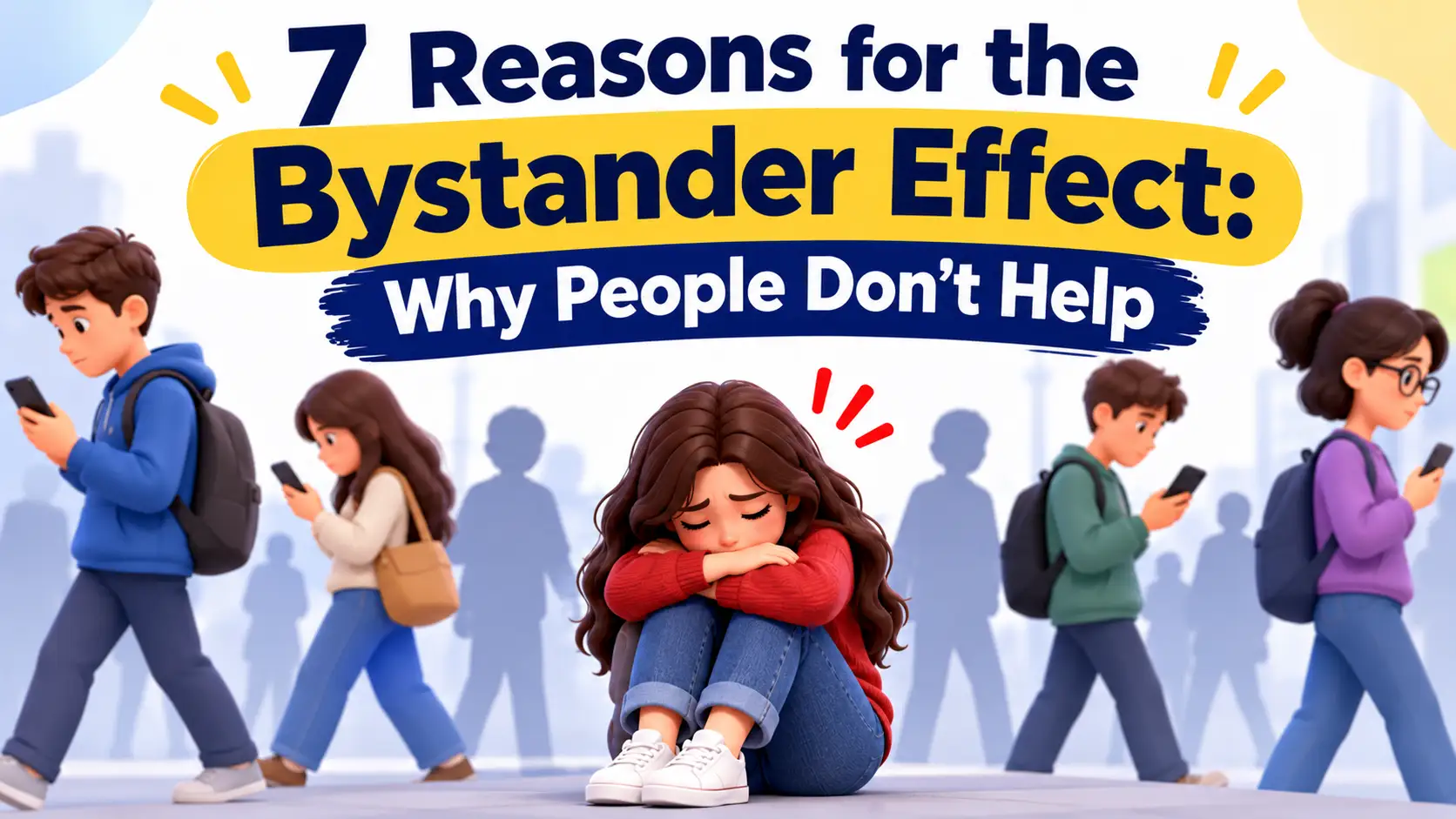
Imagine someone collapsing on a crowded sidewalk. Several people notice, but nobody immediately steps forward. Each person may assume someone else will help, wonder whether the situation is serious, or hesitate because they are unsure what to do.
This behavior raises an important question: Why do people sometimes hesitate to help when other witnesses are present?
Psychologists call this phenomenon the bystander effect. It describes a tendency for individuals to be less likely to intervene when other people are present than when they are alone.
However, the explanation is more complicated than simply saying that people in crowds are selfish. Social pressure, uncertainty, shared responsibility, and the perceived danger of a situation can all influence whether someone helps.
In this guide, you’ll learn what the bystander effect means, how psychologists John Darley and Bibb Latané studied it, what happened in the famous Kitty Genovese case, and why modern research has challenged some popular assumptions. You’ll also discover practical ways to recognize the effect and respond safely when someone needs help.
What Is the Bystander Effect?
The bystander effect is a social psychology phenomenon in which the presence of other people can reduce the likelihood that any one individual will help someone in need.
For example, imagine that you see someone fall in a busy shopping center. You notice several other people nearby, so you assume one of them will offer assistance.
But the other people may be making the same assumption.
As a result, everyone waits, even though several people recognize that something might be wrong.
The bystander effect does not mean that people are naturally uncaring. It describes how the presence and behavior of others can influence an individual’s decision to intervene.
Two points are especially important:
- It describes a tendency, not a universal rule. People do help in groups, and the effect varies depending on the situation.
- It is about behavior, not moral character. A person can genuinely care about someone in danger and still hesitate.
The concept is one of the best-known topics in social psychology, which examines how other people and social situations influence human behavior.
For a formal definition, see the American Psychological Association’s Dictionary of Psychology.
Who Discovered the Bystander Effect?
Social psychologists John M. Darley and Bibb Latané established the modern experimental research on the bystander effect in the 1960s.
Their work examined whether the presence of other witnesses could influence a person’s willingness to help during an emergency.
Their landmark research paper, Bystander Intervention in Emergencies: Diffusion of Responsibility, was published in 1968 in the Journal of Personality and Social Psychology.
The researchers wanted to investigate an important question: Could the presence of other people explain why an individual sometimes fails to intervene?
Their experiments suggested that people may feel less personally responsible when they believe other witnesses are also available to help.
This explanation became known as diffusion of responsibility.
You can read the original research here:
Darley and Latané (1968) — Bystander Intervention in Emergencies: Diffusion of Responsibility
Their research was influenced by public discussion surrounding the 1964 murder of Kitty Genovese, although the popular version of that event later proved to be inaccurate.
What Happened in the Kitty Genovese Case?
Kitty Genovese was a 28-year-old woman who was attacked and murdered near her apartment in Kew Gardens, Queens, New York, on 13 March 1964.
A widely circulated newspaper account claimed that 38 witnesses watched the attack and failed to help or contact the police.
The story became one of the most famous examples of apparent public indifference. It also helped draw attention to how people behave in groups during emergencies.
However, the popular account was substantially challenged by later historical research.
Was It True That 38 People Watched Kitty Genovese Being Attacked?
No. The available historical evidence does not support the claim that 38 people watched the entire attack and did nothing.
In a 2007 article published in American Psychologist, researchers Rachel Manning, Mark Levine, and Alan Collins examined archival material about the case.
They found no evidence that 38 people witnessed the murder, that witnesses observed the entire attack, or that everyone remained inactive.
The attack occurred in stages, and different people may have heard or seen different parts of the incident. Some witnesses reportedly misunderstood what was happening, while others did take action.
The researchers argued that the famous story had become a misleading account of the historical event.
Read the research:
Manning, Levine, and Collins (2007) — The Kitty Genovese Murder and the Social Psychology of Helping
The distinction matters: the historical story was exaggerated, but the psychological phenomenon is supported by experimental research.
Psychologists do not need an inaccurate account of Kitty Genovese’s murder to demonstrate that social situations can influence helping behavior.
What Experiments Proved the Bystander Effect?
Darley and Latané conducted controlled experiments to investigate how the presence of other people affects emergency intervention.
Two particularly influential studies involved a simulated medical emergency and the entry of smoke into a room.
1. The Seizure Experiment (1968)
In their famous experiment, Darley and Latané recruited university students to participate in a discussion through an intercom system.
Participants believed they were communicating with one or more other students in separate rooms.
During the discussion, one participant appeared to experience a seizure.
In reality, the person having the seizure was a recording. The researchers wanted to see how quickly the real participant would respond and report the emergency.
The results showed that participants were less likely to report the apparent seizure promptly when they believed others were listening.
| Perceived situation | Participants who reported the emergency before the recording ended |
| Participant believed they were the only witness | About 85% |
| Participant believed one other witness was present | About 62% |
| Participant believed four other witnesses were present | About 31% |
The findings suggested that the presence of additional witnesses could reduce an individual’s sense of personal responsibility.
Importantly, the study measured an individual’s response in a controlled situation. It did not prove that every real-world crowd will fail to help.
Original research: Darley and Latané (1968).
2. The Smoke-Filled Room Experiment
In another well-known experiment, Latané and Darley asked participants to complete a questionnaire in a room.
While they were working, smoke began entering the room through a ventilation opening.
Some participants were alone. Others were with passive strangers or other participants.
The researchers observed whether participants reported the smoke.
The results were striking:
| Situation | Participants or groups who reported the smoke |
| Participants alone | About 75% |
| Participants with passive, nonreacting people | About 10% |
| Groups of three participants | About 38% of groups |
Participants who saw other people behaving calmly were more likely to interpret the smoke as harmless.
This finding demonstrated how social information can influence the interpretation of an unclear situation.
For example, if you notice an unusual smell in a room but everyone else continues working, you might assume there is no danger.
That assumption can be wrong.
Original research: Latané and Darley (1968) — Group Inhibition of Bystander Intervention in Emergencies.
Together, these experiments helped establish two important explanations for bystander inaction: diffusion of responsibility and pluralistic ignorance.
Why Does the Bystander Effect Happen?
The bystander effect is associated with several psychological and social processes. Three commonly discussed explanations are diffusion of responsibility, pluralistic ignorance, and evaluation apprehension.
These processes can overlap, but they describe different reasons someone might hesitate.
1. Diffusion of Responsibility
Diffusion of responsibility occurs when individuals feel less personally responsible for taking action because others are present.
Imagine seeing someone fall on a busy street.
You might think:
“Someone else will call for help.”
A second person may think the same thing. A third may assume that someone has already contacted emergency services.
Everyone expects another person to take responsibility.
This is one reason that a large group can sometimes leave an emergency unattended.
The same process can appear in ordinary situations:
- A group project in which every student assumes that another member will complete an important task.
- A workplace where employees notice a problem but expect management to address it.
- An online discussion in which hundreds of users witness harassment but assume someone else will report it.
The main question behind diffusion of responsibility is:
“Who is responsible for helping?”
When responsibility feels shared, an individual may feel less pressure to act.
2. Pluralistic Ignorance
Pluralistic ignorance occurs when people privately have concerns or doubts but mistakenly interpret other people’s calm behavior as evidence that nothing is wrong.
Imagine that you are sitting in a classroom and hear a strange noise outside.
You feel concerned, but nobody else reacts. You look around and see everyone still studying.
You may conclude that the noise is probably unimportant.
However, other students may also be worried but are waiting to see how everyone else responds.
This creates a misleading social signal.
Pluralistic ignorance is especially likely to influence behavior when a situation is ambiguous.
Examples include:
- Students who are confused during a lecture but do not ask questions because nobody else does.
- Passengers who notice an unusual situation on public transport but assume it is harmless because others appear calm.
- People who hear shouting but cannot determine whether it is a serious argument or ordinary conversation.
The main question behind pluralistic ignorance is:
“Is this situation actually serious?”
This process is closely related to informational social influence, in which people use others’ behavior as information when deciding how to interpret an uncertain situation.
3. Evaluation Apprehension
Evaluation apprehension is the fear of being judged negatively by other people.
A person might recognize that someone needs assistance but hesitate because they are worried about making a mistake.
They may think:
- “What if I misunderstand the situation?”
- “What if the person does not need help?”
- “What if everyone thinks I am overreacting?”
- “What if I make the situation worse?”
This fear of embarrassment or criticism can discourage intervention.
For example, a student may notice a classmate being bullied but remain silent because they do not want to become the next target.
Evaluation apprehension is a useful additional explanation for hesitation, although it should not be treated as interchangeable with diffusion of responsibility or pluralistic ignorance.
Diffusion of Responsibility vs. Pluralistic Ignorance
These two concepts are related, but they describe different psychological processes.
| Feature | Diffusion of Responsibility | Pluralistic Ignorance |
| Main concern | Who should act? | Is action necessary? |
| Core process | Personal responsibility feels divided | Other people’s behavior is misinterpreted |
| Common thought | “Someone else will help.” | “Nobody else seems worried.” |
| Example | Everyone expects another person to call emergency services | Everyone sees calm faces and assumes there is no emergency |
Understanding this difference makes it easier to recognize why people sometimes remain inactive in groups.
What Is the Five-Step Model of Bystander Intervention?
The five-step model of bystander intervention explains the decisions a person may need to make before helping someone in an emergency.
Associated with John Darley and Bibb Latané’s work, the model shows that intervention involves several stages. A person may fail to help if they do not progress through one or more of them.
Step 1: Notice the Event
First, a person must notice that something is happening.
Distractions can make this difficult.
For example, someone walking through a busy shopping center while looking at their phone may fail to notice a person who has fallen nearby.
Without noticing the event, there is no opportunity to respond.
Step 2: Interpret It as an Emergency
Not every unusual event is immediately understood as an emergency.
A person may hear shouting and assume that two people are joking. They may see someone lying on the ground and think that the person is resting.
When a situation is unclear, people often look at others for clues.
If everyone appears calm, the situation may seem less serious than it actually is.
Step 3: Assume Personal Responsibility
After recognizing a possible emergency, a person must decide whether they should take responsibility for helping.
This is where diffusion of responsibility can become important.
Someone might assume that another witness, a security guard, or an authority figure will intervene.
A direct request can help overcome this hesitation.
Step 4: Decide How to Help
A person may want to help but feel unsure about what to do.
For example:
- Should they call emergency services?
- Should they find a security officer?
- Should they ask the person whether they are okay?
- Is it safe to approach?
A lack of confidence or knowledge can delay action.
However, helping does not always require medical training. Seeking professional assistance or engaging a qualified professional can be valuable.
Step 5: Decide to Act
Finally, the person must carry out the decision.
Fear, uncertainty, embarrassment, or concerns about personal safety can still prevent action.
The model helps explain why recognizing an emergency does not always lead immediately to intervention.
It also suggests practical ways to improve responses: pay attention, interpret warning signs carefully, accept personal responsibility, identify a safe way to help, and act.
For a clear overview of the model, see this chapter in a psychology textbook on prosocial behavior.
Does a Larger Crowd Always Make People Less Likely to Help?
No. Research supports the bystander effect, but the relationship between group size and helping is more complicated than the popular explanation suggests.
A major meta-analysis by Peter Fischer and colleagues reviewed 105 independent effect sizes involving more than 7,700 participants.
The researchers found an overall bystander effect. However, they also found that the effect became weaker in certain situations, particularly when:
- The emergency involved clear physical danger.
- A perpetrator was present.
- Intervention involved physical costs or risks.
- Other bystanders could provide useful support.
This suggests that people do not respond to every emergency in the same way.
A clear and dangerous situation may encourage intervention because witnesses can recognize that immediate action is necessary.
Read the research:
Fischer et al. (2011) — The Bystander-Effect: A Meta-Analytic Review
What Does Modern Real-World Research Show?
A particularly important study published in American Psychologist in 2020 examined video footage of 219 public conflicts in the United Kingdom, the Netherlands, and South Africa.
The researchers found that at least one bystander intervened in approximately nine out of ten observed conflicts.
They also found that a greater number of bystanders was associated with a greater likelihood that someone would intervene.
This does not contradict the classic laboratory studies.
The two types of research measured different outcomes:
- Classic experiments often examined whether an individual was less likely to intervene when others were present.
- The CCTV study examined whether at least one person in a group intervened in a real public conflict.
A group can therefore contain individuals who hesitate, yet still have a high overall chance that someone will help.
Read the study:
The important lesson is that the bystander effect is a situational tendency, not a universal law of human behavior.
Can the Bystander Effect Happen Online?
Yes. Similar social processes can influence whether people intervene when they witness online harassment, cyberbullying, or other harmful behavior.
Imagine that someone posts a humiliating comment about another person in a large social media group.
Hundreds of people see the comment, but nobody responds or reports it.
Some viewers may assume that another person will intervene. Others may worry about becoming a target themselves.
These situations can involve processes similar to those observed in offline group settings.
Examples of Online Bystander Behavior
- A student sees cyberbullying in a class group chat but remains silent.
- A social media user notices harassment but assumes someone else will report the account.
- A livestream viewer sees a person in distress but waits for another viewer to respond.
- An employee notices a colleague being humiliated in an online meeting but avoids speaking up.
However, online bystander behavior is not simply identical to the traditional emergency bystander effect. Digital environments introduce additional factors, including anonymity, platform design, visibility, social relationships, and reporting tools.
A 2026 systematic review of research on adolescent cyberbullying bystander intervention examined 49 reports. It identified empathy, confidence in one’s ability to intervene, and the way an incident is interpreted as important factors associated with intervention.
The authors also noted that much of the available research relied on self-reported and cross-sectional data, so the findings should not be interpreted as proof of a single causal pathway.
Read the review:
For practical guidance about online bullying and reporting, visit StopBullying.gov.
How Can You Overcome the Bystander Effect?
You can reduce the risk of bystander inaction by taking clear, specific, and safe steps rather than waiting for someone else to respond.
Recognizing the psychological processes is useful, but knowing what to do in the moment is even more important.
Try these five strategies.
1. Recognize the Situation
Pay attention when something appears unusual or potentially dangerous.
Do not assume that a situation is harmless simply because other people are behaving normally.
If you are uncertain, a simple question such as “Are you okay?” may help you understand what is happening.
2. Take Personal Responsibility
Instead of assuming someone else will act, decide what you can safely do.
You do not need to solve the entire emergency yourself.
You can call emergency services, find a trained professional, contact security, or ask another person to assist.
3. Give Someone a Specific Task
A direct request can make responsibility clearer.
Instead of shouting, “Somebody call for help!” try identifying a specific person:
“You in the blue jacket, please call emergency services.”
A clear instruction gives that person an identifiable responsibility and reduces uncertainty about who should act.
4. Avoid Waiting for the Crowd
If you recognize a genuine emergency, do not rely entirely on other people’s reactions.
The first person to act can make it easier for others to understand that assistance is needed.
However, always consider your own safety. Do not put yourself in unnecessary danger or attempt an intervention that requires skills you lack.
5. Choose a Safe Form of Assistance
Helping does not always mean physically approaching the person.
Depending on the situation, you could:
- Contact local emergency services.
- Ask a trained person nearby to help.
- Alert security or another responsible authority.
- Give accurate information to emergency responders.
- Report online harassment through the platform’s reporting system.
- Stay nearby if it is safe, and the person needs support.
If someone appears to be in immediate danger, follow local emergency guidance and the instructions of emergency professionals.
What Can Bystander Intervention Training Teach Us?
Bystander intervention training aims to help people recognize harmful situations and respond in safe, practical ways.
Such programs are used in educational institutions, workplaces, and community settings.
Training may include:
- Recognizing signs of harassment or danger.
- Understanding diffusion of responsibility.
- Practicing how to safely interrupt harmful behavior.
- Learning how to contact the appropriate authority.
- Supporting someone who has experienced harassment.
- Identifying situations where direct intervention may be unsafe.
A 2025 meta-analysis by Chen and colleagues examined 49 studies of interventions aimed at improving bystander behavior in bullying and cyberbullying contexts.
The researchers reported a modest overall effect and highlighted the importance of knowledge, self-efficacy, and coping skills.
This evidence is relevant to bullying-prevention programs; it should not be taken as proof that all emergency-response training produces the same results.
Read the research:
If you are a student, check whether your university offers campus safety or bystander intervention training. In a workplace, ask about relevant safety, harassment, and reporting policies.
A Practical Exercise: What Would You Do?
Understanding the bystander effect is easier when you apply it to realistic situations.
Imagine that you are standing on a crowded train platform. A passenger suddenly falls to the ground.
Several people look in their direction, but nobody immediately moves.
What would you do?
Option A: Wait, assuming someone else will help.
Option B: Look at the other passengers to decide whether the situation is serious.
Option C: Check whether it is safe to approach, ask the person if they are okay, and arrange appropriate assistance.
Option D: Avoid getting involved because you are worried about making a mistake.
What Do These Responses Suggest?
- Option A — Diffusion of responsibility: You are assuming that another person will take charge.
- Option B — Pluralistic ignorance: You are using the crowd’s reaction to decide whether the situation is serious.
- Option C — Active intervention: You are taking responsibility while considering safety.
- Option D — Evaluation apprehension: Fear of making a mistake or being judged may discourage action.
There is no need to label yourself based on one hypothetical answer. Real emergencies are complex, and your response may depend on the circumstances, your safety, and the help available.
The purpose of this exercise is to recognize the psychological processes that can influence decisions.
Quick Quiz: Test Your Understanding of the Bystander Effect
Try answering these questions before checking the explanations.
1. What is the bystander effect?
A. People always help more when they are in groups.
B. People may be less likely to help when other witnesses are present.
C. People only help friends and family.
2. What does diffusion of responsibility mean?
A. Feeling less personally responsible because other people are present.
B. Feeling responsible for every person in a crowd.
C. Avoiding all social situations.
3. What is pluralistic ignorance?
A. Assuming everyone has the same knowledge.
B. Misinterpreting other people’s calm behavior as evidence that nothing is wrong.
C. Refusing to listen to other people’s opinions.
4. Does the bystander effect occur in every emergency?
A. Yes, without exception.
B. No, it depends on the situation.
C. Only in large cities.
5. What is one practical way to reduce diffusion of responsibility?
A. Wait for someone else to act.
B. Avoid making eye contact.
C. Give a specific person a clear task.
Answers and Explanations
- B. The presence of other witnesses can reduce an individual’s likelihood of intervening.
- A. Responsibility may feel divided among the people present.
- B. People can mistakenly interpret others’ lack of reaction as evidence that a situation is harmless.
- B. Danger, clarity, relationships, and the ability to help can all influence intervention.
- C. A direct request can make responsibility clearer and encourage action.
Your score:
- 5 correct: Excellent. You understand the main psychological processes.
- 3–4 correct: Good work. Review the differences between diffusion of responsibility and pluralistic ignorance.
- 0–2 correct: Revisit the experiments and five-step model, then try again.
Frequently Asked Questions About the Bystander Effect
What is the bystander effect in simple terms?
The bystander effect is the tendency for people to be less likely to help when others are present. They may assume someone else will act, misunderstand the seriousness of the situation, or worry about how others will judge them.
Who discovered the bystander effect?
John Darley and Bibb Latané established the modern experimental research on the bystander effect during the 1960s. Their influential paper on diffusion of responsibility was published in 1968.
What are the three main explanations for the bystander effect?
Three commonly discussed explanations are diffusion of responsibility, pluralistic ignorance, and evaluation apprehension. They describe how shared responsibility, social interpretation, and fear of judgment can influence intervention.
What is the difference between diffusion of responsibility and pluralistic ignorance?
Diffusion of responsibility occurs when people assume someone else will take action. Pluralistic ignorance occurs when people interpret other people’s calm behavior as evidence that a situation does not require action.
Does the bystander effect mean people are selfish?
No. The effect does not prove that people are naturally selfish or uncaring. It shows that social circumstances can influence decisions, even among people who genuinely want to help.
Does the bystander effect happen online?
Similar social processes can influence online behavior. People may assume someone else will report harassment or defend a person being bullied. However, online environments also introduce additional influences, such as anonymity and platform design.
How can you overcome the bystander effect?
Recognize the situation, take personal responsibility, give a specific person a clear task, and choose a safe way to help. Contact emergency services when appropriate.
Does a larger crowd always reduce helping?
No. Although classic experiments found that additional witnesses could inhibit individual intervention, real-world research shows that groups often do help. The likelihood of intervention depends on the situation and on what outcome researchers measure.
Conclusion: Why Understanding the Bystander Effect Matters
The bystander effect helps explain why people sometimes hesitate to assist someone in need when other witnesses are present.
Research by Darley and Latané showed that shared responsibility and social uncertainty can influence helping behavior. Later studies have added important context, demonstrating that the effect is not universal and that people frequently intervene in real-world emergencies.
The main lesson is not that crowds make people heartless. It is that social situations can influence individual decisions, and understanding those influences can help people respond more effectively.
Remember these five practical steps:
- Notice what is happening.
- Interpret the situation carefully.
- Accept personal responsibility where appropriate.
- Decide how you can help safely.
- Take action or arrange appropriate assistance.
The next time you witness someone who may need help, do not automatically assume that someone else will take responsibility.
A clear question, a specific request, or a call for professional assistance can make a meaningful difference.
Understanding the bystander effect is the first step. Choosing a safe and helpful response is the next.
References and Further Reading
The following sources include original experiments, peer-reviewed research, a major meta-analysis, and recent systematic reviews.
- Darley, J. M., & Latané, B. (1968). Bystander intervention in emergencies: Diffusion of responsibility. Journal of Personality and Social Psychology, 8(4), 377–383.
https://doi.org/10.1037/h0025589 - Latané, B., & Darley, J. M. (1968). Group inhibition of bystander intervention in emergencies. Journal of Personality and Social Psychology, 10(3), 215–221.
https://doi.org/10.1037/h0026570 - Manning, R., Levine, M., & Collins, A. (2007). The Kitty Genovese murder and the social psychology of helping: The parable of the 38 witnesses. American Psychologist, 62(6), 555–562.
https://doi.org/10.1037/0003-066X.62.6.555 - Fischer, P., Krueger, J. I., Greitemeyer, T., et al. (2011). The bystander-effect: A meta-analytic review on bystander intervention in dangerous and non-dangerous emergencies. Psychological Bulletin, 137(4), 517–537.
https://doi.org/10.1037/a0023304 - Philpot, R., Liebst, L. S., Levine, M., Bernasco, W., & Lindegaard, M. R. (2020). Would I be helped? Cross-national CCTV footage shows that intervention is the norm in public conflicts. American Psychologist, 75(1), 66–75.
https://doi.org/10.1037/amp0000469 - Chen, Q., Lin, W., Wu, Q., & Chan, K. L. (2025). The effectiveness of interventions on bullying and cyberbullying bystander: A meta-analysis. Trauma, Violence, & Abuse, 26(5), 938–954.
https://doi.org/10.1177/15248380241297362 - Wang, Z., Wei, X., Saad, S., De Costa, F., & Liu, T. (2026). Factors associated with bystander intervention in cyberbullying: A systematic review. Frontiers in Psychology, 17, 1912279.
https://doi.org/10.3389/fpsyg.2026.1912279 - American Psychological Association. Bystander effect. APA Dictionary of Psychology.
https://dictionary.apa.org/bystander-effect