
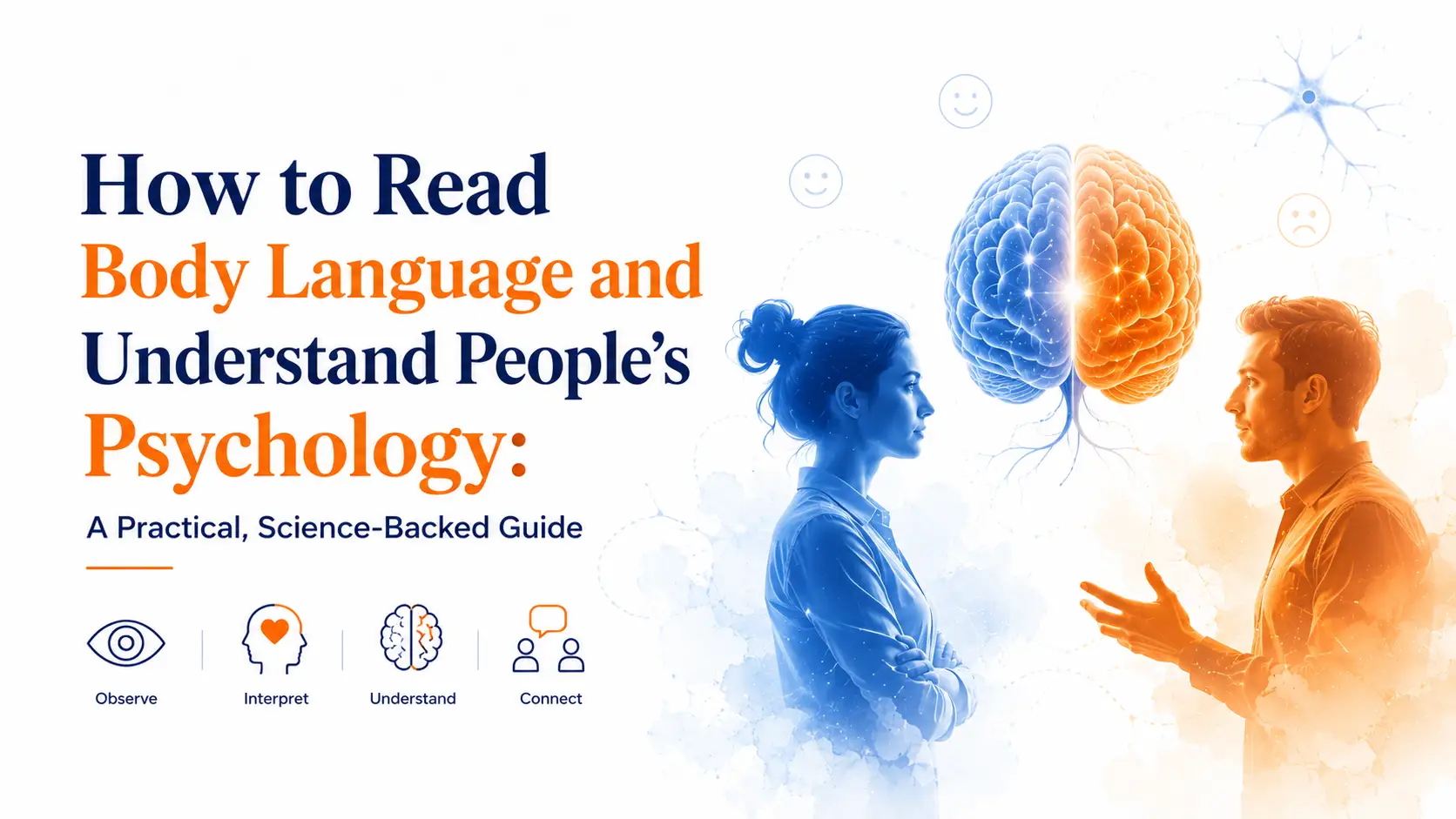
Most of what people tell you never reaches their mouths. It leaks out through a shoulder that turns away mid-sentence, a foot that points toward the exit, a smile that stops at the lips and never reaches the eyes. Learning how to read body language isn’t a party trick or a mind-reading superpower — it’s a trainable observation skill built on decades of behavioral psychology research. This guide walks you through reading body language and understanding human behavior the way trained observers actually do it: baselines first, clusters second, context always. You’ll learn the real signs, the myths that waste your time, and how to apply nonverbal communication skills at work, in relationships, and in everyday conversation.
What Is Body Language? A Clear Definition
Body language is the set of nonverbal signals — posture, gestures, facial expressions, eye behavior, spatial distance, and vocal tone — that communicate a person’s emotional and mental state, often without their conscious awareness.
Academically, the field splits into three overlapping branches:
- Kinesics — the study of body movement, gestures, and facial expressions.
- Proxemics — how people use physical space and distance, pioneered by anthropologist Edward T. Hall.
- Paralinguistics — the vocal elements around words: pitch, pace, pauses, volume, and tone.
Together, these form what psychologists call nonverbal communication. It’s older than speech, faster than speech, and far harder to fake for long stretches.
If you’re new to the wider field behind these ideas, start with this foundational primer: What Is Psychology? A Complete Guide. It gives you the vocabulary that makes everything below click into place.
Is Body Language Really 93% ofCommunicationn?
No. The famous “93% nonverbal” statistic is a misread of a narrow 1967 study. Psychologist Albert Mehrabian’s 7-38-55 rule (7% words, 38% tone, 55% facial expression) applies only to situations where someone communicates feelings and attitudes and the words conflict with the delivery. Mehrabian himself has repeatedly said the numbers were never meant to describe communication in general.
Here’s the honest version: nonverbal signals dominate when there’s a mismatch between what’s said and how it’s said. If someone says “I’m fine” with a clenched jaw and crossed arms, you believe the body. That’s the real principle — not a made-up percentage.
Being willing to correct a popular myth is the first sign of someone who actually understands the psychology of body language rather than reciting internet folklore.
Why Reading Body Language Matters (Including in Pakistan)
Understanding people’s psychology through nonverbal cues isn’t a soft skill. It’s a compounding advantage.
In your career: Interviewers form impressions within seconds. Managers read the room before they read the report. In Pakistan’s growing corporate, banking, telecom, and startup sectors, where relationship-based business is the norm, reading a client’s hesitation before they voice it can save an entire deal.
In education and counseling: With psychology programs expanding across Punjab University, Karachi University, Bahria University, and Allama Iqbal Open University, more graduates are entering counseling, HR, and clinical roles where reading distress signals is a core competency.
In relationships, Most conflicts don’t start with words. They started with a withdrawal signal that went unnoticed for weeks.
In self-protection, recognizing manipulation, pressure tactics, and dishonesty early is a defensive skill — arguably the most valuable reason to learn it.
In self-presentation: Reading others makes you conscious of your own signals. Confidence isn’t just felt; it’s broadcast.
There’s also a cultural layer that most Western books ignore. In much of South Asia, sustained direct eye contact with elders or superiors can be read as disrespectful rather than confident. Physical proximity norms are closer. Head movements carry different meanings. Any language framework you learn must be filtered through the culture you’re standing in. A cue is not a fact; it’s a question.
The Golden Rules: How to Read Body Language Accurately
Before a single gesture, internalize these four rules. Skip them, and you’ll be confidently wrong.
Rule 1: Establish a Baseline First
A baseline is a person’s normal behavior when they’re relaxed and unstressed. Some people fidget constantly. Some never make eye contact. Some talk with their whole body. None of that means anything on its own.
You’re not looking for behavior. You’re looking for deviation from behavior.
Watch someone for a few minutes of low-stakes small talk. Note their default: hand position, blink rate, speech pace, posture. Then introduce the real topic and watch what changes. The change is in the data.
Rule 2: Read Clusters, Never Single Cues
One crossed arm means nothing. Crossed arms + turned torso + reduced eye contact + shortened answers is a cluster — and clusters carry signal.
Think of it like a sentence. A single word is ambiguous; a sentence has meaning. Look for three or more cues pointing in the same direction before you form a hypothesis.
Rule 3: Context Overrides Everything
Crossed arms in an air-conditioned Lahore office in December means the person is cold. Leaning back might mean disengagement — or a bad chair. Fidgeting might mean anxiety — or caffeine.
Ask yourself the boring explanation first. It’s usually right.
Rule 4: You’re Detecting Discomfort, Not Truth
This is the single most misunderstood point in the field. Nonverbal cues reveal stress, comfort, and emotional arousal. They do not reveal why the stress exists. A nervous honest person and a nervous liar produce nearly identical signals.
Read states, not verdicts.
The 5 Main Types of Body Language
The five core categories of body language are: facial expressions, gestures, posture and body orientation, eye behavior, and touch — supported by proxemics (use of space) and paralinguistics (vocal tone). These are the channels through which almost every nonverbal message travels.
Let’s take them one at a time.
1. Reading Facial Expressions and Microexpressions
The face is the highest-bandwidth channel — and the most rehearsed.
The Universal Emotions
Psychologist Paul Ekman‘s cross-cultural research identified a set of basic emotions with recognizable facial expressions across societies: happiness, sadness, anger, fear, surprise, disgust, and contempt. His Facial Action Coding System (FACS) mapped the individual muscle movements behind them.
The research isn’t uncontested — some scientists argue emotional expression is more culturally constructed than Ekman proposed — but as a practical starting framework, it holds up.
The Genuine Smile Test
A real smile involves the eyes; a social smile doesn’t.
The orbicularis oculi muscle around the eye is difficult to contract voluntarily. When someone is genuinely happy:
- Crow’s feet appear at the outer corners of the eyes
- The cheeks lift
- The lower eyelid tightens slightly
- The whole face shifts
A polite or fake smile is mouth-only. The eyes stay flat. This is called the Duchenne smile, and once you learn to spot it, you can’t unsee it in photographs, meetings, or first dates.
Microexpressions
Microexpressions are involuntary facial expressions lasting roughly 1/25 to 1/2 second that reveal a suppressed emotion before the person masks it.
The classic example: you deliver news, and a flash of disgust crosses someone’s face for a fraction of a second before the polite smile appears. That flash was the truth. The smile was the policy.
Practical caveat: microexpression detection is genuinely hard. Most people miss them in real time. It takes deliberate training, and even trained observers aren’t infallible. Don’t let YouTube “body language analysts” convince you that you’ll be catching these on day one.
Easier and more useful for beginners:
- Lip compression — lips pressed into a thin line signal withheld thought or stress.
- Nose wrinkle / upper lip raise — disgust or disagreement.
- One-sided mouth raise — contempt or disdain. This one is a serious relationship red flag; researcher John Gottman found contempt to be among the strongest predictors of divorce.
- Eyebrow flash — a rapid raise on greeting; a genuine recognition signal.
- Forehead furrow with raised inner brows — sadness or concern (very hard to fake).
2. Eye Contact Psychology
Eyes get more mythology than any other channel. Let’s clean it up.
What Eye Behavior Actually Tells You
- Blink rate increase — cognitive load or stress. Baseline is roughly 15–20 blinks per minute; spikes are meaningful relative to that person’s normal.
- Pupil dilation — arousal, interest, or cognitive effort. Genuinely involuntary — but also driven by lighting, so read with care.
- Prolonged eye contact — could be confidence, attraction, aggression, or a rehearsed liar overcompensating.
- Gaze aversion during thought — usually just retrieval. People look away to reduce visual load while thinking. This is normal, not evasive.
- Eye blocking — covering the eyes, rubbing them, or a slow, deliberate blink when hearing something. Often signals rejection of what was just said.
The Eye-Direction Myth
Claim: “Looking up-right means lying, up-left means remembering.”
Reality: This comes from Neuro-Linguistic Programming (NLP) and has failed experimental testing. A well-known 2012 study led by Richard Wiseman found no relationship between eye direction and deception. Delete this from your toolkit permanently.
The Cultural Filter
In the US and much of Western Europe, steady eye contact reads as honesty and confidence. In Pakistan, India, much of East Asia, and many traditional cultures, lowered eyes toward an elder, teacher, or senior signal respect, not evasion.
Judging a Pakistani student’s honesty by an American eye-contact standard isn’t reading psychology. It’s importing a bias.
3. Posture, Gestures, and Body Orientation
Open vs. Closed Body Posture
Open posture — uncrossed limbs, torso exposed, palms visible, shoulders back. Signals comfort, receptivity, confidence.
Closed posture — crossed arms or legs, hunched shoulders, torso shielded by an object (a bag, a laptop, a coffee cup). Signals discomfort, defensiveness, or disagreement.
That said, what do crossed arms actually mean?
Crossed arms most often indicate self-comfort, cold, or a simple habit — not necessarily defensiveness. Treat it as defensive only when it appears alongside other closing cues and only after a specific topic. Arms that fold the instant you mention money? That’s a signal. Arms that were folded before you walked in? That’s a chilly person.
The Ventral Front Rule
Former FBI counterintelligence agent Joe Navarro popularized this concept, and it’s one of the most useful ideas in the field.
The “ventral front” is your torso — the vulnerable side housing your vital organs. Humans instinctively aim it at what they like and angle it away from what they don’t.
Watch for:
- Ventral fronting — torso squared toward you = engagement and comfort.
- Ventral denial — torso rotating away, even slightly, while the face stays polite = disengagement.
Faces lie easily. Torsos rarely bother.
The Feet Tell
Feet are the most honest and least monitored body part. Nobody manages their feet.
- Feet pointed toward you — engagement.
- One foot pivoted toward the door — the person is mentally leaving. In group conversations, watch feet to see who actually wants to be there.
- Feet locked around chair legs — anxiety or restraint.
- Bouncing feet that suddenly stop — a state change. Something just landed.
Pacifying Behaviors
When stressed, humans self-soothe. Navarro calls these pacifiers:
- Neck touching or rubbing (the suprasternal notch — extremely common under stress)
- Playing with a necklace, watch, or bangle
- Rubbing hands together or on thighs
- Stroking hair
- Rubbing the forehead or the back of the neck
- Adjusting a collar or dupatta
A pacifier tells you a person has just experienced discomfort. What it doesn’t tell you is why. Your job is to note when it fired — what word, question, or name preceded it by 1–2 seconds.
Hands and Palms
- Visible palms — openness, honesty signaling, non-threat.
- Hidden hands (pockets, under the table) — withholding, or nothing at all.
- Steepling (fingertips touching, forming a peak) — confidence and certainty. Very common in senior executives and expert witnesses.
- Hand-wringing — anxiety.
- Illustrators (gestures that match speech rhythm) — genuine engagement. When gestures stop or lag behind words, cognitive effort has spiked.
Posture and Confidence: The Power Pose Debate
Amy Cuddy‘s 2010 research and viral TED talk proposed that expansive “power poses” raise testosterone, lower cortisol, and boost real confidence. It became one of the most famous ideas in modern psychology.
Then it got complicated. Large replication attempts failed to reproduce the hormonal effects, and a co-author publicly withdrew support. What has held up somewhat better in subsequent research is the self-reported feeling of power — posture does appear to shift how confident you feel, even if the hormone story collapsed.
Practical takeaway: Standing tall probably won’t rewire your endocrine system. It will still change how you feel and how others read you. Use it, but be honest about why.
I include this deliberately. A guide that presents contested science as settled fact isn’t teaching you psychology — it’s selling you certainty.
4. Proxemics: Reading the Use of Space
Edward T. Hall’s zones offer a rough Western map:
- Intimate zone — 0 to ~45 cm. Reserved for close family and partners.
- Personal zone — ~45 cm to 1.2 m. Friends.
- Social zone — ~1.2 to 3.6 m. Acquaintances, colleagues.
- Public zone — 3.6 m+. Speaking to groups.
The insight isn’t the numbers — it’s the reaction to violation. When someone steps too close, watch for the micro-lean back, the blocking object, and the foot repositioning. That reaction tells you where their boundary sits.
South Asian, Middle Eastern, and Latin American cultures generally maintain closer personal distances than Northern European ones. What reads as intrusive in Stockholm reads as warm in Sargodha.
5. Paralinguistics: What Voice Reveals
Words are content. Voice is context.
- Pitch rise — stress, anxiety, or uncertainty. Vocal cords tighten under stress.
- Pace acceleration — excitement or nervousness.
- Pace deceleration with pauses — careful construction. It could be thoughtfulness. Could be fabrication.
- Volume drop — reduced conviction. People get quiet when they don’t believe themselves.
- Filler explosion (“um,” “you know,” “actually”) — increased cognitive load.
- Throat clearing before an answer — a stress signal. Very common.
Mirroring Behavior: The Rapport Signal
Mirroring is the unconscious mimicking of another person’s posture, gestures, speech pace, and expressions — a natural byproduct of rapport and liking.
Psychologists call it the chameleon effect. When two people genuinely connect, they synchronize: one leans in, the other follows within seconds. One picks up a glass, the other does too.
How to use it diagnostically: Change your posture subtly and wait 20–30 seconds. If the other person follows, rapport exists. If they don’t, or if they counter-mirror, you haven’t built it yet. This is the best real-time rapport test available.
How not to use it: Deliberate, obvious mimicry. It’s transparent, and getting caught mirroring destroys trust faster than never mirroring at all. Let it happen naturally by actually caring about the conversation — the body follows attention.
How to Tell If Someone Is Lying Through Body Language
Let’s be direct, because the internet lies about lying.
There is no reliable single body language cue that proves deception. Meta-analyses of deception research consistently find that untrained observers detect lies at roughly 54% accuracy — barely above a coin flip. Even most “trained professionals” perform close to chance on standard tests.
What Actually Doesn’t Work
- Gaze aversion — the most widely believed cue, and one of the weakest. Practiced liars often make more eye contact.
- Fidgeting — some liars fidget more, many freeze instead.
- Touching the nose — folklore.
- Eye direction — debunked, as covered above.
What Has Modest Support
The most defensible modern approach shifts from “stress detection” to cognitive load detection. Lying is mentally expensive — you must invent, monitor for consistency, track your story, and read your listener simultaneously. Under that load:
- Illustrator gestures decrease — hands go quiet. The Brain is busy.
- Response latency shifts — unusually long pauses, or suspiciously instant answers to complex questions.
- Detailed structure changes — truthful accounts often include incidental, non-flattering, out-of-order details. Fabricated accounts tend to be linear and clean.
- Reverse-order recall collapses — asking someone to tell the story backward is devastating for a fabricated narrative and merely difficult for a true one.
Research by Aldert Vrij and colleagues on cognitive-load interviewing is the strongest evidence base in this area.
The Ethical Line
Never accuse someone based on body language. Nonverbals generate questions, not conclusions. The correct response to a cluster of stress signals isn’t “You’re lying.” It’s “Walk me through that part again.”
Believing you’re a human lie detector is more dangerous than admitting you’re not — because false confidence turns innocent nervousness into a guilty verdict in your head. Innocent people under suspicion look exactly like guilty ones. That mistake ruins relationships, careers, and occasionally lives.
Signs Someone Is Attracted to You: Body Language of Interest
Attraction cues cluster around three themes: approach, exposure, and synchrony.
- Ventral fronting — torso and feet aimed at you consistently
- Preening — adjusting hair, clothing, or jewelry before or during interaction
- Extended eye contact with a downward break (rather than sideways)
- Neck and wrist exposure — head tilt exposing the neck, palms turned upward
- Genuine Duchenne smiles, not polite ones
- Barrier removal — moving the glass, phone, or bag from between you
- Isopraxism — natural mirroring of your movements
- Proximity tolerance — not backing up when you close the distance slightly
The critical caveat: many of these overlap perfectly with ordinary friendliness, professional warmth, or cultural politeness. In conservative cultural contexts, signals are dramatically muted or absent — and reading warmth as romantic interest is precisely how people make others deeply uncomfortable.
Body language is never consent. Verbal clarity is. Anyone selling “read the signals and skip asking” is selling harm.
Body Language Signs of Nervousness and Anxiety
Useful in interviews, negotiations, teaching, and caring for people you love:
- Neck touching, especially the hollow at the base of the throat
- Rapid or shallow breathing (watch the shoulder rise)
- Increased blink rate
- Lip compression and lip biting
- Feet tucked under the chair or wrapped around chair legs
- Voice pitch climbing
- Torso shrinking — shoulders drawing inward
- Hands gripping objects tightly
- Swallowing hard, throat clearing
How to respond: the useful move isn’t to catch it — it’s to reduce it. Soften your posture, slow your speech, open your palms, and briefly break eye contact. Comfort is contagious in the same direction as discomfort.
What Is Dark Psychology — and How to Spot It
Dark psychology refers to the study and use of manipulative, coercive, and exploitative psychological tactics used to influence others against their own interest. It overlaps with research on the “Dark Triad” personality traits: narcissism, Machiavellianism, and psychopathy.
Psychology vs. Dark Psychology: The Difference
Psychology is a scientific discipline aimed at understanding and improving human well-being under ethical codes such as the APA’s. “Dark psychology” is a popular-literature label for the deliberate misuse of psychological principles to control others. One is a field with peer review and ethics boards. The other is a genre with a marketing department.
Be skeptical of the entire “dark psychology tricks” content industry — the vast majority is recycled, unsourced, and packaged to make you feel powerful rather than to make you accurate.
How to Spot Manipulative People: Real Warning Signs
Manipulation shows up in patterns over time, not in a single gesture:
- Manufactured urgency — pressure to decide before you can think. Legitimate offers survive a night’s sleep.
- Reality editing (gaslighting) — your memory and perception are steadily reframed as unreliable.
- Guilt as currency — favors are recorded and later invoiced.
- Intermittent reinforcement — unpredictable warmth and coldness, which is psychologically addictive by design.
- Isolation drift — subtle erosion of your other relationships.
- Boundary testing — small violations first, escalating as each is tolerated.
- Charm-to-contempt whiplash — extraordinary charisma in public, dismissiveness in private.
- Reciprocity traps — unsolicited gifts and favors — create an obligation. Robert Cialdini’s work on influence documents exactly how this mechanism works.
They point out the inconsistency between an environment’s stakes and the person’s behavior in it. Watch how they treat servers, juniors, and people who can do nothing for them.
For more grounded insights into how human minds actually behave — the kind that make manipulation obvious once you see it — read 10 Interesting Psychology Facts.
Real-World Applications: Putting This to Work
In a Job Interview
Reading them: Steepling and forward lean when you describe a project = genuine interest. Note where the interviewer’s engagement spikes and expand on those points. Barrier objects moved aside = warming.
Managing you: Feet planted, palms visible, gestures inside the frame, pace steady. Don’t perform confidence — reduce your own discomfort, and confidence follows.
In a Negotiation
The most valuable moment is the micro-hesitation before agreement. A pause, a lip compress, a swallow before “okay” tells you the number pinched. That’s your cue to stop talking. Silence, at that exact moment, is worth more than any argument.
In Leadership and the Workplace
Teams read leaders constantly. Sitting behind a laptop screen during a one-on-one is a barrier signal, whether you mean it or not. In meetings, watch for ventral denial around the table — that’s your real disagreement map, and it’s more accurate than the vote.
In Teaching and Counseling
Withdrawal shows in the body long before it appears on a report card: a shrinking posture, torso rotation, fewer illustrators, and a shift in baseline energy. In a country where mental health conversations are still stigmatized, noticing the body is often the only way to notice the person.
In Everyday Conversation
Test yourself: at the next gathering, pick one person and watch their feet for ten minutes. Whom do they point at? When do they pivot? You’ll learn more about that room’s social structure in ten minutes than in an hour of listening.
Why Choose Your Brain Lens
Anyone can list gestures. Very few will tell you which of those gestures survive scientific scrBrain
Your Brain Lens exists for readers who want the difference between what’s popular and what’s true. That means:
- Evidence over folklore — we tell you when the power pose research failed replication and when the eye-direction myth was debunked, because your credibility depends on knowing.
- Context-aware, not copy-pasted — frameworks filtered through South Asian and Pakistani cultural realities instead of being imported wholesale from American bestsellers.
- Ethics built in — reading people is a responsibility. We teach observation, not manipulation.
- Plain language, real depth — psychology written for humans, not for exam halls.
- Practical drills, not trivia — everything here is designed to be used in your next conversation.
Ready to go deeper? Explore advanced psychology insights and updated guides at Your Brain Lens — where behavioral science gets translated into skills you actually use.
How to Learn Body Language: Free and Paid Resources
Free Resources
- Paul Ekman Group’s public materials on facial expression and emotion research
- Amy Cuddy’s TED talk — watch it here, then read the replication debate alongside it. Both halves matter.
- APA’s public resources — the American Psychological Association publishes accessible, peer-reviewed, and explainers
- Google Scholar — search “nonverbal deception detection meta-analysis” and read the abstracts. Primary sources beat summaries.
- Real-world observation — airports, cafés, waiting rooms. Watch conversations with the sound off. This is free and the actual training.
Paid Resources
- “What Every BODY Is Saying” — Joe Navarro. The most practical single book in the field.
- “The Dictionary of Body Language” — Joe Navarro. A reference you’ll return to.
- “The Definitive Book of Body Language” — Allan & Barbara Pease. Enormously popular; read it with a skeptical eye, as several claims outrun the evidence.
- “Influence: The Psychology of Persuasion” — Robert Cialdini. Not body language, but the best defense against manipulation you can read.
- Coursera — university-backed courses in social psychology and emotional intelligence.
- Formal study — BS Psychology programs across Pakistan (Punjab University, Karachi University, Bahria University, AIOU) offer the rigorous foundation that no book can replace.
The 30-Day Practice Plan
- Days 1–7 — Baselines only. Pick three people you see daily. Note their normal. Judge nothing.
- Days 8–14 — Deviations. Watch for changes from baseline. Write down what preceded each one.
- Days 15–21 — Clusters. Only record observations with three or more aligned cues.
- Days 22–30 — Verify. Test your reads with gentle questions: “You seemed hesitant about that — what’s on your mind?” Feedback is the only thing that converts guessing into skill.
Skip step four, and you’ll spend years getting confidently worse.
Career Scope: Where These Skills Pay
Understanding human behavior is a foundational skill across a widening set of fields:
- Clinical and counseling psychology — expanding rapidly across Pakistan as stigma slowly recedes
- Human resources and talent acquisition — interviewing, mediation, and culture work
- Sales and business development — reading hesitation is the entire job
- UX research and consumer psychology — one of the fastest-growing applied psychology fields globally
- Forensic and criminal psychology — investigative interviewing, assessment
- Leadership, training, and organizational development
- Teaching and educational psychology
- Negotiation, diplomacy, and mediation
- Healthcare — patient communication measurably affects outcomes
Salaries vary enormously by sector and country, so treat any specific number you read online with suspicion. What’s consistent is the direction: as AI automates analysis, the human-facing skills — reading rooms, building trust, sensing what wasn’t said — rise in value, not fall.
Frequently Asked Questions
What are the 5 signs of body language?
The five core body language channels are facial expressions, gestures, posture and body orientation, eye behavior, and touch. Space usage (proxemics) and vocal tone (paralinguistics) support these. Always read them as clusters against the person’s baseline, never in isolation.
Can you learn to read body language?
Yes. Reading body language is a trainable observation skill, not an innate gift. Improvement comes from three habits: establishing baselines, reading clusters instead of single cues, and verifying your reads with follow-up questions. Expect meaningful progress in weeks — and expect to stay fallible forever.
How do you know if someone is lying based on body language?
You can’t reliably determine lying from body language alone. Research shows untrained observers detect deception at roughly 54% accuracy — near chance. Body language reveals stress and cognitive load, not dishonesty. The more effective approach is cognitive-load interviewing: ask for reverse-order recall and unexpected details, then evaluate the answers.
What does crossed arms mean in body language?
Crossed arms usually indicate self-comfort, cold, or habit — not automatic defensiveness. It becomes meaningful only when it appears alongside other closing cues (torso rotation, reduced eye contact, shorter answers) and only when it follows a specific topic being raised.
What is dark psychology?
Dark psychology is a popular-literature term for the deliberate use of psychological tactics — manipulation, coercion, gaslighting, and exploitation — to influence people against their own interests. It’s associated with Dark Triad traits: narcissism, Machiavellianism, and psychopathy. It is not an academic discipline, and most “dark psychology” content online is unsourced.
How do psychologists read people?
Psychologists rely on structured methods, not gesture-spotting: clinical interviews, validated assessments, longitudinal observation, and behavioral history. Nonverbal cues inform their hypotheses — they never replace evidence. Ethical practice requires verification before conclusion.
Is body language 90% ofCommunicationn?
No. The 7-38-55 figure comes from Albert Mehrabian’s narrow 1967 studies on communicating feelings when words and delivery conflict. Mehrabian has explicitly said it doesn’t generalize. The accurate principle: when words and body contradict each other, people trust the body.
What are common psychological facts about human behavior?
People consistently overestimate how much others notice them (the spotlight effect), unconsciously mirror those they like, judge faces in under a tenth of a second, and remember unfinished tasks better than completed ones (the Zeigarnik effect). For more, see 10 Interesting Psychology Facts.
Conclusion: Observation Is a Discipline, Not a Superpower
Here’s what nobody selling “read anyone in 3 seconds” will tell you: the better you get at reading body language, the less certain you become. You start seeing how much a single gesture can mean, how easily context flips a reading, how often the boring explanation is the correct one.
That humility is the skill. The person who confidently declares “she’s lying, look at her hands” is worse at this than the person who quietly notes a discomfort spike and asks a better question.
Build it in this order:
- Baseline before you judge.
- Clusters before you conclude.
- Context before you commit.
- Curiosity instead of accusation.
Do that consistently and you’ll notice things most people walk past for a lifetime — the colleague who’s about to quit, the friend who’s not okay, the deal that died three sentences ago, the person who needed one honest question.
Reading people well isn’t about gaining power over them. It’s about paying enough attention, actually, to see them. That’s rarer than it sounds, and it changes everything.
Ready to take the next step? Read Latest Blogs written by Your Brain Lens and start applying real behavioral psychology to your career, relationships, and daily conversations — beginning with your very next one.






3 thoughts on “How to Read Body Language and Understand People’s Psychology: A Practical, Science-Backed Guide”