
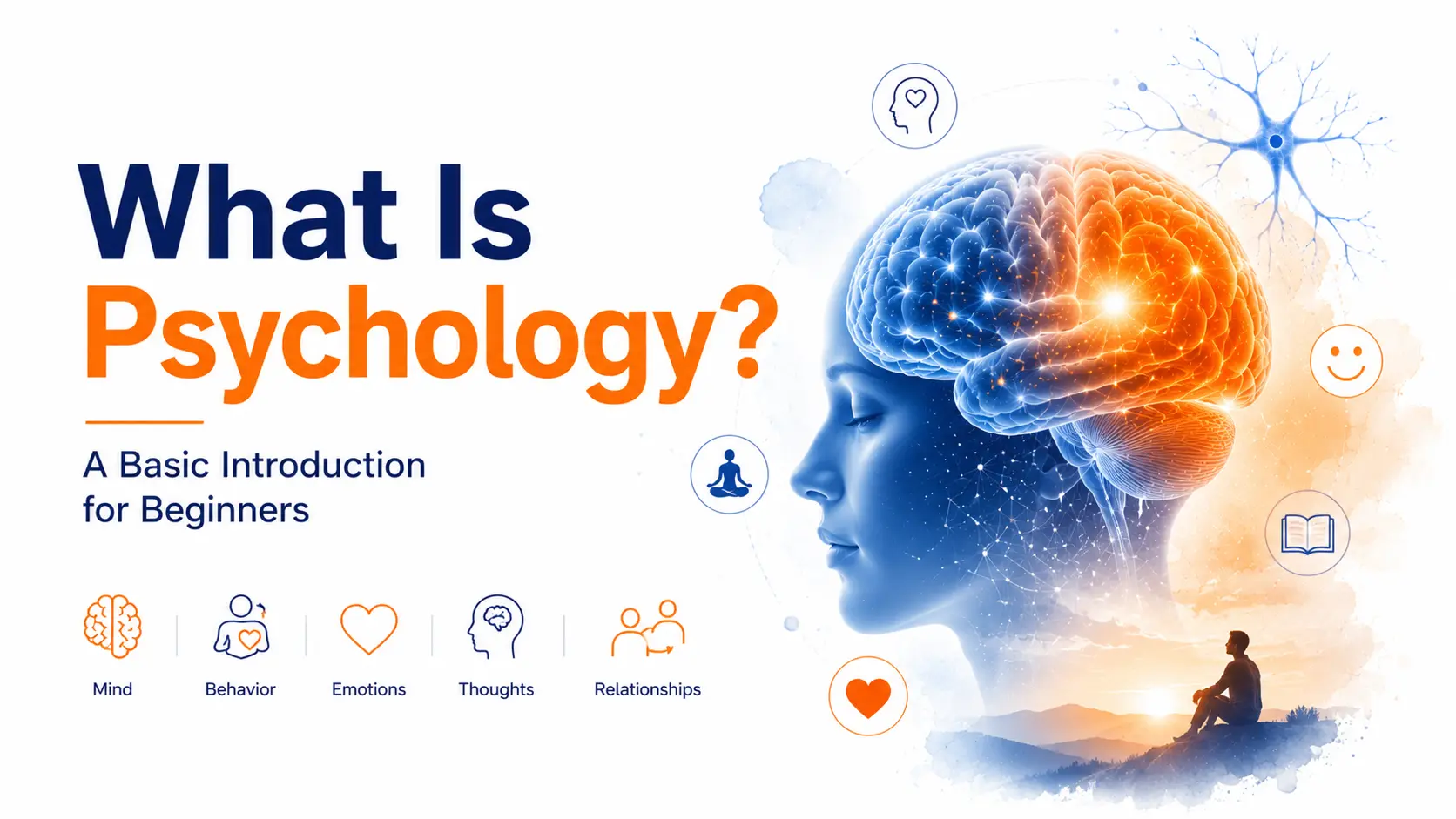
Psychology is the scientific study of the mind and behavior — how people think, feel, learn, remember, and act. It uses research and evidence (not guesswork) to explain human behavior and mental processes, and it’s applied everywhere from hospitals and schools to courtrooms, offices, and marketing teams.
If you’ve ever wondered why you procrastinate, why a red “SALE” sign makes you stop walking, or why two children raised in the same home turn out completely different, you’ve already been doing psychology. You don’t have the vocabulary for it yet.
This guide is a complete introduction to psychology for beginners and students. We’ll cover the definition of psychology, its history, the four goals of psychology, the main branches of psychology, the difference between psychology and psychiatry, the scope of psychology in Pakistan, salaries, careers, and exactly how to start learning — free and paid—no jargon walls. No filler. Let’s begin.
What Is Psychology? (Psychology Definition in Simple Words)
Psychology is defined as the scientific study of mind and behavior, including both observable actions (what you do) and internal mental processes (what you think and feel).
The word itself tells the story. “Psychology” comes from two Greek words:
- Psyche — meaning soul, breath, or mind
- Logos — meaning study or knowledge
So the literal meaning of psychology is “the study of the mind.” In Urdu, the meaning of psychology is commonly rendered as علم النفس — the science of the self or soul.
But here’s the part beginners miss: the keyword in that definition isn’t “mind.” It’s scientific.
What is psychology in simple terms?
Psychology is the study of why people do what they do, done using evidence rather than opinion. A psychologist doesn’t just say “people get angry when they’re tired.” They design a study, measure it, test it against a control group, and publish it so others can check the work.
That’s the line between psychology and armchair speculation. Your uncle has theories about human nature. A psychologist has data.
Is psychology a science?
Yes. Psychology is a science because it follows the scientific method: observation, hypothesis, controlled experimentation, measurement, statistical analysis, peer review, and replication.
It’s classified as a behavioral science and a social science, and it overlaps heavily with cognitive science and neuroscience. Some branches — like experimental psychology and neuropsychology — sit as close to biology as any lab discipline does.
The confusion happens because psychology studies something invisible. You can’t put “anxiety” on a weighing scale. So psychologists measure it indirectly: through behavior, reaction times, standardized psychological assessment tools, brain imaging, and hormone levels. Indirect measurement isn’t unscientific — physics measures black holes the same way.
Psychology vs philosophy — what’s the difference?
Both ask the same big questions about the mind, consciousness, and perception. The difference is in the method.
Philosophy answers through logic, reasoning, and argument. Psychology answers through experiments, measurement, and data.
Psychology was actually born from philosophy. For over 2,000 years, thinkers like Aristotle and Descartes debated the mind using pure reason. Psychology only became a separate discipline when someone finally decided to take the questions into a laboratory.
A Short History of Psychology: How the Mind Became a Science
Who is considered the father of psychology?
Wilhelm Wundt is widely considered the father of psychology. In 1879, he opened the world’s first psychology laboratory at the University of Leipzig, Germany — the moment psychology officially split from philosophy and became an experimental science.
Wundt’s method was called introspection: training people to carefully report their own conscious experience under controlled conditions. It was flawed, and later psychologists tore it apart — but it was systematic, and that changed everything.
You can read more about Wundt’s founding role in Britannica’s entry on Wilhelm Wundt.
(A quick note on a common exam trap: Sigmund Freud is often mistaken for the father of psychology. He isn’t — Freud is the father of psychoanalysis. Wundt built the lab; Freud built the couch.)
The major schools of thought in psychology
Psychology didn’t arrive fully formed. It argued its way into existence. Here are the major schools of thought every beginner should know:
- Structuralism (Wundt, Titchener) — Breaks consciousness into its basic elements, like a chemist breaking down a compound.
- Functionalism (William James) — Don’t ask what the mind is made of; ask what it’s for—heavily influenced by Darwin.
- Psychoanalysis (Sigmund Freud) — Unconscious conflicts, childhood experience, and defense mechanisms drive behavior. Gave us the ego, repression, projection, and displacement.
- Behaviorism (Watson, Skinner, Pavlov) — Forget the mind entirely; it’s unobservable. Study only behavior, conditioning, reinforcement, and shaping.
- Gestalt psychology (Wertheimer, Köhler) — “The whole is greater than the sum of its parts.” Perception organizes information into meaningful patterns.
- Humanistic psychology (Maslow, Rogers) — People aren’t rats or machines. They have free will, dignity, and a drive toward self-actualization.
- Cognitive psychology (Neisser, Miller) — The “cognitive revolution” of the 1950s–60s brought the mind back, treating it as an information processor.
- Biological/Neuroscience approach — Behavior is rooted in the brain, neurotransmitters, genetics, and hormones.
- Positive psychology (Seligman) — Don’t just study what’s broken; study what makes life worth living.
Modern psychology is eclectic — most working psychologists borrow from several of these at once. A clinical psychologist might use cognitive techniques, behavioral homework, and humanistic warmth in a single session.
Nature vs nurture: the argument that never ends
Are we shaped by genes or by environment? Behaviorists once claimed they could raise any healthy infant to become any specialist. Geneticists pushed back hard.
The modern verdict: both are interacting constantly. Genes load the gun; environment pulls the trigger. Twin studies, adoption studies, and the field of epigenetics have rendered the “nature versus nurture” framing outdated. It’s nature through nurture.
What Are the 4 Main Goals of Psychology?
Every psychological study, from a lab experiment to a therapy session, serves one of four goals:
- Describe — What is happening? Observe and document behavior accurately. Example: 30% of university students report severe exam anxiety.
- Explain — Why is it happening? Build theories that account for the behavior. Example: anxiety rises when perceived demand exceeds perceived coping ability.
- Predict — What will happen next? Use patterns to forecast behavior. Example: students with low sleep and high perfectionism are most likely to panic.
- Control/Change — How can we influence it for the better? Apply interventions. Example: teaching breathing and time-boxing reduces exam anxiety scores.
Think of it as a staircase. You can’t change behavior you can’t predict. You can’t predict behavior you can’t explain. And you can’t explain behavior you haven’t properly described.
(Some textbooks list a fifth goal — improve or enhance quality of life — separating it from “control.” If your exam asks for the 5 basic goals of psychology, that’s the fifth.)
Branches of Psychology: The Main Types Explained
Students often ask, “What are the 7 branches of psychology?” — but the honest answer is that the American Psychological Association recognizes dozens of divisions. Here are the ones that matter most, grouped so they actually make sense.
The core clinical and health branches
Clinical Psychology: The largest branch. Clinical psychologists assess, diagnose, and treat psychological disorders — depression, anxiety, PTSD, OCD, and schizophrenia. They conduct psychological evaluation and testing, and deliver therapy. This is the branch most people picture when they hear “psychologist.”
Counseling Psychology Overlaps with clinical, but the emphasis shifts. Counseling psychologists typically work with everyday life challenges — relationships, grief, career confusion, stress, adjustment — rather than severe mental illness.
Clinical vs counseling psychology in one line: Clinical leans toward diagnosing and treating disorders; counseling leans toward supporting well-functioning people through difficult life stages. In practice, the two increasingly overlap.
Health Psychology: How psychology affects physical health. Why patients don’t take their medication. How stress raises blood pressure. How to design a smoking-cessation program that people actually finish.
Abnormal Psychology:y The academic study of atypical behavior, psychopathology, and psychological disorders — the knowledge base that clinical practice draws from.
The research and cognition branches
Cognitive Psychology: attention, memory, perception, language, problem-solving, decision-making. Cognitive psychology, meaning, in plain terms: the study of mental software — how information gets in, gets stored, and gets used.
Experimental Psychology is not a topic but a method-focused branch that focuses on designing rigorous studies and controlled experiments to test psychological theory.
Developmental Psychology: How humans change across the lifespan — infancy to old age. Attachment, language acquisition, moral development, personality development, and cognitive aging.
Social Psychology: How other people change us. Conformity, compliance, obedience, attitude formation, stereotype and prejudice, group dynamics, persuasion.
Biological Psychology / Neuroscience: The brain-behavior link. Neurons, neurotransmitters, brain structures, and how damage to one region changes personality overnight.
The applied branches
Educational Psychology: How students learn, and how teachers can teach better. Learning theories, motivation, curriculum design, and assessment.
School Psychology Applied work inside schools — learning-disability assessment, behavior intervention plans, counseling students, supporting teachers and parents.
Industrial-Organizational (I/O) Psychology: Psychology at Work. Hiring and selection, employee motivation, leadership, burnout, productivity, and organizational culture. Consistently one of the best-paid branches globally.
Forensic Psychology: The intersection of psychology and law. Competency evaluations, expert testimony, witness reliability, custody assessments.
Criminal Psychology Closely related to forensic work but focused on the offender — motives, patterns, risk assessment, and profiling.
Sports Psychology:y Performance under pressure, focus, motivation, injury recovery, mindset.
Positive Psychology: The scientific study of happiness, resilience, gratitude, strengths, flow, and meaning.
Basic vs applied psychology — a distinction exams love
This one shows up in nearly every first-semester paper, so learn it properly:
- Basic psychology (basic research) seeks knowledge for its own sake. Question: How does short-term memory decay?
- Applied psychology uses that knowledge to solve real problems. Question: How do we design an ATM screen to prevent people from forgetting their cards?
Neither is superior. Basic research fills the toolbox; applied psychology builds with the tools. Most breakthroughs need both.
Psychology vs Psychiatry vs Counseling: Clearing Up the Confusion
This is the single most common beginner question — and getting it wrong in an interview or on an exam is costly. on an
Psychologist: Holds a psychology degree (BS/MS/MPhil/PhD or PsyD). Trained in psychological assessment, research, and psychotherapy. In most countries, cannot prescribe medication.
Psychiatrist: Holds a medical degree (MBBS/MD) plus specialist training in psychiatry. Is a licensed physician. Can prescribe medication and treat mental illness from a medical standpoint.
Counselor / Therapist: Typically holds a master’s-level qualification in counseling. Focuses on talk therapy for life difficulties. Scope of practice varies by country and licensing body.
The simple heuristic: the psychiatrist is a medical doctor; the psychologist is a behavioral scientist and therapist; the counselor is a trained talk-therapy specialist. In good treatment, they’re teammates — not competitors. A patient with severe depression may see a psychiatrist for medication and a clinical psychologist for cognitive behavioral therapy at the same time.
Why Psychology Is Important (Especially in Pakistan)
Here’s where this stops being an academic subject and starts being useful.
The mental health reality
The World Health Organization estimates that more than 1 in 8 people globally live with a mental disorder, and that depression and anxiety cost the world economy roughly US$1 trillion each year in lost productivity. In contrast, most people who need care never receive it. You can review the global data directly at the WHO mental health fact sheet.
Now localize that. Pakistan has a population of over 240 million and a critical shortage of trained mental health professionals — estimates commonly place the number of qualified psychiatrists in the low thousands, and clinical psychologists are similarly scarce relative to need. Meanwhile, stigma is dropping fast. Universities are opening counseling centers. Corporate HR departments are running wellness programs. Schools are hiring psychologists.
Translation: demand is rising faster than supply. That’s the textbook definition of a good career window.
The everyday importance of psychology
You don’t need a degree for psychology to pay you back. Here’s how psychology is used in everyday life:
- Better studying — Spaced repetition and active recall (both cognitive psychology findings) beat re-reading by a wide margin.
- Better arguments — Understanding defense mechanisms like projection and displacement changes how you handle conflict.
- Better decisions — Knowing your cognitive biases (anchoring, confirmation bias, sunk-cost fallacy) makes you harder to fool.
- Better health — Understanding stress, arousal, and homeostasis explains why burnout is a physiological event, not a character flaw.
- Better parenting — Reinforcement, shaping, and attachment theory beat trial and error.
- Better marketing — Color psychology, social proof, and scarcity drive billions in revenue every year.
- Better self-awareness — Recognizing your own behavior patterns is the first step to changing them.
Real-world examples of psychology in action
- Netflix’s autoplay exploits the psychology of decision fatigue — no choice required means no exit.
- Arrival halls in some cities were redesigned to make travelers walk farther to baggage claim. Complaints dropped. The wait was the same; the perceived wait wasn’t. That’s perception research.
- Supermarket layouts deliberately place milk at the back. You walk past everything else. That’s applied behavioral science.
- Pilot checklists, born from cognitive psychology’s work on memory limits under stress, have saved more lives than most medical breakthroughs.
- Traffic-light timers reduce red-light running because uncertainty raises frustration and aggression.
Psychology isn’t abstract. It’s already shaping your day — you just aren’t the one holding the controls yet.
Key Skills and Tools Every Psychology Student Needs
A psychology degree is not “the easy option.” It’s part science, part statistics, part communication. Here’s what you’ll actually build:
Core skills
- Research methods in psychology — experimental design, sampling, validity, reliability, ethics
- Statistics — descriptive stats (mean, median, mode), correlation, t-tests, ANOVA, regression
- Psychological assessment — administering and interpreting standardized tests
- Critical thinking — separating a correlation from a cause; spotting a bad study
- Active listening and empathy — trainable skills, not personality traits
- Report writing — clear, structured, APA-format reports
- Ethical judgment — informed consent, confidentiality, debriefing, avoiding deception
Tools you’ll learn
- SPSS, JASP, Jamovi, or R for statistical analysis
- APA 7th edition formatting — non-negotiable for every paper you’ll write
- Assessment batteries: WAIS, MMPI, Beck inventories, Raven’s Progressive Matrices
- Google Scholar, PubMed, and PsycINFO for literature reviews
- Survey platforms like Qualtrics or Google Forms
- Reference managers like Zotero or Mendeley
Can I study psychology without a science background?
Yes. Most universities in Pakistan and abroad admit students from arts, commerce, and humanities backgrounds into BS Psychology programs. Psychology sits at the crossroads of science and the humanities by design.
Two honest caveats: you will study statistics, and you will study biological psychology (neurons, brain structures, the endocrine system). If numbers make you nervous, that’s a gap to close, not a wall to hit. Thousands of arts students clear it every year.
Job Scope, Salary, and Demand: The Scope of Psychology in Pakistan
Let’s talk money and reality — the part most articles skip.
Where psychology graduates actually work
- Hospitals and clinics — clinical psychologist, psychological assessment officer
- Schools and universities — school psychologist, student counselor, lecturer
- Corporate HR — I/O psychologist, talent acquisition, L&D, employee wellness
- NGOs and the development sector — trauma and psychosocial support programs
- Rehabilitation centers — addiction treatment, special needs support
- Law enforcement and prisons — forensic and criminal psychology roles
- Marketing and UX — consumer psychology, user research, behavioral design
- Private practice — independent therapy or consulting (after proper licensing and supervision)
- Research — universities, think tanks, policy institutes
Realistic salary expectations in Pakistan
Figures move with inflation and city, so treat these as ranges rather than promises:
Entry-level (fresh BS graduate, assistant/intern roles): roughly PKR 35,000 – 70,000 per month.
Mid-level (MS/MPhil in Clinical Psychology, 2–5 years’ experience): roughly PKR 80,000 – 180,000 per month.
Senior (PhD, specialist, university faculty, or established private practice): PKR 200,000+ per month, with private-practice ceilings set largely by client volume and reputation.
Corporate I/O and UX research roles: frequently the highest-paying non-clinical route, especially in Karachi, Lahore, and Islamabad.
Two things move your number more than anything else: specialization (clinical, I/O, and forensic pay above general) and licensure plus supervised hours. A BS alone caps you early. The MS/MPhil is where the doors open.
Where to study psychology in Pakistan
Strong, established programs include the Institute of Clinical Psychology, University of Karachi; the National Institute of Psychology, Quaid-i-Azam University, Islamabad; the Institute of Applied Psychology, University of the Punjab, Lahore; GC University Lahore; and the Bahria University Institute of Professional Psychology.
Before you commit a single rupee, verify the program’s recognition status through the Higher Education Commission of Pakistan. An unrecognized degree is an expensive souvenir.
Typical BS Psychology first-semester subjects include Introduction to Psychology, English Composition, Sociology or Biology, Pakistan Studies, and an introductory research or math course. Later semesters bring cognitive psychology, abnormal psychology, developmental psychology, statistics, research methods, and psychological testing.
Why Choose Your Brain Lens
Anyone can hand you a syllabus. What most beginners are missing isn’t information — it’s sequencing: knowing what to learn first, what to skip, and how to turn a chapter into a skill you can use in an interview.
That’s the gap Your Brain Lens was built to close. Instead of dumping 40 definitions on you, we build the concept map first — psychology definition, goals, schools of thought, branches — then layer the applied material on a foundation that actually holds.
Here’s what makes the approach different:
- Concept-first, cram-last. Understanding beats memorizing, and it survives the exam for years.
- Pakistan-relevant context. Career paths, university options, and salary realities for this market — not a US-centric copy-paste.
- Beginner-safe language. Every technical term is defined the first time it appears.
- Exam and interview alignment. Content mapped to BS Psychology coursework, CSS psychology syllabus topics, and common viva questions.
- Applied takeaways in every piece. You should be able to use something the same day you read it.
Learn why students choose Your Brain Lens →
Already past the basics and want depth? Explore Advanced Psychology, updated at Your Brain Lens — deeper dives into cognitive psychology, psychological assessment, research methods, and specialist career tracks.
How to Learn Psychology as a Beginner (Free + Paid Resources)
Here’s a sequence that works. Follow it in order.
Step 1 — Build the frame (Week 1–2)
Learn four things before anything else: the psychology definition, the four goals, the major schools of thought, and the main branches. Everything else hangs on this frame. Skip I,t, and every later topic feels random.
Step 2 — Read one real introductory text (Month 1–2)
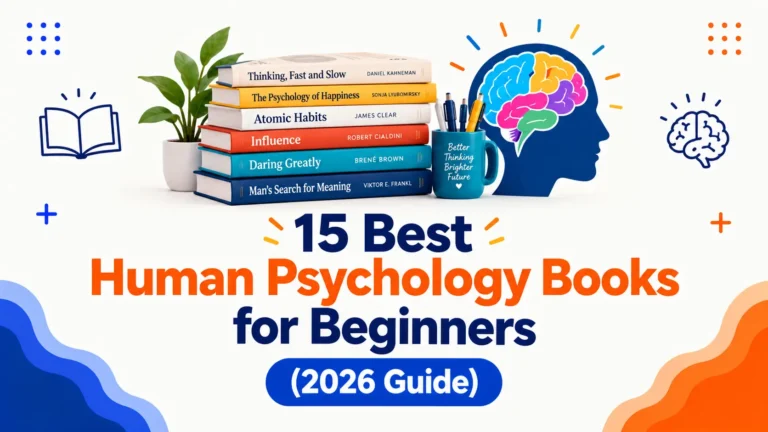
Best psychology books for beginners:
- Psychology by David G. Myers — the global standard intro textbook, readable and thorough
- Introduction to Psychology by Atkinson & Hilgard — a classic on many Pakistani syllabi
- Thinking, Fast and Slow by Daniel Kahneman — Nobel-winning work on how decisions really happen
- Man’s Search for Meaning by Viktor Frankl — the humanistic tradition at its most powerful
- The Man Who Mistook His Wife for a Hat by Oliver Sacks — neuropsychology as storytelling
Free and open access: OpenStax Psychology is a complete, peer-reviewed university textbook available at no cost.
Step 3 — Take a structured free course (Month 2–3)
- Yale’s “Introduction to Psychology” with Prof. Paul Bloom — free to audit on Coursera
- MIT OpenCourseWare psychology lectures — full university courses, free
- CrashCourse Psychology on YouTube — 40 episodes, excellent for fast revision
Step 4 — Learn to read a real study (Month 3–4)
This is the step that separates hobbyists from students. Open Google Scholar, find a paper on a topic you like, and read the abstract, method, and conclusion. Ask: how many participants? Was there a control group? Is this correlation or causation?
Do this ten times, es and you’ll never be fooled by a “science says” headline again.
Step 5 — Anchor to a trusted reference
Bookmark the American Psychological Association (APA) — the field’s leading professional body — and use Verywell Mind for beginner-friendly, expert-reviewed explanations of individual terms. When a source contradicts APA, trust APA.
Step 6 — Apply it, publicly
Explain one concept a week to someone else in plain language. Write it, post it, teach it. The protégé effect is real: teaching a concept forces retrieval, and retrieval is what builds memory. Reading feels like learning. Teaching is learning.
A warning worth taking seriously: “dark psychology,” manipulation of content, and viral “psychology facts” are mostly entertainment — often untested, frequently wrong, and occasionally harmful. Learn the real discipline first. Then you’ll be able to spot the fakes yourself.
Future Career Opportunities in Psychology
The next decade favors this field more than most, for one blunt reason: almost every emerging industry needs someone who understands humans.
- Behavioral design and UX research — tech companies pay well for people who can explain why users abandon a checkout page.
- Digital mental health — teletherapy, mental health apps, and AI-assisted screening tools — is expanding rapidly, and each needs clinical oversight.
- Corporate wellness and burnout prevention — now a board-level concern, not an HR nicety.
- Neuropsychology and rehabilitation — aging populations mean rising demand for cognitive assessment and stroke/injury rehab.
- AI ethics and human-computer interaction — as automation grows, so does the need for people to attend to human trust, attention, and error.
- Educational technology — learning science is the backbone of every serious edtech product.
- School counseling in Pakistan — an underserved, rapidly expanding role as schools professionalize student support.
The safest bet in a changing economy? Skills that machines can’t easily replicate: empathy, clinical judgment, and understanding of why people behave the way they do. Psychology teaches all three.
Frequently Asked Questions
What is psychology in simple terms? Psychology is the scientific study of the mind and behavior — how people think, feel, and act, and why. It uses research and evidence to describe, explain, predict, and change behavior.
Who founded psychology as a science? Wilhelm Wundt founded psychology as a science when he established the first experimental psychology laboratory at the University of Leipzig in 1879. Sigmund Freud, by contrast, founded psychoanalysis — a specific school within psychology, not the field itself.
What are the 4 main goals of psychology? The four goals are to describe behavior, explain why it happens, predict when it will happen again, and control or change it for the better. Some textbooks add a fifth: to improve the quality of life.
What are the 7 branches of psychology? The seven most commonly listed branches are clinical, counseling, cognitive, developmental, social, educational, and industrial-organizational psychology. Other major branches include forensic, health, abnormal, experimental, and positive psychology.
Is psychology a science? Yes. Psychology follows the scientific method — hypothesis, controlled experiment, measurement, statistical analysis, peer review, and replication — which makes it a behavioral and social science.
What’s the difference between psychology and psychiatry? A psychiatrist is a medical doctor (MBBS/MD) who can prescribe medication. A psychologist holds a psychology degree, specializes in assessment, research, and therapy, and generally cannot prescribe medication. They frequently work together on the same case.
Can I study psychology without a science background? Yes. Most BS Psychology programs accept students from the arts, commerce, and humanities streams. You will, however, study statistics and biological psychology — so be ready for numbers and neurons.
What careers can I pursue with a psychology degree? Clinical psychologist, counselor, school psychologist, I/O and HR specialist, forensic psychologist, UX and consumer researcher, lecturer, researcher, and rehabilitation specialist — among many others.
What is applied psychology? Applied psychology uses psychological knowledge to solve real-world problems — in clinics, schools, workplaces, courts, and product design. Basic psychology, by contrast, builds knowledge for its own sake.
How is psychology used in everyday life? It shapes how you study, argue, sleep, shop, parent, and lead. From spaced repetition in exam prep to color psychology in advertising to stress management at work, psychology is running in the background of your entire day.
Conclusion: Your Next Step Starts Here
Psychology is the scientific study of mind and behavior — but the more useful definition is this: psychology is the manual for the machine you’ve been operating your whole life without one.
You now have the foundation. You know the psychology definition and its Greek roots. You know, Wundt built the first lab in 1879. You know the four goals, the major schools of thought from behaviorism to humanistic psychology, the main branches, the difference between a psychologist and a psychiatrist, and what the career actually looks like in Pakistan, including the money.
That’s more than most people know after a full semester.
The gap between “interested in psychology” and “competent in psychology” isn’t talent. It’s structured, consistent learning with someone who knows how to teach it.
Ready for the next step? Book a seat at Advance Blogs, written by Your Brain Lens — and turn your curiosity about human behavior into real, applicable expertise.
Your mind is the most complex thing you’ll ever own. Start learning how it works.
Reviewed for accuracy against sources from the American Psychological Association, the World Health Organization, and the Higher Education Commission of Pakistan. Salary ranges are market estimates and vary by city, qualification, and experience. This article is educational and is not a substitute for professional psychological or medical advice.

11 thoughts on “What Is Psychology? A Basic Introduction for Beginners”